Saturday, November 25, 2023

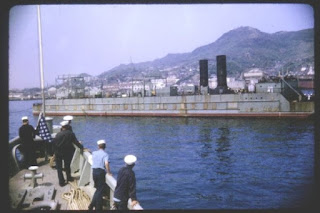
ABNAKI NOTES

Captain James Williams, Annapolis Lt., Commanding Officer

Captain Calvin Reed, a “mustang” from WWII, Lt., Commanding Officer

James Hollis - W-4, Engineering Officer - all the first enlistment guys were “his boys”

Robert Nason, Lt., Executive Officer, transferred to Riverene Forces Vietnam

Robert Turner - Operations Officer USNR University of Oklahoma his wife was a school teacher

Frances Delorme - Chief Bo’sun, one of the enlisted men who by just being himself influenced me to not seriously consider a career in the Navy.

Kenneth Wetzler - Friend, drinking buddy, occasional opponent, crew-mate, deck force, from Lake Chelan Washington

Mel Lanham (aka Cranny Rat) friend and crew-mate Engineering, one of the most guileless people I’ve ever met.

Gary Born - friend and crew mate Engineering…Gary was and is the Myers-Briggs ESTJ poster-boy

“Buck” - Lifer, “brown-bagger” ET1, friend and crew mate.  Buck and his wife frequently invited me for dinner, beers, and a night of TV, and an overnight stay on the couch…they had a little boy, “Skipper”, who was a pure joy to be around when he was 3 or 4.

Robert Knapp, ET3, friend and crew mate…we departed the ship for discharge on the same day, and shared a car and driver to Clark AFB, where we were both bumped from our flights home for the better part of 3 days.

Julius “Billy” Wheat - friend, totally crazy man, Hattiesburg MS, killed in a rainy auto accident along with his brother, a few months after discharge.

Andrew Collins - friend, Jazz aficionado, Momma’s Boy from South Chicago, squared away 3rd Class Bo’sun, the first African-American I ever had broad and continuous exposure to.

EVENTS.

July 1962 - NTC SDIEGO for boot camp

Post-boot camp - NTC SDIEGO for Radio “A” School.

Ordered to (AO-51) USS Ashtabula in SEA…boarded in June 1963 Yokuska, Japan.

Ashtabula arrived home port Long Beach November 1963.

Transferred off to make a berth for a “lifer” after the ship was chosen for the Coral Sea Celebration.

Left the Ashtabula on leave November 16, 1963, my 20th birthday…with orders to join the USS Abnaki in Pearl Harbor.  In Tucson visiting HS friends when Kennedy was assassinated.

December 24, 1965 boarded the USS Abnaki.  Took the RM3 Exams on 12/30/1963 and was promoted to RM3 in 1964.

1964 mostly local activities, except towed a harbor tug from Oakland, CA to Pearl, and made a couple trips to Johnston Island Atoll.

Anchored a target raft southwest of Johnston Atoll for the B-52 bomb sight tests 1964

Towing a dredge from Johnston Atoll to Yokosuka, sunk the dredge in a typhoon mid January 1964

March 8, 1965 supported the amphibious landing of 3500 marines and their gear at Danang. Assigned to a Mine Squadron (92?) to produce a sonar map of the Red Beach 1 landing area, and standby for salvage and recovery if needed.

Spring 1965 - Dixie station small boat interdictions with a Vietnamese Officer aboard deciding which boat, when, how much…the guy (Vietnamese Naval Officer) showed absolute disregard for fishing nets, boats, and occupants…he represented everything the poor fishermen and farmers of Vietnam must hated about their government.  Anchoring out from Vung Tau, a mostly noncombat French Colonial city with an embarcadero bordering a long beach on the oceanside, and the back bayside where parts of the Mekong River flowed past. 

Spring 1965 - Yankee Station deterring the Russian trawlers who were attempting to interfere with air operations, and intercept radio signals.

Spring 1966 - Yankee Station, interfering with Russian trawlers, carrying an electronic counter-measures “sugar shack” and its two technician/operators.

Mid-July 1966 - Subic Bay, P.I. received orders to Treasure Island for discharge.

Left the ship traveling with ET3 Robert Knapp to Clark AFB for transportation home; we spent the next 3 days being bumped from flights by Air Force staff and dependents who were traveling to the States for the Boy Scout Jamboree, had no food or billet orders so slept in base theater, ate in the canteen, and waited in the flight center til we got rides home.  A grateful nation says “Thank You!” for your service.

Spent 5 days at Treasure Island, mustering out, dental work, poked and prodded, examined for the symptoms of all the diseases on our yellow-card, promoting reenlistment, threatening us about sharing SECRETS and sensitive information with anyone, and promoting active reserve duty when we got settled in at our home address…at the end of that week, I hitchhiked to Dayton, WA to visit my parents, then eventually rode a Greyhound to Tacoma, to live with my sister, brother-in-law, Jeanie, and Davie (2 years old) for almost a year.

In August 1966 (?) I was hired by the Department of the Army as a Crypto/Communications Specialist…a civilian, GS4 with a Top Secret/Crypto Access clearance, doing what I'd done in the Navy except I was out of uniform, in a 2nd floor "vault" for not much more money, playing cribbage with one other employee on graveyard shift, and waiting for the teletypes to start, then lighting up the "burn bag" as the final act of a long, mostly uneventful nightshift.


Ritual

I have always felt that dancing is silly, when it is relegated to a ritual, group activity which is planned and takes place in a particular location, as a sort of spectator sport…”Hey, let’s dress up and go to the club. Let’s wait in line for an hour and a half while some guy with no neck and an IQ equivalent to the measure of his waist band decides if we deserve to pay a cover charge to enter a room where our hearing will be permanently damaged, and we can pay 20X the material value for a warm drink served by a dull and stoned waitsperson. EVERYBODY’S doing it!”  On the other hand, being “compelled to movement” spontaneously by the music, audible or just some internal urge, makes perfect sense to me.  

I have been uncomfortable with most all “rituals” for as long as I can remember.   I operationally define a ritual as a behavior, public or private, which has no obvious, direct, or immediate reason, or payoff.  For example: what is the obvious and immediate payoff for kneeling and genuflecting at the end of the aisle where you intend to sit, in a church dedicated to an imaginary friend in the sky?  The performer will not get something, or avoid something. The behavior is not adaptive, leading to something else of greater value. The fact that “everybody’s doing it” or at least everybody in a sub-group, is often reason enough for me to pause and delay doing it until I know why I would want to do it…why doing so would make sense for me?  The human contagion, and mimicking of movement once others near you begin to do it, feels embarrassing and wrong, regardless what the activity is…speaking in tongues…swooning at the alter…chanting the affirmations of the catechism, swaying while waving my Zippo in the air…leaving Teddy Bears and Flowers at the scene for Princess Di, ad infinitum…its how mobs work…its how hysteria is shared, spreads, and grows. Its infectious, and not in a good way.

Why am I so oppositional to ritual behavior?  Is there a “rebellion gene?” Is there a segment of my DNA which is present in me and others, but missing in most?  Is it social? Do I come from a long line of contrarians?  I don’t know.  All I know is when faced with the pressure to conform to a ritual behavior I feel something akin to refusing to go near the edge of a ledge, or a canyon.  I feel a “visceral” aversion which overcomes my desire to fit in…and, truth be told, I do desire to fit in, but not at the cost of my comfort, or my sense of self worth, my need to be congruent with Me.

Bowing, scraping, ritual posturing in prayers, upon entering a church or kneeling in the aisle at the pew, crossing, dabbing ‘holy water’…and on, and on…all seem mindlessly silly to me. Performing ritual movement in order to identify with a group seems to me mindless and cultish, herdish, automated, as though one has turned over one’s will and identity to a group, probably a group with a long-dead founder.  ”Oh! Look at me! I’m a Catholic! I’m bowing to the Virgin and crossing myself with a dab of H2O which has been blessed by some possible pedophile living a monastic life while wearing a cassock so no one will mistake him for a productive member of society!  Where did I leave my secret Latin decoder ring?” 

For me, secret handshakes, ritual fist bumping, chanted tribal grunts (“HOO-rah!”)…and more, all deserve avoidance…their performance simply serves to cast doubt on one’s intelligence, and one’s use of his personal liberty to make sensical choices.  Why would one want to resemble the lowest common denominator of a large group?  Why would one want to wear a red ball cap and cheer for an inarticulate, narcissistic “orange man?”  Why would one cheer for a politician of any ilk for that matter?  

My aversion to “ritual” extends to the mundane. For example, I would never wear a class-ring, or pay the money to do so.  It is incongruent with something in me. But, when it’s useful to do so, I will conform. For instance, I will use a placard or a tag for my disability condition because it allows me preferential parking, and, I will wear a button on my cap which identifies me as a Vietnam veteran, because it is sometimes a conversation starter. On the other hand, my cap has never gotten me a free breakfast and a "thank you for your service."

To me, ritual behavior is the equivalent of rushing to be first at the doors of the burning theater only to be crushed to lifeless mush by those behind you. As the man once said, “The 2nd mouse gets the cheese.”  The sensical thing to do is pause, wait, let the herd run over the proverbial cliff, then step over their lifeless bodies out into the fresh air of freedom wherein you can consider your options, one of which may be to return to the burning building and help the herd survive the results of its own hysteria.

So for me organized, ritual, dancing is an indicator…it begs the question, what else would I be willing to do just to fit in?  Would I ignore the smoke and smell of burning Jews wafting over my peaceful village?  Would I loot a small business owner’s building?  Would I jeer at Black children intending to attend my child’s school.


Lady Jane Goes to Hanoi

 In 1972 Jane Fonda visited North Vietnam.  The North and South governments of Vietnam were at war with each other, and, the U.S. and some allies, including New Zealand, Australia, and South Korea, were supporting the South with their combined militaries.  By 1972, the participation of the U.S. in the Southeast Asian conflict was mostly unpopular.  Of course, families of service members and most friends of combatants were sympathetic to the military members, regardless their feelings about us being there.  I was long gone from Southeast Asia, having last been in Danang in June 1966, and discharged a month or so later.  I had worked for the U.S. Department of the Army as a civilian Crypto/Communications Specialist from August 1966 to December 1968, after which I took a job as a civilian communications specialist with Weyerhaeuser Company in Tacoma, and then in Chicago.  By the time Jane did her camera appearances in Hanoi, I was leaving Chicago for return to Tacoma with my growing family of 3.

My point is, I was long gone from Vietnam by 1972, but not without opinions, memories, and loyalties.  At that time, quite simply, I regretted that Jane had not been a casualty of U.S. bombing.  But, to be clear, even then, I believed our valid reasons for being there, if there were any good reasons at all, were very weak.  I would have respected our leaders more if they had simply stated, “Hey look! We have a financial interest in being there…we’re generating a whole lot of income for a lot companies, who are hiring many Americans at good wages, and as a by-product, we may even stop or slow the spread of collectivist politics on the Asian continent!”  I had, and have, no beef with those who were totally against that war, or even war in general.  I had no beef with those who felt so strongly that they demonstrated, burned their draft-cards, and/or hustled off for Canada. I think there should always be a relatively easy “out” for citizens of a free society to avoid individual moral dilemmas, including, organized violence approved by their politicians.

So, my “beef” with Lady Jane Fonda is NOT that she was anti-war in general, or specifically anti-U.S. involvement in that war.  My beef was and is, that at 35-years old, presumably as mature in judgement as she will ever get to be, she allowed herself to be the photographed “darling” of the propaganda arm of a totalitarian government with whom HER country of birth and citizenship was at war.  She allowed a country, with no free-press and little outside scrutiny into its many barbarous cruelties to its own citizens, to use her presence to demoralize allied military, and give comfort to North Vietnamese, Chinese, and Soviet military members and civilians.  She gave interviews, accusing U.S. service members of being hypocrites and worse.  She trusted foreign propagandists to not publish pictures of her seated on an anti-aircraft weapon.  If there is such a thing as “guilt by degrees” then she sided with the government, North Vietnam, which was guilty of many, many more atrocities against its own civilians, and the civilians of its Southern neighbor than the U.S. ever could have committed by even the most liberal count.  The fact is, there is more than enough guilt to go around…for personal acts, as well as, tactical and strategic policies and practices by all involved.  But, as far as, who was the worst?  Even left-leaning authors and journalists of the UK and France give that prize to the Peoples’ government of North Vietnam.

Back to Jane.  Jane is now in her 80's.  She seems actually more sought after in Hollywood these days, than she was back then.  When I have watched a feature with her acting in it, I look at the heavily made-up elderly woman on the screen, but I can see only the 35-year-old, privileged brat, spawned from Hollywood royalty, sitting on a North Vietnamese anti-aircraft installation.  I hear that she regrets the photo op on the gun installation, but in reading the quotes I hear only that she regrets it was published when they said they wouldn’t.  I wonder why she thought they wanted pictures of her manning a weapon? Did that 35-year old think it was just so they’d have pictures to show the Mrs. when they got home?  Her consequent “black listing” in Hollywood was of no matter, since she was well-able to sell herself to a succession of rich and or powerful husbands, until the market for movies starring old women in heavy make up improved.  

For my part, I try to never watch a movie which has "Lady" Jane as a character. She's never been a particularly great actress. In my opinion, had she not be Henry Fonda's daughter, we'd have never seen her on the screen. But, the same can be said of her brother, who somehow managed to oppose the war in Vietnam without participating in a photo op and interview with the propaganda arm of the North Vietnam Communist Party.


Packaged People

 Packaging functions to create curiosity, to attract, to inform, to contain and protect its contents from outside contamination, to protect its contents from certain degrees of impact or from spillage. Some packaging is punctuated with bright, high contrast color. Some wears the colors associated with its ethnicity, the red white and blue, the white and green.  In almost all packaging, the list of ingredients is the most obscured by small print and cryptic chemical names.

Is it my imagination, or are people more likely to “package” themselves, their children, and even their pets these days…t-shirts with messages, clothes touting designers, eye-glass frames festooned with identity, MAGA caps…packaging, designed to let others know what’s inside, and what isn’t…”Stupid” and “<—I’m with Stupid.”

My guess is that humans, however dull are much more complex than any packaging could describe.  "Identity" is a form of packaging. Apparently individuals can change "identity" at will. Turns out it not something you're just stuck with from birth, decided by others.

My identity is that of a cranky old white guy who is disappointed at how "stupid" the world and its inhabitants have turned out.  For example, I had expected faith-based religion and its unreasoned superstitions to be pretty much gone by now.  Turns out church membership and participation is declining, but the noise being made by the shrinking group is even louder, as populist politicians appeal to its mindless capacity for emotion.


Lahaina, Maui

 In the Spring of 1964 my ship, USS Abnaki, left our home port of Pearl Harbor, Hawaii on the island of Oahu and sailed South East toward Maui. Along the way, we lobbed a few rounds from the ship’s main deck-gun at the island which had been reserved for gunnery practice by the fleet and its aircraft. I’ve forgotten its name.  We arrived in Lahaina and anchored out about a mile or so.  I don’t recall why we were there, or what the occasion was, but the command declared an open house, a condition usually reserved for friendly foreign ports such as Kagoshima, Japan and Kaohsiung, Taiwan.  Hawaii, in general, had a love-hate relationship with the US Navy…loved the money it brought, but hated the presence of rowdy, Haole sailors.  Lahaina was no exception. The story which follows is not told in the ship’s deck-logs.  

A community near Lahaina Town had decided to host a dance, and invite the ship’s crew and officers as guests.  It was a generous and risky invitation, which would predictably end badly.  I’m not defending bad behavior on anyone’s part, but sailors are known to be difficult “guests.”  They were known to be obscene, rowdy, intrusive, and inebriated.  This night was no exception.  According to local leadership, the sailors practiced all of their predictably bad social skills in spades, and disrespected several of the local “maidens” to boot.  Put simply, they were as a group terrible guests, and several of the young local men, who were friends and family of the disrespected young women were enraged enough to follow the bus, taking the sailors back to Lahaina at the end of the evening. The bus full of rowdy sailors, and several carloads of enraged local-boys arrived simultaneously and emptied out on the street right in front of the bar which this writer was about to exit for his short walk to the waterfront, and his ride back to the ship in the ship’s whale-boat.  Keep in mind, this writer had no clue as to what had gone on at the dance, because he, then and now, works hard to avoid dancing, dances, and the rituals generally recognized as courtship, or more often, seduction.

This writer's evening had started out at a local bar in one of Lahaina’s historical buildings, a white wooden building housing an Inn and several other businesses. I believe the bar was called “Whale’s Tale,” in memory of the village’s whaling history.  As I recall, I left the Whale’s Tale pleasantly buzzed and made my way to another watering hole at the end of the side street which passed by the now famous banyon tree and some municipal buildings. I seem to remember that my destination had some sort of hokey facade and a pirate theme, a forerunner of the persona that Lahaina would take on in earnest as it became a developed tourist attraction.  I settled in at that location, and stayed the evening, enjoying the now forgotten amenities of the establishment which was almost entirely devoid of sailors, who were all at the dance some miles away.

As I exited the bar onto the street in front, I was almost immediately engulfed by angry locals tumbling from several vehicles, already yelling, kicking, swinging…my reaction was to immediately go from defense to attack.  Usually, I would have had a beer bottle stored in my sock, undetectable due to the bell-bottom pants, but on this night I was weaponless, lured in by the peaceful streets of the almost village like town. So, I did what I know, which is every dirty trick in the book: throat punches, crotch kicks, hitting from behind, using any found “weapon” on the ground, and more.  I had just kicked a local boy in the balls and was briefly contemplating his prone figure on the pavement, wretching up the contents of his previous meal, when I heard and felt a “whoosh” followed by my lights going out. I woke up a brief second later, still standing, and saw a local-girl holding a carved leather Western style purse on a long shoulder strap.  She had swung the purse from its long strap which accounted for the swoosh, and had moved my nose, previously broken in a street fight, back toward its original location, where it remains to this day. I punched her in the throat, stepped over her gurgling form, and fought my way toward the liberty boat landing a block away. By this time, at least one officer from our ship and several others from the duty party were trying to herd the embattled liberty party back to the boat landing while admonishing the civilians to stand down and let them handle it.  Next morning at 07:30 Quarters the “mood” was somber. The Captain was not amused. The XO looked to him and mimicked his icy glare.  

I don’t recall that we foreshortened our stay, or that Liberty Call was cancelled for the new day.  But, once we got underway for home port, at Quarters the next day, we were informed that the balance of the crew’s party/picnic fund, made up of a 5-cent “tax” on each pack of our sea-store cigarette purchases, would be used for reimbursement of damages, mostly personal injuries to locals.  I don't recall, and the deck logs don't indicate, that there was any formal crew punishment. Aloha Lahaina.


Its not you, its me…

 You know that knowledge you suddenly have that the person you’ve known and been friends with for a long time and have been chatting with online, or emailing, would never again talk to you if you didn’t  initiate contact?  Yeah…that feeling. You search your last few contacts for an offense you’ve given, convinced automatically that its you.  After all its always you.  You check your sense that it’s always you who has to call. Check, it’s always me for some time now. You tell yourself, it’s probably not that they don’t like you. It’s more likely they’ve just moved on, and you’re more invested in your mutual past than they are. It never feels good to be the one who is over-invested, who cares more, in a lop-sided relationship.  And, after all they may be busier, they may have been sick, or traveling, or…or…or.  You make excuses for them because that’s who you are…the one who tries to not “take it personal.”  The one who avoids the accusation that you’re just being insecure, or worse yet “paranoid.”

You “test” your intuition by withholding contact, and, sure enough the days turn into weeks turn into months and maybe into years…nothing.  And, then one day your hear a chat ding, or receive an email, and there they are…as though no time has passed at all, and no acknowledgement of the time which has passed except for maybe a vague “…its been awhile since…”. And, what do you do?  Do you play the game, and pretend there was no lapse, or that the lapse was just inevitable, or mutual?  Do you not respond, wait them out?  I’ve done all of those responses at some time during my life, but I’m always left to wonder “What did I do (or not do) to make myself dispensable?”

A person I had worked with almost 10-years in the 1980’s, and remained active face-to-face friends with another 25 years, just suddenly stopped calling, or contacting.  If someone had asked who my best non-family friend was, I would have immediately said his name. Whenever I called or messaged him with an invitation to lunch on a particular future date, he was “busy that day” and said he would call me back when his scheduled settled down.  He didn’t. And, I would call or message again. We met for lunch a few more times.  He almost broached the unspoken subject of “Why?” a couple times, but then backed off when I asked what had changed.  “I don’t know…its me, not you.”  In 2015 I moved out of state, adding the complication of distance and even less opportunities for access.  When you go back to visit where you came from, it seems like all your friends and family who remain there want a piece of your calendar. He didn’t.  I let him know when we’d be there, and where, and it was never workable to my now retired friend.

About a year ago he suddenly died of a heart attack during a bout with pneumonia. We had chatted online about a year prior to that as he was approaching his October 2021 birthday.  Almost a year after that last chat had passed, when one day his wife messaged me that he had died suddenly from a brief illness the day before.  My friend was dead, and I would never know why our long friendship became distant, not only in miles, but in interest and contact. 

What is the lesson here? Is there a lesson here?  I know you can’t make someone love you. I know you can’t make someone tell you if it’s you, not them.  You already know that just sounds paranoid, and makes you seem needy.  One day it just starts with a sense that if you don’t call, or text, or message, or email, you may never hear from them again. And, the solemn fact is, you may never hear from them again.

Sunday, October 22, 2023

A Hard Rain's a-gonna Fall!

Years before Eric Burdon penned the classic war protest song Sky Pilot, chronicling the part religion played in manipulating the acts and consciences of fighting men, and even longer before Creedence made it clear that they were not Fortunate Sons, there was a voice of protest, more subtle and abstract, its raspy, nasal twang almost as pleasant as finger-nails on a chalk board.  It was the voice, harmonica, and guitar of that lone troubadour and poet, Bob Dylan.  I had the good fortune to see him perform. At the time, the Vietnam conflict was, for the U.S., in its infancy, and I was a recent and future player in that conflict. For the French, the conflict was finished. For the people of South East Asia, the wars had been virtually continuous for a thousand years.

My ship-mate, one time sparring partner, and drinking cohort Ken Wetzler and I entered the Waikiki Shell through the general admission gate, then found a spot on the grassy slope facing the lighted stage that warm first night of August in 1965. Each of us carried a newly purchased bamboo mat snugly rolled around an unopened bottle of fortified wine. The ticket taker at the gate was not interested in what might be rolled up in the mats.  In center stage stood a lone chrome microphone stand with a high mike for the singer, and a waist high mike for his guitar, already leaning in its stand.  A tall stool stood next to a shorter, small square table.  Eventually, a lone coffee cup, contents unknown, would occupy the table, and provide sips to its owner between songs.  

The Shell was slowly filling with spectators. The "blue hairs" were occupying the spendy seats, actual chairs, up front. The great unwashed, including Ken and me, were settling in on bamboo mats,on the grass, well away from the stage, in the darkest part of the venue.  Our ship, the USS Abnaki, had recently returned to its home-port of Pearl Harbor from South East Asia, more specifically, Yankee Station off Vietnam where our ship spent months shadowing whichever Russian spy ship happened to be in the neighborhood, intent on messing with U.S. flight operations over North Vietnam.  

We had booked a hotel room nearby, though not near the beach. That would have been way beyond our financial means.  This expensive night in Waikiki was entirely dedicated to attending a Bob Dylan concert.  The irony of funding a concert mostly comprised of songs of peace and protest using our recently earned military hazardous duty (combat) pay was entirely lost on us at the time.  I was 21. Many of life's obvious ironies were lost on me then, and Ken was no "light" in the darkness either.  We were drawn to that evening by our common love of certain music, performers, and songs, among them Bob Dylan, Joan Baez, The Rolling Stones.

Back on the ship our shared record player and collection of LP vinyl was safely stowed in the Tech Shack…an area well below the main deck, accessed by round pull-down man-hatches and vertical latters, in a caged space where several Electronics Technicians labored at all hours.  Our Bob Dylan, Joan Baez, Miles Davis, Dave Brubeck, and Rolling Stones vinyl never left the safe confines of the Tech Shack.  Add to that safe confine the fact that the space was well below the center of gravity of the rolling ship which made it less likely the stylus would skid across the vinyl when the ship rolled badly.  We who co-owned the simple record player had monetized our asset, renting it out to select listeners for a price, but only if it never left its safe harbor in the cage, and was not scheduled to be in use by any of its 5 or 6 co-owners.

So when Wetzler and I walked through the general admission gate and found adjacent spots on the grassy slope well back from the lights of the Shell venue, we had a sense of what to expect.  We were Dylan fans, though neither of us had attended a live concert of his before.  The police presence was fairly visible, and having some history with the HPD we knew there would be a sizable plainclothes presence as well, so we kept the wine out of sight until the lights turned down, and the spot light focused on the single 3-legged stool in center-stage.  

As the high-dollar seats filled up closest to the stage the police presence grew until there was a line of cops, arm’s length from each other, backs to the stage, facing the audience.  That blue-line seemed to emphasize the idea that this concert might be a celebration of protest, of resistance, of questioning authority, if not outright challenge to the powers that be, best represented by the fur-garbed, diamond studded blue-hairs now settling in facing the cops.

There was no opening act preceding Bob.  A deep male voice, invisible off stage, simply announced, “Ladies and Gentlemen…Bob Dylan” then this skinny, pale “kid” with an unruly mop of hair ambled onto the stage, a harmonica hanging in its fixture around his neck, and into the bright circle enveloping the chair, microphone, table, and acoustic guitar resting in its stand.  He pulled the top mike down to his level, and muttered a brief, unintelligible nasal greeting.  For the next 45-minutes he sang them all…all the album songs that had elevated him from a lone voice in NYC’s Village, to the poet laureate of the U.S. At the end of that set he wordlessly, and unceremoniously left the stage.

Maybe those in the spendy seats thought it was over, or maybe they just needed it to be.  As I remember the tourists in the real seats began abandoning the Shell in a stream, until there were few “blue hairs” remaining.  The disembodied male voice hurriedly announced that this was a brief intermission, but the concert would continue.  Virtually all the monied occupants of the stage side seats were long gone.  I’ve often wondered if most of them up front even knew who Bob Dylan was. Perhaps they were just at some random concert because they were lounging nearby at one of the beach hotels, and looking for a night out.  One thing was clear.  They were not Dylan’s fans.

Dylan took his time coming back for the 2nd set. But, when he did return he stepped out beyond the circle of the spot light, held his hand up to shade his eyes, and commented on the empty seats, remarking something to the effect that it felt like no one was there at all.  He could not see or hear those of us back in the darkness, on our bamboo mats, laying on the grass.  So, he grabbed the top mike, made a beckoning motion with one arm and said, “You guys back there...come on down!”  The cops immediately intervened with the early usurpers of the high priced seats, night-sticks in hand, banishing them back to the cheap seats.  Dylan futilely protested to the uniformed police, but when rebuffed simply refused to restart the show.  He put his guitar in the stand, picked up his coffee cup, and sat down silently on the stool. It seemed the show would end in stalemate.

From the darkness I watched as uniforms, tropical shirts, suits, white shirts and ties bustled back and forth, clumping up for brief inaudible desperate looking conversations, then separated to scurry to another assorted clump of responsibility, to talk and gesture in hushed animation.  Bob sat on his stool, sipping the contents of his cup as he looked on bemused, maybe puzzled or quizzical until a frazzled looking cop with lots of brass on his shoulders and gold on his hat motioned to the faceless darkness to come forward, then beat a retreat as the now energized crowd noisily claimed the the expensive seats in a wave of occupation.  Bob appeared to love it.  Revolution was in the air!  He waited for the noise to subside.  Wetzler and I stayed in the darkness on our mats, tending to our wine (now becoming less weighty in the bottles), savoring our buzz, and casually smoking our Marlboros. Smoking was banned in the expensive seats.  

Dylan’s 2nd set was made up of some old, and some new.  Dylan was one of the most prolific singer/song writers of that decade so he already had an abundance of recognizable and popular material.  That night he mixed in some I’d never heard.  They seemed almost experimental in nature, but many would become standard Dylan.  In one instance, he "stumbled" starting the song at least three times, apparently forgetting the words, before catching the momentum. The passage of time, and maybe the Mogan-David fortified wine, have conspired to wipe the names of that evening’s playlist from my old memory.  

But, I remember it as my first concert, and my first up close and personal view of the intelligent use of passive-resistance against authority…not exactly the stuff of Mahatma Gandhi in India 20-some years earlier against the British Empire, but impressive to me, a 21-year old U.S. Navy sailor freshly returned from Yankee Station, funding my evening with Vietnam combat pay, and quietly singing along in the darkness with songs of peace and protest, "...a hard rain's a- gonna fall..."  We were blissfully unaware of how hard that rain would be.  LBJ, who had been President for just under two years, was quietly building up troops in Vietnam in a reversal of Kennedy's plans which died with him in Dallas.  The war would soon grow from a disagreeable nightly news feature to a social cleaver which would brutally divide the nation, and set us out on a course of more, and more division.  

But, on this night a hard-rain was just a poetic, abstract threat. The "body counts" were still small. The economy was burgeoning. The nation was busy and distracted, doing what it did best, "making hay" before the storm came.


Sunday, December 18, 2022

In the summer of 1955 Holbrook was a small Arizona town on the main East-West U.S. highway between Flagstaff, AZ and the Arizona border with New Mexico. Not much has changed.  The town is bordered by Navajo Nation reservation land, occupied by our country’s largest registered Indian tribe and is the largest reservation by square miles.  

God, ever mysterious in His ways and reasons, had ‘called’ my Dad to save the Navajo. When my Dad was called, as he often was, it meant that we all moved.  God never failed, but success could look like failure in human terms. As it turned out, God had neglected to inform the Navajo that help was coming, so we arrived unannounced, and mostly ignored by the Navajo people.  God had also failed to coordinate our mission with the local Catholic Church, the LDS, and the U.S. Society of Friends, those known affectionately as Mackerel Snappers, Mormons, and Quakers.  Those organizations had already claimed most of the spiritual turf on the Rez, and had no apparent interest in sharing the mission field  with a self-anointed, self-appointed, evangelical “voice crying in the wilderness.”

Our initial stay in town started, as all stays did back then, in one of the independently owned motels on the main business loop of the main highway, during which time we looked for cheaper, more permanent housing.  “Permanent” in my family was a vaguely defined term which meant between 6-weeks and two-years, though two-year stays were rare.  After two or three days in the motel we found a spartan rental on the edge of downtown, South of the Southern Pacific railroad tracks where freight and passenger trains rocketed through town without slowing.  Standing in what passed as our front door, one could see the State Route highway 77 overpass, and hear the traffic’s tires on its seams.  I don’t recall what the inside of the rental looked like.  I do recall the city police regularly visiting a sometimes noisy drunken Indian neighbor who was vigorously abusing his wife and at least one kid on a regular basis, and made a huge to-do whenever his lady locked him out.  It takes a majority practice, and minority exceptions to create a stereotype...in fairness, we would only look at individuals, instead of subsets within larger groups.

I pretty much had the run of the small downtown.  One favorite activity was to stand between the main rail line and the loading dock of an abandoned warehouse as the trains rushed by, their draft almost pulling me under the speeding cars.  But, mostly I just explored, in that aimless way that a rodent explores its surroundings.  I don’t recall that I ever did anything that should have caused trouble for me or anyone else. My motivation was just youthful curiosity, one event just leading to the next in an aimless fashion.

On a certain Sunday, as I remember soon after arriving in town, we left home and headed North in our dull green four-door 1949 Hudson, which we affectionately had named “The Tank.”  I remember seeing the spires of Monument Valley from my low vantage point of The Tank’s back-seat, but I think that is likely a false memory which has been mixed in to my Sunday memory in error from a different day.  Back then the trip out took much longer than the trip back, and I remember that the trip home after our morning was pretty quick. 

I don’t recall how we happened to be invited for a home church service in a traditional Navajo hogan.  I think adults assume that kids are paying attention to conversations and somehow glean information from what they hear, but I can assure you I was not one of those kids.  Adult-speak formed a low, rolling rumble of background noise in my presence, unless I was guilty of something and anxiously listening to find out if I had been discovered.  I was not listening to adults talking unless and until someone spoke my name.  So when we pulled up to a small wood and mud structure, a pickup truck parked beside it, I became vaguely interested because this had never before happened.  

Having heard us arrive, the occupants of the hogan streamed out to greet us, though in a quiet, almost dignified fashion, led by an adult male wearing what I now know to be an expensive “cowboy” hat.  The irony of an Indian wearing a cowboy hat was lost on me at the time. I don’t recall what the rest of the family looked like but I do remember that the family did not resemble the town Indians in appearance, except in skin color.  This family appeared to belong here, whereas the town Indians always seemed to me out of place. I don’t recall whether this was a three-generation family or not.

When we stepped through the low door, I was immediately amazed by the visual feast of colors and texture.  Every inch of walls and what was no doubt a dirt floor, was covered with weaving and tapestries. They were, as it turned out, the families heritage and endowment, handed down over the years to sons and daughters.  The hands of their ancestors had chosen the dyes to make these colors, indeed grown the sheep which produced the wool, and had woven this art from designs deeply embedded in the generations, and yet the weaver had left their individual marks while observing the traditions. This family on this day could tell the story of each piece of heritage which hung on their octagonal walls, or covered the desert-dirt floor.

As I look back now I know that this Sunday morning was my beginning of seeing Indians as individuals, not just a social "problem" and generality, not just as a source of guilt and anger for white society.  Had I been more astute I would have known that this place, this traditional home, this desert, and this history was why this family so clearly belonged here and now, not just to some vague time in the past.  All of that thought came later, most recently as a behavior therapist for an agency trying to improve the mental health of Tohono O’odham People, the nation’s 2nd largest tribe by membership and land-area.

The White man didn’t cause all of the issues and unproductive behavior of the Indians.  One of my native clients pointed out to me that the “noble savage” is just another mistaken white view of native reality.  As he put it, “There’s nothing more noble about Indians than anyone else!  We’re as fucked up as anyone, and we were enslaving and killing each other, beating our wives, and stealing from each other long before the white man showed up, illegally occupied and settled our land, and tried to wipe us out!”

But, on that Sunday in the Summer of 1955 a small fissure formed in one small developing brain, at that time in one life when that brain is forming, and all the dots are yet to be connected into almost irreversible values and beliefs.  And, on the ride back to Holbrook in the back-seat of The Tank something had shifted, only slightly, and that shift would allow the next possibility to become a question seeking an answer, instead of a conclusion, and simple answer for a couplex issue.  And, one day, far in the future an adult brain would ask in effect, “If we are wrong about that what else did we get wrong?” 

Maybe Custer did die for our sins.

Sunday, December 4, 2022

By the Summer of 1971, Jennifer, Kim, and I had returned to University Place, Washington from Oaklawn, Illinois.  I had worked for Weyerhaeuser Company in Chicago’s “loop” district since being moved out there in February 1969.  Now that we were back in the PNW, I wanted to attend college, and perhaps even get a Master’s.  I was 28 years old, married with a child and a foster child named Wayne whose Mom was incarcerated at the Purdy Women’s Correctional Center near Gig Harbor.  Wayne deserves a story of his own, as does Nina our 2nd foster child.

The loss of job, and relocation move from Chicago back to Tacoma was a consequence of technological advances in high-speed data transmission which eliminated the need for me and my technical group to do what we did, and ultimately resulted in my transfer and demotion.  I vowed to never again be on the technological “dime.”  The fateful day I received the call from my boss on the West coast that our control center would be shut due to advances in AT&T data technology I felt stupid, naive, and more than a little duped.  I blamed myself…but, I will always believe my Manager Al Berry, who had by this time departed Weyerhaeuser, was aware of the temporary nature of the assignment even before Jennifer and I transferred from Tacoma to Chicago.  I believe I  simply failed to ask the right questions of him before accepting the move.  Al was smooth, not in the good sense of the word, an ex-AT&T manager who had come to Weyerhaeuser’s Information System Group in Tacoma, which meant he was joining one of AT&T’s larger customers.  By the time our Network Center was slated for closure, Al Berry would be replaced by Helmut Heim.  Helmut was a German with an accent, and, one of the most professional guys I ever worked for…a true leader who was committed to taking care of his crew.  No one had ever discussed an exit plan for those of us who moved out to Chicago…we just assumed we would be brought back home.  Fortunately, Helmut was willing to relocate us home though no written agreement to that effect existed.

I don’t remember what I said to Jennifer that night, after getting the call at work from Helmut, then taking the long train-ride home.  When I rode the Rock Island commuter train into town that morning, I had had a future…now?  In those days, I was still lodged somewhat in the cultural values that the husband was the head of the family, and ultimately made all the big decisions, after optionally listening to the opinions of others.  Clinging to this myth was part of my leftover Evangelical legacy…some would call it cultural.  I would have gladly shared my sense of failure at that time with another collaborator, or totally given it away.  I just felt I shoulda known, because I coulda known, and woulda never come to Chicago for anything less than a sure success for me and my family.  I don’t remember our homecoming in University Place being celebratory for me.  My sense was more that I had been almost buried by circumstances in a defeat, I was in retreat, and it was going to take a while to erase the loss…probably years.  I had the sense that everyone knew we had returned home in defeat.  It was my first first job-loss, but would not be my last.

Having accepted the company’s relocation package back to home base in Tacoma, I was also accepting the rotating shift position as an hourly Production Controller in the Computing and Telecommunications Operations Department, at a 40 percent wage reduction compared to Chicago’s wage.  From the company’s perspective, I had been terminated in one position, then hired into another position though there was no break in service. My direct manager in Tacoma, Scott Crozier who by then reported to Helmut Heim, was able to step-down my pay-rate over a period of time, I want to say equal reductions each two weeks for 3 months, so Jennifer and I could better manage the hit to our finances.  Jennifer learned quickly to be a world-class cash-manager.  It would be the first time we had to ask creditors to bear with us.  We were committed to paying, but if they all piled on we would go under.  There would be one more time, after a house sale fell through and we briefly owned two mortgages, when we would again seek forbearance from our creditors.  At that 2nd time, we would get even more practice at playing the float, and asking, ”Just don’t send us to collection and everyone will eventually get their money plus interest!” and again we paid something regularly, communicated often so as to never leave an open question, and did without everything but necessities.

As for my goal of returning to school, I could not attend college full-time and also work a 40-hour rotating shift which “dogged” backwards on the clock every 3-months.  No available University at that time had that level of flexibility in their on-campus offerings.  The sole solution which would satisfy all needs was that the shifts would have to be “frozen” vs. being rotated and dogged backwards on the clock every 3 months.   It took me almost a year to demonstrate to management that our staff’s array of skills could adequately cover 3-shifts, 24X7, with enough volunteers accepting a “permanent” day, swing, or graveyard shift assignment, with enough flexibility to accommodate job-turnover, vacations and sick-days. Sometime in March the following year I started my first college Freshman class at Tacoma Community College after demonstrating the staffing of all shifts, 24/7, with qualified volunteers who preferred an unchanging shift which would best accommodate their foreseeable lives.  Only the Data-Entry department stayed on their traditional Swing and Graveyard shifts because all the new data had to be entered after the close of business, and available for use by 7a.m. East Coast time each following business day.  

The next quarter I could enroll in at Tacoma Community College would start in March 1973.  Jennifer and I decided we would apply for Veteran’s educational benefits, a considerable amount of monthly income for a family of 3.  But, we would bank that VA money and use it in a year for a down payment on the house we were renting from a young couple at church who had been relocated to the East Coast.  We had committed in writing to either buy their house for an agreed on sum, or manage the selling of the house for an agreeable sum. With Jennifer’s cash-management skills, a bit of luck, and the kindness of friends and family, we would be able to pay the community college expenses out of pocket, until such time as I would be forced to go to Pacific Lutheran University…a private, expensive local University...and be approved for a student loan.  The collateral from owning a home would come in handy at that point a year and a half later.

At the time I enrolled for Spring Quarter 1973, all incoming Tacoma Community College freshmen were required to take an English aptitude test, get at least an 80% on it, and take a non-credit, “bone-head” English course when they failed, as most did.  Two of us, both recent military veterans, passed the test on our first attempts, out of a class of 30.  I would take all the transferable 100 and 200 level courses I could at TCC, before moving to PLU.  The student loan process went smoothlyI graduated college in the Summer of 1975 with a Bachelor’s from Pacific Lutheran University, and an acceptance letter to Graduate School at the same institution.  I had precisely enough credits to graduate…no expensive extras, no side trips, no retakes, .  My Bachelor’s GPA was 3.87…and a four-year degree in 3-calendar years while working 40-hour weeks and occasional overtime.  Not bad for a kid who had graduated 3rd from the bottom in his high school class of almost 600. However, there is a certain “pressure” in bringing home your grades to share with others who are sacrificing so one can attend college.  The entire grading spectrum is emotionally skewed.  By that I mean, a “C” feels like an “F” and a “B” feels like a “D.”  An “A” feels like the only truly acceptable result.  I would learn to do even better in graduate studies where I graduated with a 4.0.  As I crossed the stage to get my empty folder from the school’s President, I searched the audience to find the face of the person in the crowd to whom I owed my grades…that woman I never wanted to disappoint.

I never again lost a job due to technological advances. The “technologies” of training, management development, and human resource management would of course change over time, but the changes would be gradual enough to predict, and off-set, or to simply choose to go to a company which was “old school.” More often than not later on I would find myself “dodging” another human instead of technology, a CEO or Chairman of the Board, a VP of Sales or Marketing, who believed that his position had been achieved as a consequence of his own brilliance and his innate knowledge-of-everything, including better knowledge than my own specific areas of expertise. Crossing one of these blind-messiahs could result in damage every bit as fast and thorough as changing technology.  I was to learn this the hard way at least once, as a job loss, and more often as some senior manager simply shut the door on a discussion with the silent words, “Humor me! I’m your boss!” Beware the man who believes himself to be some sort of “renaissance man” for he is more likely a narcissist.

So, immediately after earning my Bachelor’s degree, at the start of the next semester, I began my graduate studies.  I took a full load every semester, including Winter semester and so finished in less than 2-calendar years.  This accelerated pace saved us at least $2,000 back when $2K was equivalent to $11,000 at present value.  Justin was born in the early hours of March 27, 1974 just as I was going through semester finals.  The final I left the hospital to go take on his birth morning was for a class wherein the professor had been very clear that the only valid reason for one’s absence was one’s own death.  This same “understanding” professor would one day soon continue to plague me as a member of my graduate committee.  

Looking back, the entire 5 1/2 years of school seemed hard on everyone, even after graduate studies started.  The graduate classes and clinical practicums allowed a longer leash, more flexibility, but one still had to do the work…including a Thesis or 3 thesis quality research studies, with APA quality papers. I opted for the “bite sized” efforts because it seemed somehow more manageable to spread the effort over the entire graduate phase.  By then, the full-time work had by become a day shift, salaried staff position which helped my boss handle the employee relations of our Operations group.  He had developed the job with me specifically in mind, and, the position would cease to be when I left the company in November 1978.  My boss, Scott Crozier, was destined to die that same December.The goal to keep me employed during 5 1/2 years of schooling had been achieved, and my mentor was now gone.  The world had changed, seemingly overnight, and for the first time in my life, at 35 years old, I sensed mortality’s beckoning in the tick of the clock, in the swoosh of the calendar pages.  Time seemed to become an actual asset, not simply an abstract, and I was “wasting” my time in pretense…trying to be that person I wasn’t, but which others thought I was, or should be.

It would take more than a year before I would “come out” so to speak.  As it occurred, gay people do not have the monopoly on “coming out.”  Starting Thanksgiving Weekend 1979 I would start reconciling my public life with my actual life by starting a life long effort to live my actual life publicly.  My actual life would be the sum things left out, things kept, and new things added.  Evangelical faith, would be the big reduction.  At the core of that reduction was the simple fact that I did not believe the Christian, or any other religious, myth.  Success has been difficult, and results have been mixed.  In trying to live entirely in the “light” I’ve learned it was easier to live in the shadows, and just tell important others what they wanted, expected, to hear, than it is to justify your deeds in a way that’s convincing for others.  So my latter life has been a process of “coming out” as opposed to an event, or even a series of events.

People from my early life knew me in the context of church, shared beliefs, common values, and even shared prejudices. Fundamentalism is a way of life, not just observing a written dogma. Fundamentalism has its own code, its “looks” and sideways glances which in the context of the moment pass shared meanings between believers.  Nothing new and different from any other belief.  Fundamentalism is a system, with inputs, processes, and results which are then reprocessed or adjusted to become part of the inputs. The system even has a way of getting rid of waste. I soon discovered that even in purely social events, I was a guest but no longer a member. I had become waste.  The people I number as friends from my evangelical times are all important to me.  That group is made up from friends and family, some who have known me as a friend since the 1950’s.  The responses to my changes have ranged from unquestioning acceptance to outright denial, “Why that’s ridiculous! Everyone believe in God!”  That sort of comment pretty much shuts the door on exploratory discussion.

Do I believe in a Creator? Yes. I believe the Universe evolves, creating-destroying-creating, as it winds down.  Who or what created the Universe in the first place? Who or what is responsible for the Void, the Matter, the Anti-Matter, the Energy, the Light, the Dark Stuff?  I don’t know…maybe it Is because it Is…maybe it came to Be just because It could…for me, that is easier to believe then believing in a Teddy Bear Deity which occupies Himself with my comfort and welfare, and gives me fair weather while wiping out Bangladesh with annual floods.

I have learned to be careful with the beliefs of others.  I have learned that sometimes they’re barely holding on, and belief is about all they have. I no longer need to destroy their beliefs in order to be at home with my lack of Faith.  Perhaps we create the Cosmos which we are most comfortable in.  I am not comfortable in a Reality where a fickle Deity pulls the strings, and favors this or that person over another. I don’t want to live in that world.  I want to live in a fair world…by fair, I mean a world where the probability, and possibilities are as near randomly distributed as possible in order to favor or disfavor no one.  I choose to not accept the favor or disfavor of a deity which would require his star worshipper to sacrifice his own son as proof of allegiance to the Deity.  I decline to believe any doctrine that requires me to become intellectually disabled, “like a child”, in order to tolerate its outrageous lack of coherent facts.  I refuse any belief which refuses to show the calculations which lead to its revealed claims.  Revealed “knowledge” is rumor, not reality.


Friday, September 2, 2022

My Sister Lois

Its hard to talk about Lois without first talking about our mother Goldie.  Goldie was born in Eminence, MO in May 1915 to King Isaac McKinnon (aka Ike) and Josephine (Josie) Davis McKinnon.  Goldie had 3 older sisters including Faye, Mabel, Hazel and at least one younger brother Theodore (Teddy).  I think its likely Teddy was gay, though no one ever said that in so many words.  

Josie died of Leukemia in 1930 when Goldie was 15.  After Josie’s death Ike became his own best customer for his illegal whiskey, and, shortly after that became “too interested” in his younger daughters, Hazel and Goldie.  Consequently Hazel and Goldie moved to St. Louis and lived with Faye and her husband Olan for awhile.  During this time Goldie and Hazel worked as cigarette packers at the Leggett-Mayer tobacco company in St. Louis. It was in St. Louis during  the early ‘30’s that “the girls” (Hazel and Goldie) met “the boys” (John and William). I want to say they were married in 1932.  This union would occur during the deepest days of the Great Depression.  William, had already been West, riding the rails, doing odd jobs, being arrested for vagrancy or trespassing in various towns, doing municipal convict work, so he had some knowledge about what awaited the four when they went West.  The couples also did jobs as they found them, including working the woods in New Mexico near Taos…the men working at falling and choker-setting, the women working in the kitchen and dining hall.  Part of their wage included food, and lodging in the rail-road “dormitory-cars” which were boxcars turned living quarters.  Later, William got a job painting structures at the Air Force Base which would become Davis Monthan AFB in Tucson.  I believe both couples moved on to Tucson together.

My sister Lois was born in Tucson, AZ in December 1935.  At that time my parents, Bill and Goldie, lived in Tucson with John and Hazel.  About 18-months after my sister was born Hazel and John Karns would produce a baby boy and name him Wayne.  Lois and Wayne would become life-long friends, and she would see Wayne for the last time in July 1991 on a trip to St. Louis in which Lois and I took Papa to visit his surviving sisters, a short while before he died. They, Wayne and Lois, were “double-Cousins.”  I know very little about the family between 1935 and 1943. I know my father had moved to look for work in the dryer climate of Southern Arizona due to his Tuberculosis, which later went into remission as do approximately 25% of cases. He claimed to have been healed on a specific night involving laying-on of hands at the Tucson Assembly of God, and, was simultaneously “called” to preach the gospel, which eventually led Bill, Goldie, and Lois to migrate North to Montana where Bill and Goldie would pastor a start-up Assembly of God church in Dillon.  I was born there in November 1943.  Lois was seven-years old, about to be eight.  John, Hazel, and Wayne had moved back to the mid-West where the little family broke up, Hazel became a lifelong victim, and John went off to find fresh flesh.  Wayne was embittered by the divorce, and felt abandoned and largely ignored by his father.

Lois and I often talked about the fact that each of us was an “only child.” She had 8-years of singular attention, and I had 8-years without a sibling after she and Leroy married in February 1954.  It should be noted that Goldie had a stillborn delivery somewhere between Lois’ and my births.  My earliest direct memories of Lois start in Kendrick, ID in 1946 or 1947.  Our father was pastoring another Assembly of God church there.  My earliest memory of Lois is hearing and seeing my mother become very upset when a neighbor with a telephone came rushing over to say that Lois had been taken from school to the doctor’s office because she had broken an arm on the “monkey-bars.”  In my 3 or 4 year old ignorance I envisioned a broken arm as similar to breaking a branch on a tree, her limb freely dangling. To my disappointment, when she got home she was wearing a plaster cast, and her arm was not dangling, and swinging freely.  As far as I know, this was the first time I had to consider that words were often vague and ambiguous.

I don’t know why we left Kendrick.  In fact, I never truly knew for sure why we left any of the 36 towns we would live in.  But, leave we did and by deduction I believe we went from Kendrick, to a wide spot in the road East of Spokane (Post Falls), then back to Tucson, where we lived in an itinerant cabin court at the intersection of Oracle Road and The Miracle Mile. This would have been 1948 and part of 1949.  The cabins were fashioned from cinder-block, on concrete slab foundations. They had running water, and hand-pumped device,  screened windows without glass, no heat or air conditioning, 1 bedroom with a door, an indoor toilet and tub, and an open living/diningroom/kitchen, where Lois and I shared a cot by the front door, or maybe it was folding ‘roll-away’ bed…unfortunately for her I regularly and copiously wet the bed.  I recall that many of the tenants worked in the citrus fields near Oracle Road, just North of our intersection.  We attended the Assembly of God church where my dad had been “healed” and where he had been “called.”  Reverend Gilmore and his “wing-nut” wife Fanny Mae Gilmore, were still the pastors.  My Dad was an unpaid assistant pastor, who was allowed to sit on the platform at Sunday services.  It was at this time in Tucson that Lois came out as my champion, though quite often she was the informer who got me whipped.

Several boys in the cabin court cornered me in a vacant part of the desert near the cabin court and sexually molested me.  I can still smell their cheesy crotches, and taste the slightly saline penises in my mouth.  In spite of the memory, I was not traumatized.  The memory seems mostly benign.  It wasn’t a violent assault. I simply just didn’t know what was happening, or even that it shouldn’t be happening.  

I casually told my sister about it. She had the common sense, as did my parents whom she told, to not come “unglued” in my presence.  Point being, for a while  it didn’t occur to me that anything important had happened.  However, a day or so after this event, at the school bus stop in front of the court’s convenience store, Lois encountered the “ring leader” of the group, picked him up (literally) off the ground by his hair and threw him repeatedly into the hot pavement of the parking lot, promising him certain and sudden death if he or they ever touched her brother again.  I saw her in a whole new light starting then.  Here was someone who was unapologetically, irrationally, unconditionally on my side.  That “thread” persisted until her death.  I knew Lois was on my side, and when Jennifer and I married, Jennifer was automatically included in the deal.  Jennifer and I have often talked of the times that Lois was there for us…a bridge-loan til payday, a borrowed car when ours broke down, a place for Kim to stay when the sitter fell through, or just a friendly, tolerant, non judging presence on the phone when I was scared and about to fly to the Philippines to board my first Navy ship, or our world had turned to shit for some other reason.  So the molestation event would have been 1949.  Lois would be married and gone in another 5 years.

I entered school the first time in the 1st grade in Lewiston, ID probably in 1950 when I was about to be 7 years old, making Lois 14.  We lived in a shotgun shack on Snake River Road, which was on the road which formed the levee for the Snake River flood plain on the outskirts of Lewiston. Lois and I walked up the hill behind our house to our respective schools.  When Lois left the house and walked up the hill there was a particular point at which she stopped, fished in her purse for a mirror and make-up and adorned herself for school. Makeup was verboten at that time, for her, in my family.  I doubt Goldie would have denied use to Lois if she (Goldie) was using it, so I’m assuming this was one of Papa’s “holiness” rules, one of many involving all the sins of “the world” real and imagined.  Lois would often encounter me at the end of the school day, and walk me home. When she didn’t, I considered it an opportunity to use my dubious discretion, which is a euphemism for ‘getting in trouble’.  For instance, one Christmas season I was stealing ornaments off the graves in a cemetery which was on our route home from school.  

From Lewiston, we moved to Thurston, Oregon in time to start the 2nd grade, which probably put Lois in Springfield High School as a 10th grader.  We lived in an itinerant cabin court near the boundary of East Springfield and Thurston, but left there during the school year for a house on D Street in Springfield nearer Lois’s highschool, and resulting in my changing schools.  It was here that Lois contracted rheumatic fever, and developed a heart murmur, starting the cardiac progression that likely ultimately cost her life.  I had just started Cub Scouts, but dropped out when our family and house were quarantined by the city’s health department.  Lois was my baby sitter after my school day ended, thereby assuring that she could not take part in after school activities.  Nana was working afternoons and nights at a nursing home across the bridge in Eugene to augment my Dad’s income from painting. This time in our history was our first contact with the Four Square organization.  We attended church less than two blocks from our house, where my dad assisted as invited.  This contact becomes important later in the story.

Writing this now reminds me of how little Lois and I talked about our family’s conditions, the ceaseless moving, and the consequent poverty which accompanied that lifestyle.  It was a given back then. Complaining would be as absurd as griping about Gravity, or sunrise.  But, I know our life was doubly tough on her, partly because she was a girl, and more social.  But, largely because she was an older girl, and a heavier burden of responsibility and accountability was placed on her.  She was often the glue that made things work.  She was early home from school so Goldie could be gone and making a few bucks as a housecleaner or attendant at a nursing home.  When other girls were practicing with the Cheer Club after school, Lois was hurrying home to intercept me when I got out of school.  That’s one example, but there were many. She was always the third adult that helped life function in the constant poverty, which I believe was created by the constant moving, and the constant search for the “center” of God’s will.  After Goldie died, Lois became more forthright about her own feelings regarding our lifestyle.  I felt that Goldie’s death allowed Lois permission, finally, to express her displeasure.  No need for a loyal, solid front any longer.

We left Springfield in 1953 for Cortez, CO.  Papa announced that, “This is where we’re going to stay!  We bought furniture on “credit” which was the first and only time I ever saw Papa allow the use of revolving credit.  But, a couple months into our stay, during a regular phone call home by Goldie to St. Louis, MO, we found that a member of my Dad’s family was terminal.  My father’s youngest brother Charles had Type I Diabetes and was terminal.  Medical technology had yet to develop ways to scrub toxins from the blood and urine, and patients like Charles could qualify for only limited units of blood replacement.  Charles, at 28 years old, was near losing his battle…so we we left the key under the mat, called the furniture store and told them where they could fetch their items, and went to be with Charles and his wife Edna, during his final months. 

My Dad and Mom were heartbroken.  Charles was not only the baby, he was (everyone agreed) the favorite son.. I joined the 3rd grade in progress, as I remember, which means Lois would have joined her 11th grade already in progress.  It was not the first school year that Lois and I would appear at a new school after the “clicks” had already formed and exclusion was the habit of the herd.  The teachers tried to help, but usually that resulted merely in undesirable attention by the ‘townies’.  Again, it was just a “given.”

When Charles died in 1953 we finished up school and headed for the West. Papa had been making excellent money working in a production spray booth shooting shellac onto large caliber artillery casings at the Small Arms factory.  Remember, the Korean War was in progress, and had been for some time, and America’s economy thrives during war; war in the U.S. raises the economies of even unskilled labor.  We left core family, both Karns and McKinnon, good paying jobs, a 4-plex on a sunny, tree lined Blair Avenue, and Lois’s teen employment at a  “five & dime” in a business district a few blocks away.  I think we went to Lander, WY. I’m not sure why, but we stayed there for only a few weeks, then set sail for (I think) Western Washington.

I don’t know how many moves occurred between 1949 in Tucson, and February 1954 when Lois and Leroy married and we all separated, but there were several different, short-stay towns.  One of the final moves involving Lois was to the Grays Harbor area, and specifically Aberdeen, WA. My Dad linked up with a Four-Square Church minister. We attended his church for a while, and in that congregation was a young man, discharged from the Marines not too long before, named Leroy Seeley.  As a child of maybe 8 or 9 I was awestruck by a large, burgundy colored birthmark on his face.  Lois never saw it.  To the day she died, I never heard her speak about it, and after a few weeks I never again perceived Leroy as having a birthmark.  The Pastor at Aberdeen helped get my Dad connected with church officials, who appointed him to pastor a “broken” church in Colville, WA.  It was a Four Square church with at least two warring families who would rather see the church disintegrate than give an inch to their church enemies.  As a child,  I was entirely unaware of the mutual attraction between Lois and Leroy, until we all began living together in Colville, WA. A few weeks after we moved from Aberdeen, Leroy showed up, got a job at the local Safeway, and became our boarder.  When the church ‘split’ then fired my Dad and we moved to Monterrey, CA Leroy, in his little Studebaker moved with us, and became a boarder at our next house.  The neighboring city, Pacific Grove, was where he and Lois would marry a few months later, in February 1954.

I believe Lois and Leroy stayed until Lois finished up her senior year at Pacific Grove High School.  After that school year ended, the two families went their own ways.  Lois and Leroy ultimately went to Los Angeles where Leroy worked as a photographer for Douglas Aircraft.  I seem to remember that Lois worked for Bell Telephone as a commercial account rep, and of course, the major event was that Jeanie was born.  The three of us, Papa, Nana, and me visited several times over the months and years including speeding toward LA, but still managing to be a little late for Jeanie’s birth.  We visited at other times as well.  By the time Nana, Papa, and I lived in Santa Barbara during 1959 we, or the three Seeley, made the 100 mile trip between Santa Barbara and LA.  I don’t recall the exact year, probably 1961, Lois, Leroy, and Jeanie stopped off for a one night stay at our house in Springfield, OR…they were moving from LA to UP/Tacoma.  I don’t recall if their immediate destination was the house on Olympic or if that came later.  I know they bought the Olympic property from an older couple in the UP church who helped “shoehorn” them into that wonderful house and location where they would spend their years until moving to Taylor Bay.

During the ‘60’s, I boarded with Lois, Leroy, Jeanie and eventually Davie.  I was home on Leave and met baby Judy during her brief stay on the big-ride…and, I know that her tragic death from a birth defect changed Lois forever, and probably Jeanie as well.  Lois blamed herself for the death…maybe not aloud, but in the silence and darkness when she awoke at night, she blamed herself…and, for the first time in my experience of Lois, “Satan” put in an appearance in her Cosmos.  She told me directly that sometime after Judy died, whether in a dream or what I don’t remember, Satan laughed and jeered at her for Judy’s death.  I didn’t know what to say. I hope I said nothing, because there’s no rational response to her claim.  I wrote it off to anguish and despair.  So, briefly, in 1962 between my high school graduation and Navy bootcamp I stayed with Lois, Leroy and Jeanie in UP.  Again, in July 1966 til probably May or June of 1967 I stayed with the Seeley’s, fully paying my way with room and board. I was working at Ft Lewis for the Department of the Army in a Classified Crypto/communications position at the Logistics Center.

Jennifer and I married in early 1968.  Lois accepted Jennifer as a sister, in every sense of the word…and to this day, Lois occupies a place of respect, gratitude, and grace in Jennifer’s memories.  Neither of us can come up with a complaint regarding Lois’s presence or actions in our life.  I personally think that somehow Goldie’s sense of “grace” was passed on to Lois.  They were different, but Lois’s spirit of tolerance and grace was very Goldie-like.

Lois and I were spiritually/emotionally close, even as we were comfortable with our physical and temporal distance. “I’ll see ya when I see ya” was our usual parting exchange.  We spoke on the phone, but not often.  We visited Taylor Bay infrequently over the years.  Its hard to explain how it was sufficient for each of us to just know the other was “out there.”  And, now she’s not out there.  I felt the loss tremendously, and have continued to experience the slow ache of absence.  I cherish her in my life, though I seem less able to express what she means to me, and what she meant to me at each remembered age we had together.  Gratitude. The over-arching emotion is quite simply Gratitude.


Tuesday, July 19, 2022

Wayne

Why do we waste time being remorseful over events we can no longer alter?  I assume I’m not alone in this seemingly useless reverie.  Or, maybe the behavior of remorse isn’t inconsequential.  Maybe remorse has some evolutionary efficacy.  Perhaps we improve as a future human “product” if we experience an appropriate level of psychical pain (remorse) for specific past events.  Is it remorseful to look back on a specific event with dissatisfaction for the way it went? Fantasizing about a do-over? But, short of a do-over being willing to settle for just knowing things turned out okay?  After all, here we are.

I think there’s a huge difference between looking back on the totality of one’s life with remorse, or looking back on a specific event or phase and being still dissatisfied with how it unfolded. Perhaps its sophomoric of me but I do believe if all the players are still alive the event is not necessarily over…maybe it’s just on pause, and the next unfolding is yet to happen, or about to happen, and may bring some sort of closure.  I have experienced an ongoing episode of remorse for such an event.  I don’t spend every waking hour obsessing about it, but its never far out of mind or out of memory:

Baby-Wayne lived with us for about 2-years, maybe a bit more, in the early 1970’s.   He was a so-called foster-child, our first of two.   My memory has misplaced the specific dates now, but I know he came to us while we were renting the little duplex in University Place, just after our return to the West from Chicago.  Wayne’s mother, whose last name I can’t recall, was already in prison across the Narrows Bridge at the Purdy Detention Center for Women.  Her conviction and imprisonment was a consequence of her persistence in writing checks against accounts which were not her own, or which were her own but with insufficient funds to cover the expense.  She did this when she was drinking according to the story, but at some point “society” got tired of her antics and tried to get her attention with prison time, since the presence of her newborn had done little to alter her behavior.  Wayne came to us when he was 9-months old, just before he started walking.

Part of our foster-deal was that we had committed to regularly taking Wayne across the bridge and through the security check-points to visit his Mom while we, Jennifer, Kim, and I, waited nearby in a comfortable public area. I think the foster-agency was hoping to keep “Mom” emotionally attached to the fact that she had a child.  The bonding intent and outcome seemed entirely lost on Wayne throughout his stay with us, though we would speaking often of Mommy, in particular on our way over and back from Purdy.

The Purdy facility was about as unprisonlike as it could be and still be secure.  Wayne’s mom had her own space which could be locked from the inside, and upon which she could impose reasonable stylistic touches, pictures, furnishings, and the like.  As I remember we visited inside her room once, and I came away with the perception that she, a convicted felon and prisoner, was living better than most sailors in the 7th Fleet of the U.S. Navy…a life I had led earlier for four years…including the fact that she wore her own civilian clothes as opposed to an orange-jumpsuit provided by the State.

Our visits and constant reminders of “Mom” made little or no obvious impression on Wayne.  Soon after starting to talk, he began to call Jennifer Mommy and me Dadda.  During his visits to his Mom he responded to her as he would have to any benevolent adult.  He was a friendly, stable kid who didn’t demonstrate much anxiety about anything, ever.  We weren’t trying to forge a bond in competition with his Mom, but how do you detach from a child whom you live with 24/7?  Wayne walked on his own for the first time with us.  He went to church and played with other kids, the children of our friends.  He began conversing easily and regularly, particularly with Kim, during his time with us.  To me, we “felt” like a family of four. Kim was maybe two years older than Wayne and seemed to consider him her brother, though Kim was precocious enough to know he had a different mother, and possibly she even remembered when and how he had come to us, but she seemed to accept his presence without question or jealousy.

Wayne was still with us when we moved to the new “rent to own” house on 44th St. West.  He was by now meeting all the age-appropriate developmental milestones of language, socialization, mobility.  He was just “one of the kids.”  Speaking only for me, I studiously avoided looking forward to accept that the day would come when he might leave with his mom.  I wasn’t exactly delusional.  I just pushed the possibility into the future as a possibility, sometime.   He was one of us, providing his fair share of childhood inconvenience, and often humorous kid stuff. For instance, one cold day as I was doing school-work, and “sort of” baby-sitting Kim and Wayne were playing outside I saw Wayne walk by the patio sliding door munching on some frozen something.  I yelled to Kim, “What is Wayne eating?”  Kim walked over to him, leaned down to look, then straightened back up and as she continued playing yelled, “Dog poop!”  Another time I intervened barely in time as Kim successfully coaxed Wayne into riding his tricycle off the picnic table onto the concrete patio, “C’mon Wayne! I’ll catch you!”  I got to the table just as the front-wheel started to drop.  My point is we were a family in all respects, including the older child seemingly trying to injure or kill the younger.

There was a social worker involved, who could visit at will.  I don’t remember her being heavy-handed or ever questioning our level of care for Wayne, or our motives, or our financial expenditures.  Yes there was a monthly check for his care, and “No” it did not cover the expense of Wayne’s growing needs for food, clothing, sundries, and the fuel for the round-trip to see Wayne’s mother on Sunday afternoons.  But, looking back the whole effort was “currency” for our Souls.

These were the times when even nominal Christians (and pretenders like me) tried to do good in the world…it may have been a “seventies thing.”  Evangelicals had yet to swallow the manifest destiny expansion of doctrine to include material prosperity and entitlement.  Some of us were truly trying to keep alive the rumor of Angels…even while our own “hearts” were awash in doubt…I wasn’t alone in this regard.  I can’t speak for Jennifer, but I was a doubtful “Christian-in-name-only” who had yet to “come out” boldly with my doubt.  I accepted  the possibility that belief, Faith, might have its useful social consequences, and that our family might function as one of those positives, but any idea of some future reward by an Imaginary Omni-Friend was long gone, and had been for quite awhile.  “And the three men I admire most,The Father, Son, and the Holy Ghost, They caught the last train for the coast” but, for me their departure had occurred long before the music died. (Apologies to Don McLean).

I don’t recall if the social worker called or came by the house to give us the news that Wayne’s mom would soon be released from prison, and into supervised community living.  She, Wayne, and her male “friend” would be moving to some unnamed community in Eastern Washington State.  We would not know where Wayne was to be living, or how he would be getting along…not immediately, and not ever.  We would not have contact with his mom, or she with us.  We would not know if his mom ever reoffended and Wayne came up for adoption…(I secretly hoped for this…yes, I was that petty)…I fantasized that his mother would fail so that I could have what I wanted…of course, my desires were all couched in these imaginings only as it might benefit Wayne. But, the weeks and months after Wayne left would roll along, as they do, and there would be no reunions, no birthday pictures, no Christmas presents sent. There would be no closure for us, and for him, no knowledge that he had been a fully emotional member of our family…he would likely never know that three other people loved him as though he had been their own.  

We respected the rules of complete separation.  Though, I had read the name of Wayne’s grandfather in a news article written after Wayne’s mom was convicted…Wayne’s grandparents lived nearby, actually less than 3 miles away, in Chambers Creek, I did not reach out.  I could have broken the rules after Wayne left, and tried to get Grandpa to talk about recent events, where Wayne was, how they were doing…but I didn’t.  And, for that matter, “grandfather” (and grandma) never reached out to us during that two years when Wayne lived with us.  Maybe everyone in their family had burned all the emotional bridges by then as adults sometimes do…the father was in law-enforcement as I remember from the news article of Mom’s conviction.  Having a criminal daughter may have been a bridge too far for him.  But, who knows?  In any case, I never attempted to work around the “rules.”  My respect for the rules at that time occurred without the benefit of 50-years of remorse.

My enduring last image of Wayne is of his little face bathed in sunlight looking out at me through a rear-car window, his mouth wide open, eyes tightly closed in muted screams as two strangers, one of them being his bio-mom, drove him away strapped in the newly fastened car seat which I had just helped install. I don’t remember ever feeling more crushed than I was at that moment, or more guilty.  The parting was emotionally even more poignant than any death of another which I’ve experienced to date.  It should have been enough for me that Jennifer and I had tried to do something to improve the world, but, you know what? It wasn’t enough and it never will be…I needed to know that Wayne was okay, and even now I’d like to know how it went, how it’s gone…and, regardless how its gone, does he know that his “family” loved him and has thought about him often starting then, and for the 50 years since?

I still carry the hope, though only faintly now, to see an email or listen to a voicemail from an unknown number, and when I listen to it maybe I’ll hear the words, “Hello my name is Wayne…I don’t know if you remember me…are you the Karns family that I lived with for awhile in the early ‘70’s?”

Wednesday, December 15, 2021

BK’s service story June 1962 - August 1966

 I promised Michael Watt that I would capture my military service history. This piece is an attempt to keep that promise.  I’ll start with some random pictures.


                                                    USS Abnaki, 1965
Extra Duty - Shaft Alley bilges

Ashtabula - Oil in the hoses


                                            Shadowing the Russian Trawler
                                            Abnaki & ‘Skunk D’ Yankee Station


                                            Unrep in the Tonkin Gulf 1963
                                            CVA14 Ticonderoga & Ashtabula


                                            RM3 Karns, Coffee Break


                                               Nagasaki, Japan power barge
                                            Off to Okinawa


                                            Typical fleet radio-shack
                                           Morse-Code key-stations

Service Timeline:
Location                 Date(s)                  Activity 

U.S. Navy Pier        6/10 -7/15/62.     Enlistment; physical; oath
Seattle, WA

US NTC SDIEGO    7/16/1962             Boot-Camp NTC SDIEGO

US NTC SDIEGO     10/1/1962            Graduate basic training

US NTC SDIEGO      11/16/1962          Commence Radio “A” School

US NTC SDIEGO       05/03/1963       Graduate Radio “A” - Promoted to RMSA (E2),
                                                               Transferred to Subic Bay, P.I. Transient Center

Subic Bay, P.I.            06/18/1963        Boarded USS Ashtabula, Yokosuka, Japan

Long Beach, CA         11/16/1963         Depart Ashtabula, personal leave, transfer to Abnaki

Pearl Harbor, HI          12/24/1963        BoardedUSS Abnaki, Pearl Harbor Hawaii

Pearl Harbor, HI           7/1964               Promoted to RM3 (E4)

Subic Bay, P.I.              7/17/1966.         In-transit to Treasure Island, CA for discharge

T.I., CA                          8/8/1966           Medical/dental/disease observation; outprocessing
                                                                  for discharge from Active to Inactive Reserves.

Ft. Lewis, WA                9/66-12/68       Civilian crypto/comm spec. Dept of the Army at Ft. 
                                                                  Lewis Logistics Center.


Pre-Military.
I graduated from Tucson High School on June 2, 1962, 3rd from the bottom of my class of nearly 600, by GPA.  I crossed the same stage and shook the same hands as did the Honor Society graduates with 4.0 GPA’s.  The morning of June 3rd, my parents and I left Tucson driving two vehicles, a 1953 Plymouth and a 1948 GMC pickup, destined for Lois and Leroy’s University Place, WA home. Upon arrival my parents stayed briefly at the Seeleys, then left on the latest mission from God after selling one of their vehicles.  I don’t recall my parents’ destination.  I recall going with them to some church near Bremerton to talk to someone, but it didn’t work out.  The Lord works in mysterious ways, or what I refer to as ‘randomness.’

University Place, my Sister and Brother-in-Law’s home was a good base for a teen-ager intent on looking for work on a merchant ship in nearby Port of Tacoma.  The personal environment was accepting and non-judgmental.  I’m sure Lois looked on at what I pretended was a valid job search and wondered why I couldn’t get out of bed and get gone before Noon.  If so, she didn’t express those thoughts, or make me feel that I was doing anything less than my best.

At the time, automation of merchant ships was reducing the sizes of ship’s crews.  Even seamen with seniority were being let go, according to some who I talked to.  I wasn’t choosy about a possible ship. For instance, one day I boarded a Turkish ‘nightmare’ ship which, though understaffed, wouldn’t hire me…the Captain yelling, wagging his finger in my face, ‘You Americans complain all the time, and cause problems! No place for you on my ship…no place for you!’  So the small amount of money I had saved in the event I went to college was dwindling, and would soon run out altogether.  Lois and Leroy didn't need a freeloader, though they never mentioned my dilemma. I decided to enlist in the Navy; enlistment being my Plan B for going to sea in Asia.

I enlisted in Tacoma, but the activity was soon shifted to Seattle’s Navy Pier where I was poked, prodded, weighed, measured, sampled, questioned, interviewed with particular interest as to whether I might be a communist, socialist, criminal, or homosexual. I was none of the above.  However, my medical exam at the Navy pier in Seattle discovered that I weighed more than my 5 ft 9 in height would allow by Naval fitness regs.  I was given a month to lose the weight.  If I could not do that I would be deemed physically unfit to serve in the Navy, which meant that a less choosy U.S. Army would pick me up in some future selective-service draft.  I lost the weight, and then some, and on July 15, 1962, after sleeping at the YMCA in downtown Seattle, flew out of Boeing Field on a charter, and arrived at the Naval Training Center ‘boot camp’ in San Diego late in the day.  I would sleep in a barracks for the first time ever later that night.

Boot-Camp.
The first full day of boot camp was perceptually the longest day of my life.  Awakened at 5 a.m., by some psychopath beating on the bunk bed with a night-stick, I was disoriented, confused, unprepared for everything that happened during the remainder of that day.  I had talked with no one about their own boot-camp experiences before deciding to join the Navy, so my expectations were probably along the lines that it would be similar to summer Bible camp.  It wasn't.  We marched in our civilian clothes, arrived too early everywhere, stood in endless lines to be fed, receive shots, answer questions.  We were re-poked and re-prodded, measured for work and dress uniforms, which we would pay for by way of regular deductions over the next year.  Our heads were shaved, we were marched to barracks and chow halls, and required to choose enlisted "leaders" from a group of 80 men, none of whom had met each other before now.  (This experience was where I began to form the theory that anyone who desires leadership is likely unfit to lead).  

We met our Company Commander, a slightly built Petty Officer First-Class Gunner's Mate, Mr. Mathern, who referred to us collectively as 'maggots' and appeared to hate us, collectively and individually.  He had one volume — LOUD! He had one tone - OUTRAGED!  He apparently didn’t sleep, having the habit of appearing at all hours of the evening and early morning, armed with his flash-light, to inspect our clothing lockers for items which were buttoned wrong, folded wrong, or not buttoned at all.  When he found a discrepancy he went on a tantrum, screaming, grabbing clothes out of lockers, and throwing them out the double-doors onto the blacktop pavement in the darkness at the entrance of the barracks.  One individual’s fuck up, caused pain and chaos for the other 79 men….but, Individuals seldom made the same error twice, after enduring group justice and punishment…and, so we slowly improved…and, when we did Mathern’s attention would move on to a different trivial infraction, such as body-oil on the collar of your jumper at personnel inspection which occurred outside every morning before chow.

By Navy standards, I was considered a ‘fat boy’ due to my body weight being near the maximum limit for my height at enlistment. Upon arrival at Nimitz Island, after our Company was formed, I was designated as a ‘chow runner.’  The fattest boy in the company was always a chow runner. The Chow Runner left the barracks, or wherever the company happened to be at meal-time, and ran to the chow-hall’s formation grinder where the companies of men would soon arrive, standing in formation, awaiting their turn to eat.  The faster the chow runner arrived at check-in, the sooner his Company was able to eat after they had arrived, marching in formation.  The sooner the company ate, the more relaxation and smoking time was available before the next scheduled training event. If the chow runner was later, the company ate later, and perhaps the time available to eat, smoke, and relax was foreshortened.  Late arrival did not endear the chow-runner with Mr. Mathern or the other 79 men.

Once the company was in the #1 position by the doors of the chow hall, the formation broke up and the individual men rushed into single lines to grab cups, steel trays, and flatware, and were to be served in a cafeteria style line, find open seating, eat, and re-form into a company outside…all in less than 1/2 hour.  Causing your Company to eat later, or worse yet, have the meal time shortened, was not a plus for the fat-boy chow runner.  As for being late to training after a meal?  In no Universe was that going to happen, so if the company got a late start, it meant the meal would be shorter.  Being late to form up, or being late to the next training activity was not an option.  As a result the smart chow-runner tried harder, ran faster, cut corners, lost more weight and developed a thick skin regarding verbal insults about his personal body weight, speed, and the like. ‘Run fat boy, run!’ was a commonly heard mantra, yelled by strangers along the route to the chow hall.  The other call-out from perfect strangers to the marching basic training companies was, ‘You’ll be soooorrrrryyyyy!’   And, we were, until we began to catch on, and gain confidence in the group and in Mr. Mathern.  One day it clicked for me! Mathern was not simply an asshole, military misfit who couldn’t survive anywhere else.  He was trying to train us to adapt and survive in extreme, out of control situations, by relying on each other and taking care of each other. Things got easier after that epiphany.  We began to think like Mathern, and as we did, he backed off and loosened up. Somewhere around two weeks before graduation, he began to behave almost like we were his peers…his shipmates.

As a result of being a ‘chow runner’ and the other usual marching in formation at boot-camp I developed a so-called ‘marching break’ in a small bone of my right foot.  Fortunately, this break was discovered after I had already completed the swimming and abandon ship water training and testing, so  I was able to stay with my original company wearing a so-called walking cast, but I was relieved of chow-running duties.  I graduated boot-camp with my original company on October 1, 1962, knowing that when I returned to San Diego after being home on leave, I would begin attending Radio ‘A’ school, and would presumably graduate as a Radio Seaman Apprentice on May 3rd 1963.  Usually, at least back then, once boot-camp was completed and one received one’s initial training orders, the next 6 months or more was pretty much a known, because you had received your orders for your next assignment sometime during the final two weeks of your current assignment.

All went as planned at Radio School, and, as an added bonus, I graduated 3rd in my Radio ‘A’ class of 80, 79 of us USN guys and one Coastie, qualifying me to (more or less) choose my next duty.  I just wanted to be on a ship in Asia…I was likely imagining myself as some sort of modern day character out of a Josef Conrad novel…a young man going to sea and traveling the world in search of adventure, and in the process, finding the self that was meant to be.  I know, I know…very romantic and mystic, but in my defense I was 18 years old, had never gone to a movie or had a TV in my home, so all I had for entertainment was to read.  Josef Conrad, John Steinbeck, Henry Miller, Kurt Vonnegut, Jr, Ernest Hemingway and more, whose characters were all my friends, and my models of what men were, and what men did.

After graduating from Radio ‘A’ school I returned to University Place on Leave to visit with Lois and Leroy and family at their house on Olympic Blvd, after which, my orders took me to the Treasure Island Naval Base near San Francisco, for transfer by chartered flight from Travis AFB East of Oakland, to Subic Bay in the Philippines and, planned embarkment on my first ship, U.S.S. Ashtabula (AO-51) an ‘oiler’ so-called, because she carried, and distributed oil for fuel in the propulsion boilers on other ships, as well as jet fuel and AV gas, a high-octane fuel for prop-planes, and some helicopters assigned to aircraft carriers.

We sailors and Marines who were transiting to South East Asia from Treasure Island were bused to Travis Air Force Base to catch various chartered flights West.  Just before my flight left near midnight I called Lois.  I needed to hear a familiar, friendly, reassuring voice.  I had never felt as unprepared to grow up as I felt that night.  I had run out of male bravado.  Lois was the familiar comfort I needed before boarding the plane which would take me to the life I said I wanted, aboard my first ship in the Far East.  Sometime in the near future I would board the USS Ashtabula in Subic Bay.  Except: the ship never came to the Philippines. Instead, after waiting in the transient barracks for her arrival at Subic Bay for nearly 5 weeks, I finally got orders to join the Ashtabula elsewhere. Elsewhere being Yokosuka Japan on June 17, 1963 after a very hairy charter flight during a tropical storm, landing precariously in a cross-wind at an AFB near Tokyo.  

After arriving at the pier in a gray school bus, and being signed into the crew by the Officer of the Day,  I took an open rack in the Operations berthing compartment, in the same 3-rack stack as an Electronics Technician named Willy from Yakima, Washington.  We were amiable and considerate berthmates, but failed to gel as friends who would ever share a common interest. I made no lasting friendships on the Ashtabula.  To this day, I have had no additional contact with anyone from those months aboard the Ashtabula, though I met some ‘characters’ very worth knowing.  I think the reason is that I was aboard less than 6-months, and I left so suddenly, that only my work-circle knew I was going.

Life on a US Naval vessel is ruled by routines.  These routines are signaled by the bells, and announcements over the 1MC (internal/external speaker system), and sometimes by the Bosun’s pipe…a tin-whistle which in skilled hands can signal dozens of distinct calls to action, or information.  From reveille, to lights out, the bells, calls, and pipes signal the routines.  Quarters (the morning meeting where departments assemble to hear the plan for the day), meals, sweepers, guests, dignitaries, “brass” coming aboard, launching small boats, the Captain’s comings and goings, getting underway, tying up, supply work-parties, movie call, and even when and where you can smoke a cigarette…’the smoking-lamp is lit on the fantail…’, and more.  Routines.  Every hour and 1/2 hour between reveille and lights out was signaled audibly by the bells and pipes.  Unexpected events are also signaled by the bells, the pipe, and the 1MC…fires, spills, collisions, unidentified aircraft or vessels, and attacks can all be signaled by the call to General Quarters.  During GQ every crew member and officer has a place to be, an objective to meet, and duties to perform, until the condition has changed, and the signal is passed to ‘stand down from General Quarters.’  My GQ spot was on the bridge with the tactical radio handset and earphones, two feet from the Captain’s left-shoulder…but, only after carrying and dropping off two 40lb CO2 fire extinguishers at the bottom of the ladder (stairs) to the bridge, so they would be available at midship. Routine.  Under any operational set of conditions, every crew member had a place to be, equipment to bring, and activities to perform, and, he knew what these expectations were, had been trained to do them, and understood that there could be no acceptable excuse for failing to perform them. These activities were drilled, practiced, by unpredictable calls to action…at any time of day, sometimes (though rarely) during meals or sleeping hours.  Practice, practice, practice.  Sometimes we didn’t know if a drill was real or practice until it was over.

Meanwhile back aboard the Ashtabula, we traversed the South China Sea from North to South and from just off shore of Vietnam to the Philippines multiple times, unrepping other ships.  Unrep is an operational abbreviation for ‘underway replenishment’ where in the oiler refuels other ships while both are underway at perhaps 10 knots, and often in rough weather.  The ‘messenger lines’ are shot across the void.  The messenger lines then are used to pull the distance lines across the chasm from the Oiler to its customer, followed by large, thick black hoses, which carry AV-gas, jet-fuel, and thick bunker-oil heated to a fluid viscosity so it can be pumped. Think of an ‘oiler’ as a mobile fuel-station for other ships, including aircraft carriers, their defenders, and auxiliary ships such as, ammo and supplies.  We would refuel an entire battle group, often starting well before dawn and pumping steadily until after 2200 (10pm) that night…eating on station, drinking on station, leaving only long enough to poop or pee, then back at it.  While passing oil and fuel to the other ship, we might be receiving food, supplies, mail, or movies for our ship’s use. Then when finally empty of fuel, we would haul for Subic Bay, or some other fuel-depot, to top off, and less than 24 hours later we would be running back for the Tonkin Gulf to do it all again…and again…and again…for an endless line of aircraft carriers, destroyers, frigates, and supply ships.

The high point of my 5 month aboard the Ashtabula time was our R&R liberty in Hong Kong.  We anchored in the hazardous cargo area near Stone Cutter Island.  The boat ride to the city was 45 minutes or so, and, of course that meant a 45 minute ride back, when the boat was packed with aggressive drunks who were either about to puke, had already puked, or were puking at the time…often puking into the wind caused by the boats forward motion.  It was a long 45-minute return, and not for the feint of heart or queasy of stomach.

My first R&R in Hong Kong was unlike anything I had ever experienced.  Even Mexico City where I had been several times as a younger kid, seemed tame and pristine by comparison.  Hong Kong was serving the carnal needs and wants of several of the world’s largest navies, including: Great Britain, the U.S., Canada, Australia, South Korea, and New Zealand…drugs, sex, and rock and roll were available at all hours of the day, right out in the open.  Some of the activity was obscene beyond being erotic.  For instance, I didn’t understand then, and I don’t understand now why anyone would want to watch a girl have sex with a pony, but if you were someone with that desire, you could pay to see it in the Wanchai District of Hong Kong, or at least the street hawker said you could…I am not nor have I ever been a fan of intraspecies sex.

I had never been anywhere as openly ‘capitalistic’ as Hong Kong, Kowloon, and the surrounding neighborhoods…literally, anything and everything was for sale.  It was rumored that in the Colony of Macau about an hour’s ferry ride away, you could buy another human.  I had never been anywhere where poverty was more palpable…one afternoon while evading the Shore Patrol I had the experience of crossing several roof-tops on Wanchai slum apartment blocks.  Every square foot of the roof tops was occupied by families living in make-shift structures fashioned from cardboard, or pallets…cooking on charcoal fires, pirating water and electricity from the apartments on the five or six floors below.  Up there, they were entirely exposed to nature, including the tropical storms and typhoons which frequent this part of China.

When we left the ship for liberty, we were encouraged to grab and swallow a handful of penicillin capsules out of the large brown glass jar on the Quarter Deck to help combat any “bugs” we might encounter in the city.  The ‘Clap’ was abundant and about the friendliest STD likely to be encountered by a drunk and horny sailor…some microbes, even then, were reputed to be antibiotic resistant, including the dreaded ‘chancroids.’  Thankfully, I never contacted any of the gifts which keep on giving, in Asia or elsewhere.

In late October 1963 the Ashtabula was ordered to return to home port in Long Beach, CA.  We departed Asia along the Great Polar route.  The trip was as cold and wet as I’ve ever been. Salt spray froze on the forward superstructure and the catwalk between the forward and aft superstructures where I often stumbled along in the dark, carrying a cup or two of coffee from the mess decks aft to the Radio Shack forward.  Soon after we arrived in Long Beach we were informed that our ship had been selected for the highly prized participation in the annual Coral Sea Celebration which would take us to Thailand, Singapore, and Australia.  Soon after that, I received orders transferring me off the Coral Sea destined Ashtabula to my next ship, which was not going to the Coral Sea Celebration…some unknown faithful ‘lifer’ would instead be rewarded with my billet on the Ashtabula.  Singapore, Sydney, and Melbourne would have to wait for a future cruise.  As it occurred, that cruise would be aboard the Holland-America Amsterdam in the Fall of 2012, in the company of my traveling and life companion, Jennifer.

I left the Ashtabulafor the last time, later in the afternoon of the same day that the Long Beach police department brought me back to the ship under arrest.  The night before, on Broadway in downtown Long Beach, I had dozed off while leaning against the right-front fender of a parked police cruiser, after being awake and ‘celebrating’ for the better part of 3-days. The fact that I was not drunk was irrelevant to the police.  The boys in blue simply cuffed me, transported me, and booked me into their finest overnight accommodation at the Long Beach city jail.  When I arrived back at the ship the next morning,  it was November 16, 1963, coincidentally my 20th birthday, and historically the week before JFK was killed in Dallas.  

By the time Kennedy was shot, I was on leave visiting my high school friend Jim Brogdon in Tucson.  He and I stood and watched the story unfold on the black and white television in the lobby of the Student Union at the University of Arizona where I met him after his final class that fateful day for the U.S.  Though I was not, and am not, a Kennedy fan I can recall being disoriented by the event…in what world could the rich, famous, and powerful be so vulnerable that a traitorous nut-case could reach him with impunity?  If a Kennedy was vulnerable, how could anyone else possibly be safe?

Within days of the assassination, Jim drove me to the local air force base to get a cash pay advance for travel.  I showed them my orders, transferring me to the USS Abnaki, and received the maximum pay allowable under the circumstances.   I said goodbye to my church and high school friends in Tucson, as I started making my way to the Northwest to see family, and eventually West to Pearl Harbor Hawaii to catch my next ship.  It would take the better part of a month of hitchhiking, stand-by flights, sleeping in air terminals, and layovers to get to the USS Abnaki on Christmas Eve morning 1963.  

When I arrived at the ship, which was berthed at the Pearl Harbor Submarine Base, perhaps 25% of the crew was aboard.  Most everyone else was home for Christmas, and would remain home and out of sight until after January 1st.  The Officer of the Day and a dungaree clad Bos’un’s Mate greeted me on the Quarter Deck, checked my orders, signed me into the ship’s manifest. The enlisted Messenger of the Watch took me down to the Operations berth to find me an empty rack.  I lucked out and got a deck-level rack, claimed it, and soon conked out for a long sleep, waking up in time for Christmas breakfast, which was, a ‘cook your own,’ open grill, with steak and eggs and hash browns.  The cook had thoughtfully labeled different sections of the the flattop grill to identitfy what goody should cook there, and, he had put out all the fixings.  Turns out he did that every Sunday morning when the ship was destined to stay in port. Merry Christmas to me, 1963.

Though I was a Radioman Seaman (E-3) the ship needed me to function as a Petty Officer (E-4) in order to supervise a Radio watch with at least one subordinate, so I was recommended for the competitive Navy-wide examinations for for Radioman Petty Officer 3rd Class, which would be held on 12/30/1963.  I had less than a week to prepare for the exams.  I passed the exam, and was awarded a stripe, and thereafter was deemed ‘qualified’ to do the job I had been doing since December 1963.  My elevation, however, was brief.  On July 20 1964 I was busted to RMSN (suspended for 6 months) fined, and confined to quarters for intoxication, during which alleged intoxicated time I referred to four of Honolulu’s finest plainclothes detectives as ‘dumb fuckin’ Kanakis’ a term which they, and the Navy, deemed to be racially offensive.  As it occurred, the term ‘Kanaki’ was acceptable to use only if you were one…I, not being of mixed Polynesian origin, was, not welcome to use the term, therefore was presumed ‘racist.’  Of course I knew that.  My intent had been to openly disrespect all four of them in front of each other. My racial disdain was very purposeful, not a position I am now proud to have taken, but again my only defense is that I was under construction as a human…a 20 year old white male with a bad attitude, an abundance of ignorance which often overrode my best instincts, and more than my share of unexplainable rage.  I was, quite often, simply mean and angry without specific reason or obvious cause.

I was let off pretty easy, busted, fined, reduced in pay — but, all suspended for 6-months.  Unfortunately for me, I again offended within the 6 month suspension, and was actually busted to RMSN, reduced in pay, fined, and awarded 14-days extra duties, in addition to standing my normal watches.  This time, the extra duties got my attention…2 weeks X 4 hours a day chipping, sanding, and preserving in the shaft alley bilges (see the picture above) while standing waist deep in water with grease, oil, semen, urine, rat cadavers, and god know’s what else floating in it while the ship was underway, rolling back and forth…resulting in my puking into the same water I was standing in, until I could puke no more.  OK…so long story short, Captain James Williams got my attention, and I finished out my final months of Active Duty pretty much squared away…not exactly the perfect sailor, but close enough to perfect to not attract the attention of serious critics and others who could affect the quality of my day-to-day life, or alter my Honorable Discharge in the future.

I was on the Abnaki for a total of 29-months.  That time deserves some expanded information.  Some of the events I describe below have been augmented in my memory by recently reading the archived “Deck Logs” on file and on-line at the National Archives.  Deck Logs are handwritten accounts of the operational events during each 4-hour segment of the calendar day, starting at 0001 local-time 7-days a week.  Others, such as most of the Vietnam operations were Classified, so the Deck Logs during ‘Special Operations’ are not descriptive, each 4-hour segment simply labeled as ‘Special Operations.’  

The ship was a fleet seagoing tug, commissioned in 1943. It was designed to do long haul towing and assist in salvage operations, and we did some of that. But, it was the ‘one-off’ projects which were the most interesting to me, for example:  anchoring a target raft in the nuclear testing area of the South Pacific so the B-52’s could test a new bomb sighting system from an altitude of 50K feet.  

In brief, the project involved anchoring a target raft in the Pacific Nuclear Bombing range, at a water-depth exceeding two miles, then waiting for the B-52’s to drop their test ‘bomb’ from an altitude of 50,000 feet.  This was not an actual nuclear device, but in all aspects was a simulacrum of such a device.  The weapons officer on the B-52 calculated in a 1 degree error so the ‘bomb’ would not actually hit the raft, destroying it.  We, almost 10-miles below, would stand-off a measured 3-miles from the raft, and mark the distance from the raft where the ‘hit’ splashed, thereby triangulating the ‘real’ difference between the 1 degree purposeful error and the splash-site.  This was an incredibly complex project, starting with the deep-water anchorage, then once anchored, maintaining the raft which had several ‘systems’ operating aboard, including: Radar emitter, an electric motor, fluorescent light, a signal-generator, an infrared generator, and more…the B-52 ‘sight’ could target any of the sources of energy.  

The raft, of course, kept breaking down in the unfriendly environment, resulting in spare parts needing to be sea-dropped by aircraft for us to retrieve, and, there were multiple rubber-raft visits daily to fuel and otherwise repair or maintain the target.  The project lasted the better part of a month, before we retrieved two+ miles of nylon rope and the metal anchors from the depths, and departed for Johnston Island Atoll to offload the used gear, then haul home to Pearl Harbor.

Another assignment involved intercepting sampans off Vung Tau on the Mekong Delta of Vietnam near Dixie Station.  We carried a Vietnamese Naval Officer aboard who gave us ‘legal’ authority to identity, stop, question or board and search civilian sampans.  The boarding crew included: a Junior officer, a motorman, at least one gunner, a Bosun’s Mate, a Radioman, and a medical Corpsman.  The sampans were identified and marked by Radar as they gathered around a cargo ship in International Waters, each one assigned a ‘name’ for tracking and communication purposes, then, the decision was made which one(s) to stop when they headed for shore.  There were dozens of sampans around each Russian, Chinese, Polish,
or North Korean vessel…remember, this was well before the days when satellites provided any useful imagery.  All the sampans headed for shore virtually simultaneously…dozens and dozens headed for the Mekong Delta all at once, and all at approximately the same speed, spreading out so that each was miles apart from any other by the time we could reach them…we had to choose. The Vietnamese officer would decide who to stop, who to question, or who to board.  We, the boarding party, stood by our rubber raft or motorized ‘whale boat’ and waited for the word to go.  All six of us were armed with a weapon which fit our role.  The party was usually nervous while waiting…people would ask me if I’d checked the radio equipment, or, if the batteries were ‘fresh.’  The reason was that if the ship lost contact with the boarders for more than 5-minutes, it had a ‘standing order’ to open fire on the sampan. The presumption being that the boarding party had been overpowered, i.e., killed or captured.  So, the boarders were ‘nervous’ as we smoked our final cigarettes before the ride over the 1000 or so yards of water.  

Among the few small boats we actually boarded and searched, there was never an incident and we never found any contraband.  More often we signal the sampan to come alongside.  The Vietnamese Officer would question them from his perch on the bridge-wing, then send them on their way.   Perhaps only 1 out of 10 of the dozens and dozens of sampans carried contraband…it was just a ‘crap shoot.’  ‘They’ (VC) knew we couldn’t be everywhere at once, and, we could check only a few small boats before the rest disappeared into the 1000’s of mangrove lined channels of the Mekong Delta. The odds were excellent that much of their contraband would make it up the river, and into the ‘right’ hands.  Later in the war, the SWIFT boats were organized for search and seizure.  At 60 mph they could stop many more boats.  With their size, they would risk only 5 or 6-guys while tied up to the sampan, instead of having to raft over from a larger ship, and at some point, the U.S. gained the authority to legally search South Vietnamese citizens and their homes. And with their armament, the SWIFT boat could devastate a target in a matter of seconds.

 However, the most time consuming of the Special Operations, one such assignment lasting 64-days without a break, was running interference and jamming the Russian Trawler (Skunk Delta) on ‘Yankee Station’ off North Vietnam, wherein, the Russians would try to interrupt CVA’s during flight operations launching sorties over Hanoi and Haiphong.  Three aircraft carriers operated simultaneously on Yankee Station.  At any given time, two carriers were launching or retrieving aircraft, while the 3rd CVA was off-line doing maintenance, replenishing armaments, repairing planes, resting its crew and pilots, in preparation for its next two-days on line.  

The Russian ‘trawler’ was in fact an electronics surveillance platform, a ‘spy ship’, chocked full of tracking and communications equipment.  It surveilled sorties, and ‘listened’ to pilots talking to each other on the way to the targets, or on the way back.  Intelligence…some of it immediately useful to the awaiting SAM and AA crews, and other intelligence which could be useful when combined with other info, sometime in the future. They, the Russians, relayed info to the surface-to-air missile sites and antiaircraft crews of North Vietnam, and, they made attempts to physically cross the bows of the CVA’s and interfere with flight-operations while they were retrieving and launching aircraft.  It was our job to assure, by any means available, that they were unsuccessful.  Running interference on the trawler was a 24/7 operation, involving our staying within 500 yards of the trawler, and maintaining the international rules of ‘right of way.’  When a sortie launched, we would try to place ourselves between the sortie and the trawler and electronically ‘jam’ the airwaves back against the trawler, and away from the sortie.  I have no idea how successful we were.  

On one occasion, months after I had transferred off, the Abnaki actually purposely collided with the trawler to block it from crossing the bow of the USS Ranger which passed 500 yards ahead of the trawler at 25 knots.  The trawler sustained sufficient damage that it had to be relieved of duty, and another trawler assigned, providing the carriers with almost two weeks of harassment-free operations.  The Abnaki sustained only another minor scuff to its exterior paint, and added yet another small dent which would soon just blend in with the others accumulated since its commissioning in 1943.

One afternoon during the Spring of 1966, after leaving Danang harbor headed for Yankee Station and coincidentally, my final month of Vietnam duty, we went North as we should, but then turned toward the beach around midnight.  We did so in order to insert a sniper into the beach near the DMZ between South and North.  He paddled away in the darkness, on his small black rubber boat.  The sniper had transferred aboard during a supply visit from a barge in Danang harbor early that same day.  In short, the small supply barge with 6 guys aboard came out with supplies, and after the supplies were loaded, only 5 guys went back to shore in Danang.  Hopefully, any ‘watching eyes’ from shore would not notice this discrepancy.  That night, as I went out on the fantail for a cigarette just before starting my mid watch, I encountered the guy.  There were only 3 ‘passengers’ aboard: the sniper, and two guys who were the operators of the jamming shack on our fan tail…this guy was clearly our sniper ‘passenger’ and was having his last cigarette before he would raft to shore and disappear into the cover of night.  He told me he had a photo of a Vietnamese guy (his target) a sandbag, a target rifle, some rounds, some jerky, water, antibiotics, and a spotting scope.  If all worked out, he would put a single round through the forehead or torso of his target after identifying him from the grainy black and white picture, then head South for the ‘friendlies.’  If he couldn’t take a good shot, or couldn’t be certain of the identity of his target, he’d pass up the shot and head South for the ‘friendlies.’  I never heard how it ended, of course.  One of the issues with SEA is you hardly ever heard the rest of the story.

Searching for, and never finding, downed fliers…searching for the blinking light on an orange inflatable vest in the vast darkness of the Tonkin Gulf.   This happened multiple times while shadowing the trawler on Yankee Station, that a flier would be unable to make it back to within visual contact with his CVA.  If they splashed out of sight the odds of finding them were greatly reduced.  Jets sank fast once they splashed, so if there was a survivor, it presented as a tiny speck in a sea of blue reflections, or as a blinking yellowish-whitish bulb.  If the flier had not ejected by the time it splashed, odds were he didn’t survive…but, we looked…and looked, until the next call or another task forced us to move on.

On March 6, 1965 we arrived in Danang harbor from Subic Bay, P.I.  It was common knowledge that our Old Man and some officers had been meeting with some Mine Squadron guys in Subic.  And, it was common knowledge that when we left Subic, we had a passenger aboard, a Mine Squadron Officer.  All this info is confirmed by the Deck Logs before March 6, 1965, at which time we were classified as a ‘Special Operation.’  We met up with a Mine Squadron and came under the operational command and control of the senior officer of that Squadron.  We were there, among other reasons, to map the bottom approaches to Red Beach 1 with a portable SONAR transponder.  The Mine Squadron was there to check for previously placed enemy (or French) mines, remove them if any were found, and, to plant our own defensive mines in preparation for the Marine landing the morning of March 8, 1965…the one and only amphibious landing of the entire war, where not even one Marine lost his life.  By the time they (3,500 Marines, APC’s, artillery pieces, and more) trudged up the beach from the surfline, we were standing off 5 miles in case there was salvage work to be done or an LST that required towing after grounding on the beach.  Instead of gunfire, the landing party was met by local dignitaries, reporters, and young women offering flowers.  We hung around a few more days before departing Danang for Subic Bay again.

On both ships I served on, while in the Vietnam bays, tributaries, and coastal waters, we evaporated sea water for drinking, bathing, cooking, laundry, and the like.  On both ships, we swam in the Tonkin Gulf near shore as a recreational treat for the crew…a cool down.  We were all exposed to Agent Orange.  I don’t claim to know what is true and actual.  I have no certain knowledge that my heart conditions are related to my Navy service in Vietnam.  The VA believes they were.  They believe this with enough certainty that in May 2021 I was awarded a life-long, 100 percent service-connected disability for Ischemic heart disease, presumed to have been caused by exposure the toxins of Agent Orange, as a direct connection to my service.  I have mixed feelings about the entire matter, and I know now that I always will.  And, in some sense this development keeps the Vietnam ‘question’ alive in my mind, when I felt I was about to close out the question.  When I volunteered for shipboard duty in Asia there were a few thousand American ‘uniforms’ in Vietnam.  By the time I left in the Summer of 1966 there were maybe 65,000 uniforms in-country and along the coast.  The war the American public thinks it remembers, mostly between 1968 and 1973, is not my war, though ‘my’ war developed into the mess wherein hundreds of thousands of American troops were present at any given time.  My Vietnam war was an ‘advisors’ action involving fewer than 65,000 uniforms on any given day…many of those uniforms at sea on carriers, defensive vessels, cargo ships and other auxiliary vessels like mine, all of us exposed to the toxins of Agent Orange.  It is impossible to know to a certainty that my Ischemic Heart Disease, or, his urinary cancer was caused by Agent Orange. Another open question.

Cities.
While on both ships, I visited Yokosuka and Sasebo, Japan several times each. Both are large naval cities. Kagoshima, Japan, its island volcano glowing in the bay, once. Nagasaki, Japan once…from where we towed a power barge owned by the Army which had been on loan to the city during its reconstruction after the nuclear attack; we towed the power barge Impedance, complete with its crew of 23, to Okinawa, though originally we had set out for Yokosuka  I was in Kaohsiung, Taiwan twice, once of the Ashtabula and once on the Abnaki. Hong Kong three times. Subic Bay, Philippines many times. Naha, Guam two or three times. Johnston Island Atoll in the South Pacific at least three times. Oakland, CA Naval Supply Center to pick up a tow, a harbor tug, which we towed back to Pearl Harbor for re-outfitting and local duty.  Each city and port had its unique characteristics, but my least favorite destination was Guam.  ‘Guam’ was never welcoming or happy to see us, and even the staff of the on-base businesses made sure we felt it.  ‘Welcome to Guam. Come again when you can leave sooner.’

In the smaller Japanese towns, such as Kagoshima, the young local men in bars would act as our hosts…we were not allowed to pay for our own beer, nor were we allowed to reciprocate and buy them one.  The irony of toasting with the locals…raising my Sapporo or Kieran high…under the large wall-murals of Japanese Zeros diving on and attacking American Naval ships, was not lost on me.  ‘Loser buys the drinks!’ Though in a rare show of good judgement, I never uttered those words aloud!

At least half of my sea days, and 25 percent of my shore-days, were spent on duty in a windowless radio-shack. (Above somewhere is a picture of a typical fleet radio shack). The radio shack was designed like a vault…one metal door in, same door out, with a 40-lb fire extinguisher hanging on the metal bulkhead by the hatch with a four-digit combination lock and handle outside to allow access in the rare event that it happened to be unoccupied.  Or, one could be let in by the occupant once identity was confirmed via the peep-hole.  Inside the radio-shack, there was another smaller separate vault-room which contained all the crypto information, locked in individual combination wall safes, as well as, the manually operated crypto machine which converted plain language to 5-character encrypted clusters, or conversely 5-character clusters to plain language.  My Navy clearance classification was Secret-Crypto Access.  When I went to work after discharge for the U.S. Army as a civilian at Ft. Lewis Logistics Center, my clearance was elevated to Top Secret - Crypto Access.  On board the Navy ships, the Operations Officer performed the manual Top Secret-Crypto Access activities.

The radio shack’s bulkheads were entirely covered by electronic equipment…6-foot tall transmitters, receivers of all sizes, signal-generators, electronic crypto machines (KW’s), patch-panels which enabled us to move teletype machines from receiver to receiver (frequency to frequency) in order to maintain a continuous flow of teletype traffic on the two common networks.  If you were quick enough, you could patch a teletype into a new receiver without causing even one garbled character…if you were unfortunate the delay could not only cause garbled data, but cause you to lose synchronization between the electronic crypto equipment (KW35) and the receiver, which resulted in a minimum of 5-minutes of lost data which had to be reconstructed.

The combined electronic and electrical equipment put off a terrific amount of heat…some just radiating, others with active exhaust fans pushing warm air out while humming low.  The two teletypes on two separate ‘common-networks’ ran 24/7, the busier one dumping out over 20,000 messages a day while in South East Asia, each requiring the Radio Operators to pick out his ship’s name or ‘call sign’ from the flow of continuous, attached messages…missing a message would be the end of a radio career, resulting in completing one’s enlistment as a ‘deck-ape’ chipping paint on some other ship.  The space was not airconditioned although it did have good outside air exchange, thereby replacing the electronically heated air with atmospherically heated outside air.  The decking inside the shack was wall-to-wall rubber tread to reduce the chance of electrical grounding and shock.  The teletype signal current itself, coming off the end of the patch-cord, was 60 milliamps, enough to stop a heart.  

The radio-shack always shared a space physically near the Captain’s cabin.  Many/most of the messages were for the Captain, and required him to initial in receipt at all hours of the day, and perhaps even write out and sign a response to be radioed out, and, he might further distribute the incoming message by scribbling one or more of his Officer’s names on the page for the Radioman to further distribute the message.  When the copy had been fully initialed it was filed in the radio-shack or returned to the Captain for personal filing.  When the ship was underway, it was rare that a fleet Captain would sleep through a night with no knock at the door of his cabin, where a Messenger would be standing holding at least one message on a clipboard, the content obscured by an appropriate classification cover-page.

Some of the Radiomen, me included, had so-called tactical radio ability.  Tactical radio might involve using a ‘telephone’ handset on the bridge under the direct verbal guidance of the Captain or the Officer of the Deck. Or it might involve using a portable radio (a back pack), as a crew member of a small boat performing some off ship duty, for example, boarding a sampan or streaming back in a rubber raft to board a vessel under tow, or taking a sick crewman to a shore clinic or a waiting sea-plane.  The portable ‘tactical’ radio was a battery operated, heavy backpack, prone to failure, which quickly sapped its single-use batteries…on air chatter was discouraged, and brief when required at all.  The tactical radioman was quite simply the voice of the senior Officer present…a conduit.  Depending on the watch rotation, I might be the tactical radioman on the bridge when we were entering or leaving port.  If I was on the bridge, I would be trailing the Captain or the Officer of the Deck around, two-feet from his left shoulder, relaying his comments to the Harbor Master or another ship involved in the tactics.  It was similar to being a ventriloquist’s dummy, only one was in motion instead of sitting on his knee.

By the final time I went to Vietnam in 1966, the Navy was experiencing shortages of skilled Operations ‘A’ school graduates (Radar, Radio, Electronic Technicians, SONAR operators, etc.) on board the smaller ships, including ours.  At the same time there were shortages of Operations specific skills, the overall sizes of the ship’s crews were getting larger to accommodate the potential for casualties, and the numbers of generally needed seamen, gunners, and engineering crew.  Our ship was designed for about 75-crew members, but we were carrying almost 95 by the Summer of 1966.  This is more crew than there were beds; it meant too that frozen and refrigerated foods were consumed more quickly, resulting in powdered, canned, dehydrated foods being used sooner, and sooner…eating powdered, dehydrated, canned foods longer and longer…using more, making more, fresh water for drinking, cooking, laundry…resources, in total, were being strained by too many people.

At the same time we had only one Signalman aboard…but, he had to sleep and eat, and poop and shower, and have breaks from duties…no one can work 24/7 very long.  Solution? If we got a flashing-light signal while he was off duty, presumably sleeping, one of the available Radiomen ran to the bridge and took the signal in his stead. Morse-code is morse-code whether its an audible radio signal or flashing light.  The next step was to give my bed in the berthing compartment away, and instead provide me a folding army cot on the flying bridge where I could be easily awakened to take a flashing light signal at any hour.  The benefit was that I got to sleep out in the open air under a tent like tarp covering.  The liability was that there was no such things as having predictable ‘time off.’

When I stood my watch in Vietnam in 1966, my Messenger was an ET1, an Electronics Petty Officer First Class (E6) which meant he was two ranks above me.  He could manage his department’s repair and maintenance team and function as my messenger also, because he too had a SECRET Crypto security clearance.  Fortunately we were friends, and the difference in rank never became an issue.  He would carry the message board, but he could also set up receivers and transmitters as well as resynching the KW35 encryption device when it dropped the network connection.  It could be resynched only on the 5’s using the signal from the British Radio Observatory in Greenwich England (Greenwich Mean Time) as the world-wide standard for time.

The South China Sea was infested with electronic ‘spooks’ and anomalies, which defeated RADAR, LORAN, and Radio signals of all kinds, including creating “bogies” which appeared on RADAR to be attacking, but which turned out to not actually be there…some of these events were so ‘real’ that the Captain was convinced to go to ‘General Quarters’ a battle-ready, shipwide condition, only to stand down when an attack or other incident did not come.  On one low visibility night, our Captain actually ordered the large carbon arc spotlight to be activated in order to see what our Radar was telling us was just yards away from our position.  There was nothing there in the spot light, though the radar was clearly reflecting a large, solid object in the exact spot we had lighted up.  On occasion, sitting just North of the Equator in the South China Sea, radio contact was easier to establish a link with Keflavik, Iceland (or WASHDC, or SFRAN) than it was with the communication station less than 600 miles away in Subic Bay, P.I.

So, in mid-July 1966, my drinking-buddy and electronics technician colleague Robert-not-Bob Knapp and I left the ship in a chartered car with a hired local driver, carrying orders to be discharged at Treasure Island, California.  The driver was to drive us to Clark AFB, a leisurely half-day’s drive away.  On the way to Clark AFB we stopped at a local roadside cafe/bar, and ate tasty local food washed down with many bottles of San Miguel beer…the driver joined right in with our festivities.  Knapp and I had orders for transportation from Clark to a domestic base, but had no orders for on-base meals or billeting of any kind if we got hung up at Clark or in between.  The plan was, transportation would be immediate, and complete, requiring no onbase meals or overnight stays, and as they say, ‘Bob’s your Uncle!’ except the US Airforce had made other plans.

In fact, as it turned out, we were flying home at exactly the week that the military family Boy Scouts and their uniformed parents and Scoutmasters were flying home to the U.S. out of Clark AFB for the Scouting Jamboree in Indiana.  Jamboree attendees had a higher flight priority than we who were returning home from Active duty in South East Asia.  We were continuously ‘bumped’ off flights for the next 3-days. We ate on our own dime in the canteen. We slept in the theater and in the waiting room of the air terminal. Three-plus days later we finally got on stand-by flights, and said good-by as Knapp’s flight took him to his destination, and later, my flight left for the hop across to Hawaii and then Treasure Island.  I think Knapp’s destination was the Great Lakes Naval Center near Chicago.  I never saw him or heard from him again, though I’ve heard from others that he is OK.

At Treasure Island, the Navy took a week to do the administrative and medical tasks which could have been done in a day.  In their defense, they did also do some minor dental work, and they observed me for the manifestation of various tropical diseases, including: leprosy, plague, malaria, and yellow fever.  I got paid the money owed me, and including the money I came with, I spent like a ‘drunken sailor’ while visiting the various dens of inequity offered by the San Francisco Bay Area. The money I spent there in a week would be equivalent to more than $2,000 now.  I drank top shelf Bourban, paid covers, including paying the cover for at least one stranger to a Count Basie show in North Beach. I tipped large, ate well, rode cabs, and did my best to spend it all.  In spite of myself, I managed to head home to University Place with money left over…after stopping over in Dayton, Washington to visit Goldie and Papa at their church, and shutting down several bars in Walla Walla before bussing to Seattle and Tacoma, I still had money.  In truth, I was helped along in saving money a bit by the Blue Laws of Washington State, because I was riding a bus from Dayton to Tacoma, on Sunday, and so could buy no ‘hair of the dog’ alcohol in any city on my route to UP, arriving with the remnants of a dreadfully painful hangover.  Lois, as usual, voiced no judgement, though I felt she was secretly pleased by my lack of foresight and planning.

So that’s my military story which comes to mind at this point.  I’m sure there are events, people, places that I’ll think of later which deserved mention or expansion.  Chronological history is not my strong suit…I tend toward thinking of history as a patchwork of stories, stitched together by time and place.  In some sense, its all happening simultaneously at the moment you’re remembering it…one story reminds you of another.  One lesson learned points you to another related event.  In the end, everything which has gone before exists all at once…or so it seems.

Post Scripts.
During my later life I have attempted to understand ‘my war’ better by reading about it through the writing of others.  I have steered clear of autobiographies, because I don’t trust the ‘actors’ to know or understand their own parts…I think we humans are notoriously bad about seeing ourselves, our intentions, our motives, and their consequences clearly. I have never read an autobiography.  On the other hand there are a scant handful of books or papers about Vietnam which might be worthwhile.  These are, in my opinion:

  • The so-called ‘Pentagon Papers’ which was an actual classified white-paper chartered by President Lyndon Johnson, and made famous by Daniel Ellsworth who ‘leaked’ it for serial publication in a newspaper.
  • VIETNAM: An Epic Tragedy (1945 - 1975), by Max Hastings…in my opinion the most objective and worthwhile of the various articles and books.
  • A Bright and Shining Lie, by Neil Sheehan…a painstakingly researched book focused entirely on American involvement and the cross-purposes of the political, military, and intelligence communities.
  • The Road Not Taken, by Max Boot.
If you could read only one book, I would recommend it be the Max Hastings tome, because he more clearly places ‘Vietnam’ in the flow and context of history, avoiding the myopic bias of American authors and politicians, who tend to view Vietnam as ‘America’s war.’  Hastings knows and opines that we joined Vietnam ‘in progress.’  We did not start it, and we did not lose it…we were merely the latest Western presence to make it worse, on its way to its inevitable reunification of North and South under its hybrid form of Communism.  By 1984 the harsh communism of the North became more locally adaptable, and rational…I think Uncle Ho would approve.