Wednesday, December 15, 2021

BK’s service story June 1962 - August 1966

 I promised Michael Watt that I would capture my military service history. This piece is an attempt to keep that promise.  I’ll start with some random pictures.


                                                    USS Abnaki, 1965
Extra Duty - Shaft Alley bilges

Ashtabula - Oil in the hoses


                                            Shadowing the Russian Trawler
                                            Abnaki & ‘Skunk D’ Yankee Station


                                            Unrep in the Tonkin Gulf 1963
                                            CVA14 Ticonderoga & Ashtabula


                                            RM3 Karns, Coffee Break


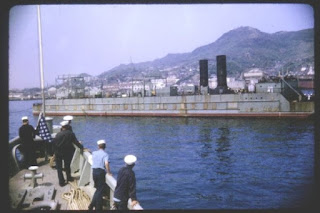
                                               Nagasaki, Japan power barge
                                            Off to Okinawa


                                            Typical fleet radio-shack
                                           Morse-Code key-stations

Service Timeline:
Location                 Date(s)                  Activity 

U.S. Navy Pier        6/10 -7/15/62.     Enlistment; physical; oath
Seattle, WA

US NTC SDIEGO    7/16/1962             Boot-Camp NTC SDIEGO

US NTC SDIEGO     10/1/1962            Graduate basic training

US NTC SDIEGO      11/16/1962          Commence Radio “A” School

US NTC SDIEGO       05/03/1963       Graduate Radio “A” - Promoted to RMSA (E2),
                                                               Transferred to Subic Bay, P.I. Transient Center

Subic Bay, P.I.            06/18/1963        Boarded USS Ashtabula, Yokosuka, Japan

Long Beach, CA         11/16/1963         Depart Ashtabula, personal leave, transfer to Abnaki

Pearl Harbor, HI          12/24/1963        BoardedUSS Abnaki, Pearl Harbor Hawaii

Pearl Harbor, HI           7/1964               Promoted to RM3 (E4)

Subic Bay, P.I.              7/17/1966.         In-transit to Treasure Island, CA for discharge

T.I., CA                          8/8/1966           Medical/dental/disease observation; outprocessing
                                                                  for discharge from Active to Inactive Reserves.

Ft. Lewis, WA                9/66-12/68       Civilian crypto/comm spec. Dept of the Army at Ft. 
                                                                  Lewis Logistics Center.


Pre-Military.
I graduated from Tucson High School on June 2, 1962, 3rd from the bottom of my class of nearly 600, by GPA.  I crossed the same stage and shook the same hands as did the Honor Society graduates with 4.0 GPA’s.  The morning of June 3rd, my parents and I left Tucson driving two vehicles, a 1953 Plymouth and a 1948 GMC pickup, destined for Lois and Leroy’s University Place, WA home. Upon arrival my parents stayed briefly at the Seeleys, then left on the latest mission from God after selling one of their vehicles.  I don’t recall my parents’ destination.  I recall going with them to some church near Bremerton to talk to someone, but it didn’t work out.  The Lord works in mysterious ways, or what I refer to as ‘randomness.’

University Place, my Sister and Brother-in-Law’s home was a good base for a teen-ager intent on looking for work on a merchant ship in nearby Port of Tacoma.  The personal environment was accepting and non-judgmental.  I’m sure Lois looked on at what I pretended was a valid job search and wondered why I couldn’t get out of bed and get gone before Noon.  If so, she didn’t express those thoughts, or make me feel that I was doing anything less than my best.

At the time, automation of merchant ships was reducing the sizes of ship’s crews.  Even seamen with seniority were being let go, according to some who I talked to.  I wasn’t choosy about a possible ship. For instance, one day I boarded a Turkish ‘nightmare’ ship which, though understaffed, wouldn’t hire me…the Captain yelling, wagging his finger in my face, ‘You Americans complain all the time, and cause problems! No place for you on my ship…no place for you!’  So the small amount of money I had saved in the event I went to college was dwindling, and would soon run out altogether.  Lois and Leroy didn't need a freeloader, though they never mentioned my dilemma. I decided to enlist in the Navy; enlistment being my Plan B for going to sea in Asia.

I enlisted in Tacoma, but the activity was soon shifted to Seattle’s Navy Pier where I was poked, prodded, weighed, measured, sampled, questioned, interviewed with particular interest as to whether I might be a communist, socialist, criminal, or homosexual. I was none of the above.  However, my medical exam at the Navy pier in Seattle discovered that I weighed more than my 5 ft 9 in height would allow by Naval fitness regs.  I was given a month to lose the weight.  If I could not do that I would be deemed physically unfit to serve in the Navy, which meant that a less choosy U.S. Army would pick me up in some future selective-service draft.  I lost the weight, and then some, and on July 15, 1962, after sleeping at the YMCA in downtown Seattle, flew out of Boeing Field on a charter, and arrived at the Naval Training Center ‘boot camp’ in San Diego late in the day.  I would sleep in a barracks for the first time ever later that night.

Boot-Camp.
The first full day of boot camp was perceptually the longest day of my life.  Awakened at 5 a.m., by some psychopath beating on the bunk bed with a night-stick, I was disoriented, confused, unprepared for everything that happened during the remainder of that day.  I had talked with no one about their own boot-camp experiences before deciding to join the Navy, so my expectations were probably along the lines that it would be similar to summer Bible camp.  It wasn't.  We marched in our civilian clothes, arrived too early everywhere, stood in endless lines to be fed, receive shots, answer questions.  We were re-poked and re-prodded, measured for work and dress uniforms, which we would pay for by way of regular deductions over the next year.  Our heads were shaved, we were marched to barracks and chow halls, and required to choose enlisted "leaders" from a group of 80 men, none of whom had met each other before now.  (This experience was where I began to form the theory that anyone who desires leadership is likely unfit to lead).  

We met our Company Commander, a slightly built Petty Officer First-Class Gunner's Mate, Mr. Mathern, who referred to us collectively as 'maggots' and appeared to hate us, collectively and individually.  He had one volume — LOUD! He had one tone - OUTRAGED!  He apparently didn’t sleep, having the habit of appearing at all hours of the evening and early morning, armed with his flash-light, to inspect our clothing lockers for items which were buttoned wrong, folded wrong, or not buttoned at all.  When he found a discrepancy he went on a tantrum, screaming, grabbing clothes out of lockers, and throwing them out the double-doors onto the blacktop pavement in the darkness at the entrance of the barracks.  One individual’s fuck up, caused pain and chaos for the other 79 men….but, Individuals seldom made the same error twice, after enduring group justice and punishment…and, so we slowly improved…and, when we did Mathern’s attention would move on to a different trivial infraction, such as body-oil on the collar of your jumper at personnel inspection which occurred outside every morning before chow.

By Navy standards, I was considered a ‘fat boy’ due to my body weight being near the maximum limit for my height at enlistment. Upon arrival at Nimitz Island, after our Company was formed, I was designated as a ‘chow runner.’  The fattest boy in the company was always a chow runner. The Chow Runner left the barracks, or wherever the company happened to be at meal-time, and ran to the chow-hall’s formation grinder where the companies of men would soon arrive, standing in formation, awaiting their turn to eat.  The faster the chow runner arrived at check-in, the sooner his Company was able to eat after they had arrived, marching in formation.  The sooner the company ate, the more relaxation and smoking time was available before the next scheduled training event. If the chow runner was later, the company ate later, and perhaps the time available to eat, smoke, and relax was foreshortened.  Late arrival did not endear the chow-runner with Mr. Mathern or the other 79 men.

Once the company was in the #1 position by the doors of the chow hall, the formation broke up and the individual men rushed into single lines to grab cups, steel trays, and flatware, and were to be served in a cafeteria style line, find open seating, eat, and re-form into a company outside…all in less than 1/2 hour.  Causing your Company to eat later, or worse yet, have the meal time shortened, was not a plus for the fat-boy chow runner.  As for being late to training after a meal?  In no Universe was that going to happen, so if the company got a late start, it meant the meal would be shorter.  Being late to form up, or being late to the next training activity was not an option.  As a result the smart chow-runner tried harder, ran faster, cut corners, lost more weight and developed a thick skin regarding verbal insults about his personal body weight, speed, and the like. ‘Run fat boy, run!’ was a commonly heard mantra, yelled by strangers along the route to the chow hall.  The other call-out from perfect strangers to the marching basic training companies was, ‘You’ll be soooorrrrryyyyy!’   And, we were, until we began to catch on, and gain confidence in the group and in Mr. Mathern.  One day it clicked for me! Mathern was not simply an asshole, military misfit who couldn’t survive anywhere else.  He was trying to train us to adapt and survive in extreme, out of control situations, by relying on each other and taking care of each other. Things got easier after that epiphany.  We began to think like Mathern, and as we did, he backed off and loosened up. Somewhere around two weeks before graduation, he began to behave almost like we were his peers…his shipmates.

As a result of being a ‘chow runner’ and the other usual marching in formation at boot-camp I developed a so-called ‘marching break’ in a small bone of my right foot.  Fortunately, this break was discovered after I had already completed the swimming and abandon ship water training and testing, so  I was able to stay with my original company wearing a so-called walking cast, but I was relieved of chow-running duties.  I graduated boot-camp with my original company on October 1, 1962, knowing that when I returned to San Diego after being home on leave, I would begin attending Radio ‘A’ school, and would presumably graduate as a Radio Seaman Apprentice on May 3rd 1963.  Usually, at least back then, once boot-camp was completed and one received one’s initial training orders, the next 6 months or more was pretty much a known, because you had received your orders for your next assignment sometime during the final two weeks of your current assignment.

All went as planned at Radio School, and, as an added bonus, I graduated 3rd in my Radio ‘A’ class of 80, 79 of us USN guys and one Coastie, qualifying me to (more or less) choose my next duty.  I just wanted to be on a ship in Asia…I was likely imagining myself as some sort of modern day character out of a Josef Conrad novel…a young man going to sea and traveling the world in search of adventure, and in the process, finding the self that was meant to be.  I know, I know…very romantic and mystic, but in my defense I was 18 years old, had never gone to a movie or had a TV in my home, so all I had for entertainment was to read.  Josef Conrad, John Steinbeck, Henry Miller, Kurt Vonnegut, Jr, Ernest Hemingway and more, whose characters were all my friends, and my models of what men were, and what men did.

After graduating from Radio ‘A’ school I returned to University Place on Leave to visit with Lois and Leroy and family at their house on Olympic Blvd, after which, my orders took me to the Treasure Island Naval Base near San Francisco, for transfer by chartered flight from Travis AFB East of Oakland, to Subic Bay in the Philippines and, planned embarkment on my first ship, U.S.S. Ashtabula (AO-51) an ‘oiler’ so-called, because she carried, and distributed oil for fuel in the propulsion boilers on other ships, as well as jet fuel and AV gas, a high-octane fuel for prop-planes, and some helicopters assigned to aircraft carriers.

We sailors and Marines who were transiting to South East Asia from Treasure Island were bused to Travis Air Force Base to catch various chartered flights West.  Just before my flight left near midnight I called Lois.  I needed to hear a familiar, friendly, reassuring voice.  I had never felt as unprepared to grow up as I felt that night.  I had run out of male bravado.  Lois was the familiar comfort I needed before boarding the plane which would take me to the life I said I wanted, aboard my first ship in the Far East.  Sometime in the near future I would board the USS Ashtabula in Subic Bay.  Except: the ship never came to the Philippines. Instead, after waiting in the transient barracks for her arrival at Subic Bay for nearly 5 weeks, I finally got orders to join the Ashtabula elsewhere. Elsewhere being Yokosuka Japan on June 17, 1963 after a very hairy charter flight during a tropical storm, landing precariously in a cross-wind at an AFB near Tokyo.  

After arriving at the pier in a gray school bus, and being signed into the crew by the Officer of the Day,  I took an open rack in the Operations berthing compartment, in the same 3-rack stack as an Electronics Technician named Willy from Yakima, Washington.  We were amiable and considerate berthmates, but failed to gel as friends who would ever share a common interest. I made no lasting friendships on the Ashtabula.  To this day, I have had no additional contact with anyone from those months aboard the Ashtabula, though I met some ‘characters’ very worth knowing.  I think the reason is that I was aboard less than 6-months, and I left so suddenly, that only my work-circle knew I was going.

Life on a US Naval vessel is ruled by routines.  These routines are signaled by the bells, and announcements over the 1MC (internal/external speaker system), and sometimes by the Bosun’s pipe…a tin-whistle which in skilled hands can signal dozens of distinct calls to action, or information.  From reveille, to lights out, the bells, calls, and pipes signal the routines.  Quarters (the morning meeting where departments assemble to hear the plan for the day), meals, sweepers, guests, dignitaries, “brass” coming aboard, launching small boats, the Captain’s comings and goings, getting underway, tying up, supply work-parties, movie call, and even when and where you can smoke a cigarette…’the smoking-lamp is lit on the fantail…’, and more.  Routines.  Every hour and 1/2 hour between reveille and lights out was signaled audibly by the bells and pipes.  Unexpected events are also signaled by the bells, the pipe, and the 1MC…fires, spills, collisions, unidentified aircraft or vessels, and attacks can all be signaled by the call to General Quarters.  During GQ every crew member and officer has a place to be, an objective to meet, and duties to perform, until the condition has changed, and the signal is passed to ‘stand down from General Quarters.’  My GQ spot was on the bridge with the tactical radio handset and earphones, two feet from the Captain’s left-shoulder…but, only after carrying and dropping off two 40lb CO2 fire extinguishers at the bottom of the ladder (stairs) to the bridge, so they would be available at midship. Routine.  Under any operational set of conditions, every crew member had a place to be, equipment to bring, and activities to perform, and, he knew what these expectations were, had been trained to do them, and understood that there could be no acceptable excuse for failing to perform them. These activities were drilled, practiced, by unpredictable calls to action…at any time of day, sometimes (though rarely) during meals or sleeping hours.  Practice, practice, practice.  Sometimes we didn’t know if a drill was real or practice until it was over.

Meanwhile back aboard the Ashtabula, we traversed the South China Sea from North to South and from just off shore of Vietnam to the Philippines multiple times, unrepping other ships.  Unrep is an operational abbreviation for ‘underway replenishment’ where in the oiler refuels other ships while both are underway at perhaps 10 knots, and often in rough weather.  The ‘messenger lines’ are shot across the void.  The messenger lines then are used to pull the distance lines across the chasm from the Oiler to its customer, followed by large, thick black hoses, which carry AV-gas, jet-fuel, and thick bunker-oil heated to a fluid viscosity so it can be pumped. Think of an ‘oiler’ as a mobile fuel-station for other ships, including aircraft carriers, their defenders, and auxiliary ships such as, ammo and supplies.  We would refuel an entire battle group, often starting well before dawn and pumping steadily until after 2200 (10pm) that night…eating on station, drinking on station, leaving only long enough to poop or pee, then back at it.  While passing oil and fuel to the other ship, we might be receiving food, supplies, mail, or movies for our ship’s use. Then when finally empty of fuel, we would haul for Subic Bay, or some other fuel-depot, to top off, and less than 24 hours later we would be running back for the Tonkin Gulf to do it all again…and again…and again…for an endless line of aircraft carriers, destroyers, frigates, and supply ships.

The high point of my 5 month aboard the Ashtabula time was our R&R liberty in Hong Kong.  We anchored in the hazardous cargo area near Stone Cutter Island.  The boat ride to the city was 45 minutes or so, and, of course that meant a 45 minute ride back, when the boat was packed with aggressive drunks who were either about to puke, had already puked, or were puking at the time…often puking into the wind caused by the boats forward motion.  It was a long 45-minute return, and not for the feint of heart or queasy of stomach.

My first R&R in Hong Kong was unlike anything I had ever experienced.  Even Mexico City where I had been several times as a younger kid, seemed tame and pristine by comparison.  Hong Kong was serving the carnal needs and wants of several of the world’s largest navies, including: Great Britain, the U.S., Canada, Australia, South Korea, and New Zealand…drugs, sex, and rock and roll were available at all hours of the day, right out in the open.  Some of the activity was obscene beyond being erotic.  For instance, I didn’t understand then, and I don’t understand now why anyone would want to watch a girl have sex with a pony, but if you were someone with that desire, you could pay to see it in the Wanchai District of Hong Kong, or at least the street hawker said you could…I am not nor have I ever been a fan of intraspecies sex.

I had never been anywhere as openly ‘capitalistic’ as Hong Kong, Kowloon, and the surrounding neighborhoods…literally, anything and everything was for sale.  It was rumored that in the Colony of Macau about an hour’s ferry ride away, you could buy another human.  I had never been anywhere where poverty was more palpable…one afternoon while evading the Shore Patrol I had the experience of crossing several roof-tops on Wanchai slum apartment blocks.  Every square foot of the roof tops was occupied by families living in make-shift structures fashioned from cardboard, or pallets…cooking on charcoal fires, pirating water and electricity from the apartments on the five or six floors below.  Up there, they were entirely exposed to nature, including the tropical storms and typhoons which frequent this part of China.

When we left the ship for liberty, we were encouraged to grab and swallow a handful of penicillin capsules out of the large brown glass jar on the Quarter Deck to help combat any “bugs” we might encounter in the city.  The ‘Clap’ was abundant and about the friendliest STD likely to be encountered by a drunk and horny sailor…some microbes, even then, were reputed to be antibiotic resistant, including the dreaded ‘chancroids.’  Thankfully, I never contacted any of the gifts which keep on giving, in Asia or elsewhere.

In late October 1963 the Ashtabula was ordered to return to home port in Long Beach, CA.  We departed Asia along the Great Polar route.  The trip was as cold and wet as I’ve ever been. Salt spray froze on the forward superstructure and the catwalk between the forward and aft superstructures where I often stumbled along in the dark, carrying a cup or two of coffee from the mess decks aft to the Radio Shack forward.  Soon after we arrived in Long Beach we were informed that our ship had been selected for the highly prized participation in the annual Coral Sea Celebration which would take us to Thailand, Singapore, and Australia.  Soon after that, I received orders transferring me off the Coral Sea destined Ashtabula to my next ship, which was not going to the Coral Sea Celebration…some unknown faithful ‘lifer’ would instead be rewarded with my billet on the Ashtabula.  Singapore, Sydney, and Melbourne would have to wait for a future cruise.  As it occurred, that cruise would be aboard the Holland-America Amsterdam in the Fall of 2012, in the company of my traveling and life companion, Jennifer.

I left the Ashtabulafor the last time, later in the afternoon of the same day that the Long Beach police department brought me back to the ship under arrest.  The night before, on Broadway in downtown Long Beach, I had dozed off while leaning against the right-front fender of a parked police cruiser, after being awake and ‘celebrating’ for the better part of 3-days. The fact that I was not drunk was irrelevant to the police.  The boys in blue simply cuffed me, transported me, and booked me into their finest overnight accommodation at the Long Beach city jail.  When I arrived back at the ship the next morning,  it was November 16, 1963, coincidentally my 20th birthday, and historically the week before JFK was killed in Dallas.  

By the time Kennedy was shot, I was on leave visiting my high school friend Jim Brogdon in Tucson.  He and I stood and watched the story unfold on the black and white television in the lobby of the Student Union at the University of Arizona where I met him after his final class that fateful day for the U.S.  Though I was not, and am not, a Kennedy fan I can recall being disoriented by the event…in what world could the rich, famous, and powerful be so vulnerable that a traitorous nut-case could reach him with impunity?  If a Kennedy was vulnerable, how could anyone else possibly be safe?

Within days of the assassination, Jim drove me to the local air force base to get a cash pay advance for travel.  I showed them my orders, transferring me to the USS Abnaki, and received the maximum pay allowable under the circumstances.   I said goodbye to my church and high school friends in Tucson, as I started making my way to the Northwest to see family, and eventually West to Pearl Harbor Hawaii to catch my next ship.  It would take the better part of a month of hitchhiking, stand-by flights, sleeping in air terminals, and layovers to get to the USS Abnaki on Christmas Eve morning 1963.  

When I arrived at the ship, which was berthed at the Pearl Harbor Submarine Base, perhaps 25% of the crew was aboard.  Most everyone else was home for Christmas, and would remain home and out of sight until after January 1st.  The Officer of the Day and a dungaree clad Bos’un’s Mate greeted me on the Quarter Deck, checked my orders, signed me into the ship’s manifest. The enlisted Messenger of the Watch took me down to the Operations berth to find me an empty rack.  I lucked out and got a deck-level rack, claimed it, and soon conked out for a long sleep, waking up in time for Christmas breakfast, which was, a ‘cook your own,’ open grill, with steak and eggs and hash browns.  The cook had thoughtfully labeled different sections of the the flattop grill to identitfy what goody should cook there, and, he had put out all the fixings.  Turns out he did that every Sunday morning when the ship was destined to stay in port. Merry Christmas to me, 1963.

Though I was a Radioman Seaman (E-3) the ship needed me to function as a Petty Officer (E-4) in order to supervise a Radio watch with at least one subordinate, so I was recommended for the competitive Navy-wide examinations for for Radioman Petty Officer 3rd Class, which would be held on 12/30/1963.  I had less than a week to prepare for the exams.  I passed the exam, and was awarded a stripe, and thereafter was deemed ‘qualified’ to do the job I had been doing since December 1963.  My elevation, however, was brief.  On July 20 1964 I was busted to RMSN (suspended for 6 months) fined, and confined to quarters for intoxication, during which alleged intoxicated time I referred to four of Honolulu’s finest plainclothes detectives as ‘dumb fuckin’ Kanakis’ a term which they, and the Navy, deemed to be racially offensive.  As it occurred, the term ‘Kanaki’ was acceptable to use only if you were one…I, not being of mixed Polynesian origin, was, not welcome to use the term, therefore was presumed ‘racist.’  Of course I knew that.  My intent had been to openly disrespect all four of them in front of each other. My racial disdain was very purposeful, not a position I am now proud to have taken, but again my only defense is that I was under construction as a human…a 20 year old white male with a bad attitude, an abundance of ignorance which often overrode my best instincts, and more than my share of unexplainable rage.  I was, quite often, simply mean and angry without specific reason or obvious cause.

I was let off pretty easy, busted, fined, reduced in pay — but, all suspended for 6-months.  Unfortunately for me, I again offended within the 6 month suspension, and was actually busted to RMSN, reduced in pay, fined, and awarded 14-days extra duties, in addition to standing my normal watches.  This time, the extra duties got my attention…2 weeks X 4 hours a day chipping, sanding, and preserving in the shaft alley bilges (see the picture above) while standing waist deep in water with grease, oil, semen, urine, rat cadavers, and god know’s what else floating in it while the ship was underway, rolling back and forth…resulting in my puking into the same water I was standing in, until I could puke no more.  OK…so long story short, Captain James Williams got my attention, and I finished out my final months of Active Duty pretty much squared away…not exactly the perfect sailor, but close enough to perfect to not attract the attention of serious critics and others who could affect the quality of my day-to-day life, or alter my Honorable Discharge in the future.

I was on the Abnaki for a total of 29-months.  That time deserves some expanded information.  Some of the events I describe below have been augmented in my memory by recently reading the archived “Deck Logs” on file and on-line at the National Archives.  Deck Logs are handwritten accounts of the operational events during each 4-hour segment of the calendar day, starting at 0001 local-time 7-days a week.  Others, such as most of the Vietnam operations were Classified, so the Deck Logs during ‘Special Operations’ are not descriptive, each 4-hour segment simply labeled as ‘Special Operations.’  

The ship was a fleet seagoing tug, commissioned in 1943. It was designed to do long haul towing and assist in salvage operations, and we did some of that. But, it was the ‘one-off’ projects which were the most interesting to me, for example:  anchoring a target raft in the nuclear testing area of the South Pacific so the B-52’s could test a new bomb sighting system from an altitude of 50K feet.  

In brief, the project involved anchoring a target raft in the Pacific Nuclear Bombing range, at a water-depth exceeding two miles, then waiting for the B-52’s to drop their test ‘bomb’ from an altitude of 50,000 feet.  This was not an actual nuclear device, but in all aspects was a simulacrum of such a device.  The weapons officer on the B-52 calculated in a 1 degree error so the ‘bomb’ would not actually hit the raft, destroying it.  We, almost 10-miles below, would stand-off a measured 3-miles from the raft, and mark the distance from the raft where the ‘hit’ splashed, thereby triangulating the ‘real’ difference between the 1 degree purposeful error and the splash-site.  This was an incredibly complex project, starting with the deep-water anchorage, then once anchored, maintaining the raft which had several ‘systems’ operating aboard, including: Radar emitter, an electric motor, fluorescent light, a signal-generator, an infrared generator, and more…the B-52 ‘sight’ could target any of the sources of energy.  

The raft, of course, kept breaking down in the unfriendly environment, resulting in spare parts needing to be sea-dropped by aircraft for us to retrieve, and, there were multiple rubber-raft visits daily to fuel and otherwise repair or maintain the target.  The project lasted the better part of a month, before we retrieved two+ miles of nylon rope and the metal anchors from the depths, and departed for Johnston Island Atoll to offload the used gear, then haul home to Pearl Harbor.

Another assignment involved intercepting sampans off Vung Tau on the Mekong Delta of Vietnam near Dixie Station.  We carried a Vietnamese Naval Officer aboard who gave us ‘legal’ authority to identity, stop, question or board and search civilian sampans.  The boarding crew included: a Junior officer, a motorman, at least one gunner, a Bosun’s Mate, a Radioman, and a medical Corpsman.  The sampans were identified and marked by Radar as they gathered around a cargo ship in International Waters, each one assigned a ‘name’ for tracking and communication purposes, then, the decision was made which one(s) to stop when they headed for shore.  There were dozens of sampans around each Russian, Chinese, Polish,
or North Korean vessel…remember, this was well before the days when satellites provided any useful imagery.  All the sampans headed for shore virtually simultaneously…dozens and dozens headed for the Mekong Delta all at once, and all at approximately the same speed, spreading out so that each was miles apart from any other by the time we could reach them…we had to choose. The Vietnamese officer would decide who to stop, who to question, or who to board.  We, the boarding party, stood by our rubber raft or motorized ‘whale boat’ and waited for the word to go.  All six of us were armed with a weapon which fit our role.  The party was usually nervous while waiting…people would ask me if I’d checked the radio equipment, or, if the batteries were ‘fresh.’  The reason was that if the ship lost contact with the boarders for more than 5-minutes, it had a ‘standing order’ to open fire on the sampan. The presumption being that the boarding party had been overpowered, i.e., killed or captured.  So, the boarders were ‘nervous’ as we smoked our final cigarettes before the ride over the 1000 or so yards of water.  

Among the few small boats we actually boarded and searched, there was never an incident and we never found any contraband.  More often we signal the sampan to come alongside.  The Vietnamese Officer would question them from his perch on the bridge-wing, then send them on their way.   Perhaps only 1 out of 10 of the dozens and dozens of sampans carried contraband…it was just a ‘crap shoot.’  ‘They’ (VC) knew we couldn’t be everywhere at once, and, we could check only a few small boats before the rest disappeared into the 1000’s of mangrove lined channels of the Mekong Delta. The odds were excellent that much of their contraband would make it up the river, and into the ‘right’ hands.  Later in the war, the SWIFT boats were organized for search and seizure.  At 60 mph they could stop many more boats.  With their size, they would risk only 5 or 6-guys while tied up to the sampan, instead of having to raft over from a larger ship, and at some point, the U.S. gained the authority to legally search South Vietnamese citizens and their homes. And with their armament, the SWIFT boat could devastate a target in a matter of seconds.

 However, the most time consuming of the Special Operations, one such assignment lasting 64-days without a break, was running interference and jamming the Russian Trawler (Skunk Delta) on ‘Yankee Station’ off North Vietnam, wherein, the Russians would try to interrupt CVA’s during flight operations launching sorties over Hanoi and Haiphong.  Three aircraft carriers operated simultaneously on Yankee Station.  At any given time, two carriers were launching or retrieving aircraft, while the 3rd CVA was off-line doing maintenance, replenishing armaments, repairing planes, resting its crew and pilots, in preparation for its next two-days on line.  

The Russian ‘trawler’ was in fact an electronics surveillance platform, a ‘spy ship’, chocked full of tracking and communications equipment.  It surveilled sorties, and ‘listened’ to pilots talking to each other on the way to the targets, or on the way back.  Intelligence…some of it immediately useful to the awaiting SAM and AA crews, and other intelligence which could be useful when combined with other info, sometime in the future. They, the Russians, relayed info to the surface-to-air missile sites and antiaircraft crews of North Vietnam, and, they made attempts to physically cross the bows of the CVA’s and interfere with flight-operations while they were retrieving and launching aircraft.  It was our job to assure, by any means available, that they were unsuccessful.  Running interference on the trawler was a 24/7 operation, involving our staying within 500 yards of the trawler, and maintaining the international rules of ‘right of way.’  When a sortie launched, we would try to place ourselves between the sortie and the trawler and electronically ‘jam’ the airwaves back against the trawler, and away from the sortie.  I have no idea how successful we were.  

On one occasion, months after I had transferred off, the Abnaki actually purposely collided with the trawler to block it from crossing the bow of the USS Ranger which passed 500 yards ahead of the trawler at 25 knots.  The trawler sustained sufficient damage that it had to be relieved of duty, and another trawler assigned, providing the carriers with almost two weeks of harassment-free operations.  The Abnaki sustained only another minor scuff to its exterior paint, and added yet another small dent which would soon just blend in with the others accumulated since its commissioning in 1943.

One afternoon during the Spring of 1966, after leaving Danang harbor headed for Yankee Station and coincidentally, my final month of Vietnam duty, we went North as we should, but then turned toward the beach around midnight.  We did so in order to insert a sniper into the beach near the DMZ between South and North.  He paddled away in the darkness, on his small black rubber boat.  The sniper had transferred aboard during a supply visit from a barge in Danang harbor early that same day.  In short, the small supply barge with 6 guys aboard came out with supplies, and after the supplies were loaded, only 5 guys went back to shore in Danang.  Hopefully, any ‘watching eyes’ from shore would not notice this discrepancy.  That night, as I went out on the fantail for a cigarette just before starting my mid watch, I encountered the guy.  There were only 3 ‘passengers’ aboard: the sniper, and two guys who were the operators of the jamming shack on our fan tail…this guy was clearly our sniper ‘passenger’ and was having his last cigarette before he would raft to shore and disappear into the cover of night.  He told me he had a photo of a Vietnamese guy (his target) a sandbag, a target rifle, some rounds, some jerky, water, antibiotics, and a spotting scope.  If all worked out, he would put a single round through the forehead or torso of his target after identifying him from the grainy black and white picture, then head South for the ‘friendlies.’  If he couldn’t take a good shot, or couldn’t be certain of the identity of his target, he’d pass up the shot and head South for the ‘friendlies.’  I never heard how it ended, of course.  One of the issues with SEA is you hardly ever heard the rest of the story.

Searching for, and never finding, downed fliers…searching for the blinking light on an orange inflatable vest in the vast darkness of the Tonkin Gulf.   This happened multiple times while shadowing the trawler on Yankee Station, that a flier would be unable to make it back to within visual contact with his CVA.  If they splashed out of sight the odds of finding them were greatly reduced.  Jets sank fast once they splashed, so if there was a survivor, it presented as a tiny speck in a sea of blue reflections, or as a blinking yellowish-whitish bulb.  If the flier had not ejected by the time it splashed, odds were he didn’t survive…but, we looked…and looked, until the next call or another task forced us to move on.

On March 6, 1965 we arrived in Danang harbor from Subic Bay, P.I.  It was common knowledge that our Old Man and some officers had been meeting with some Mine Squadron guys in Subic.  And, it was common knowledge that when we left Subic, we had a passenger aboard, a Mine Squadron Officer.  All this info is confirmed by the Deck Logs before March 6, 1965, at which time we were classified as a ‘Special Operation.’  We met up with a Mine Squadron and came under the operational command and control of the senior officer of that Squadron.  We were there, among other reasons, to map the bottom approaches to Red Beach 1 with a portable SONAR transponder.  The Mine Squadron was there to check for previously placed enemy (or French) mines, remove them if any were found, and, to plant our own defensive mines in preparation for the Marine landing the morning of March 8, 1965…the one and only amphibious landing of the entire war, where not even one Marine lost his life.  By the time they (3,500 Marines, APC’s, artillery pieces, and more) trudged up the beach from the surfline, we were standing off 5 miles in case there was salvage work to be done or an LST that required towing after grounding on the beach.  Instead of gunfire, the landing party was met by local dignitaries, reporters, and young women offering flowers.  We hung around a few more days before departing Danang for Subic Bay again.

On both ships I served on, while in the Vietnam bays, tributaries, and coastal waters, we evaporated sea water for drinking, bathing, cooking, laundry, and the like.  On both ships, we swam in the Tonkin Gulf near shore as a recreational treat for the crew…a cool down.  We were all exposed to Agent Orange.  I don’t claim to know what is true and actual.  I have no certain knowledge that my heart conditions are related to my Navy service in Vietnam.  The VA believes they were.  They believe this with enough certainty that in May 2021 I was awarded a life-long, 100 percent service-connected disability for Ischemic heart disease, presumed to have been caused by exposure the toxins of Agent Orange, as a direct connection to my service.  I have mixed feelings about the entire matter, and I know now that I always will.  And, in some sense this development keeps the Vietnam ‘question’ alive in my mind, when I felt I was about to close out the question.  When I volunteered for shipboard duty in Asia there were a few thousand American ‘uniforms’ in Vietnam.  By the time I left in the Summer of 1966 there were maybe 65,000 uniforms in-country and along the coast.  The war the American public thinks it remembers, mostly between 1968 and 1973, is not my war, though ‘my’ war developed into the mess wherein hundreds of thousands of American troops were present at any given time.  My Vietnam war was an ‘advisors’ action involving fewer than 65,000 uniforms on any given day…many of those uniforms at sea on carriers, defensive vessels, cargo ships and other auxiliary vessels like mine, all of us exposed to the toxins of Agent Orange.  It is impossible to know to a certainty that my Ischemic Heart Disease, or, his urinary cancer was caused by Agent Orange. Another open question.

Cities.
While on both ships, I visited Yokosuka and Sasebo, Japan several times each. Both are large naval cities. Kagoshima, Japan, its island volcano glowing in the bay, once. Nagasaki, Japan once…from where we towed a power barge owned by the Army which had been on loan to the city during its reconstruction after the nuclear attack; we towed the power barge Impedance, complete with its crew of 23, to Okinawa, though originally we had set out for Yokosuka  I was in Kaohsiung, Taiwan twice, once of the Ashtabula and once on the Abnaki. Hong Kong three times. Subic Bay, Philippines many times. Naha, Guam two or three times. Johnston Island Atoll in the South Pacific at least three times. Oakland, CA Naval Supply Center to pick up a tow, a harbor tug, which we towed back to Pearl Harbor for re-outfitting and local duty.  Each city and port had its unique characteristics, but my least favorite destination was Guam.  ‘Guam’ was never welcoming or happy to see us, and even the staff of the on-base businesses made sure we felt it.  ‘Welcome to Guam. Come again when you can leave sooner.’

In the smaller Japanese towns, such as Kagoshima, the young local men in bars would act as our hosts…we were not allowed to pay for our own beer, nor were we allowed to reciprocate and buy them one.  The irony of toasting with the locals…raising my Sapporo or Kieran high…under the large wall-murals of Japanese Zeros diving on and attacking American Naval ships, was not lost on me.  ‘Loser buys the drinks!’ Though in a rare show of good judgement, I never uttered those words aloud!

At least half of my sea days, and 25 percent of my shore-days, were spent on duty in a windowless radio-shack. (Above somewhere is a picture of a typical fleet radio shack). The radio shack was designed like a vault…one metal door in, same door out, with a 40-lb fire extinguisher hanging on the metal bulkhead by the hatch with a four-digit combination lock and handle outside to allow access in the rare event that it happened to be unoccupied.  Or, one could be let in by the occupant once identity was confirmed via the peep-hole.  Inside the radio-shack, there was another smaller separate vault-room which contained all the crypto information, locked in individual combination wall safes, as well as, the manually operated crypto machine which converted plain language to 5-character encrypted clusters, or conversely 5-character clusters to plain language.  My Navy clearance classification was Secret-Crypto Access.  When I went to work after discharge for the U.S. Army as a civilian at Ft. Lewis Logistics Center, my clearance was elevated to Top Secret - Crypto Access.  On board the Navy ships, the Operations Officer performed the manual Top Secret-Crypto Access activities.

The radio shack’s bulkheads were entirely covered by electronic equipment…6-foot tall transmitters, receivers of all sizes, signal-generators, electronic crypto machines (KW’s), patch-panels which enabled us to move teletype machines from receiver to receiver (frequency to frequency) in order to maintain a continuous flow of teletype traffic on the two common networks.  If you were quick enough, you could patch a teletype into a new receiver without causing even one garbled character…if you were unfortunate the delay could not only cause garbled data, but cause you to lose synchronization between the electronic crypto equipment (KW35) and the receiver, which resulted in a minimum of 5-minutes of lost data which had to be reconstructed.

The combined electronic and electrical equipment put off a terrific amount of heat…some just radiating, others with active exhaust fans pushing warm air out while humming low.  The two teletypes on two separate ‘common-networks’ ran 24/7, the busier one dumping out over 20,000 messages a day while in South East Asia, each requiring the Radio Operators to pick out his ship’s name or ‘call sign’ from the flow of continuous, attached messages…missing a message would be the end of a radio career, resulting in completing one’s enlistment as a ‘deck-ape’ chipping paint on some other ship.  The space was not airconditioned although it did have good outside air exchange, thereby replacing the electronically heated air with atmospherically heated outside air.  The decking inside the shack was wall-to-wall rubber tread to reduce the chance of electrical grounding and shock.  The teletype signal current itself, coming off the end of the patch-cord, was 60 milliamps, enough to stop a heart.  

The radio-shack always shared a space physically near the Captain’s cabin.  Many/most of the messages were for the Captain, and required him to initial in receipt at all hours of the day, and perhaps even write out and sign a response to be radioed out, and, he might further distribute the incoming message by scribbling one or more of his Officer’s names on the page for the Radioman to further distribute the message.  When the copy had been fully initialed it was filed in the radio-shack or returned to the Captain for personal filing.  When the ship was underway, it was rare that a fleet Captain would sleep through a night with no knock at the door of his cabin, where a Messenger would be standing holding at least one message on a clipboard, the content obscured by an appropriate classification cover-page.

Some of the Radiomen, me included, had so-called tactical radio ability.  Tactical radio might involve using a ‘telephone’ handset on the bridge under the direct verbal guidance of the Captain or the Officer of the Deck. Or it might involve using a portable radio (a back pack), as a crew member of a small boat performing some off ship duty, for example, boarding a sampan or streaming back in a rubber raft to board a vessel under tow, or taking a sick crewman to a shore clinic or a waiting sea-plane.  The portable ‘tactical’ radio was a battery operated, heavy backpack, prone to failure, which quickly sapped its single-use batteries…on air chatter was discouraged, and brief when required at all.  The tactical radioman was quite simply the voice of the senior Officer present…a conduit.  Depending on the watch rotation, I might be the tactical radioman on the bridge when we were entering or leaving port.  If I was on the bridge, I would be trailing the Captain or the Officer of the Deck around, two-feet from his left shoulder, relaying his comments to the Harbor Master or another ship involved in the tactics.  It was similar to being a ventriloquist’s dummy, only one was in motion instead of sitting on his knee.

By the final time I went to Vietnam in 1966, the Navy was experiencing shortages of skilled Operations ‘A’ school graduates (Radar, Radio, Electronic Technicians, SONAR operators, etc.) on board the smaller ships, including ours.  At the same time there were shortages of Operations specific skills, the overall sizes of the ship’s crews were getting larger to accommodate the potential for casualties, and the numbers of generally needed seamen, gunners, and engineering crew.  Our ship was designed for about 75-crew members, but we were carrying almost 95 by the Summer of 1966.  This is more crew than there were beds; it meant too that frozen and refrigerated foods were consumed more quickly, resulting in powdered, canned, dehydrated foods being used sooner, and sooner…eating powdered, dehydrated, canned foods longer and longer…using more, making more, fresh water for drinking, cooking, laundry…resources, in total, were being strained by too many people.

At the same time we had only one Signalman aboard…but, he had to sleep and eat, and poop and shower, and have breaks from duties…no one can work 24/7 very long.  Solution? If we got a flashing-light signal while he was off duty, presumably sleeping, one of the available Radiomen ran to the bridge and took the signal in his stead. Morse-code is morse-code whether its an audible radio signal or flashing light.  The next step was to give my bed in the berthing compartment away, and instead provide me a folding army cot on the flying bridge where I could be easily awakened to take a flashing light signal at any hour.  The benefit was that I got to sleep out in the open air under a tent like tarp covering.  The liability was that there was no such things as having predictable ‘time off.’

When I stood my watch in Vietnam in 1966, my Messenger was an ET1, an Electronics Petty Officer First Class (E6) which meant he was two ranks above me.  He could manage his department’s repair and maintenance team and function as my messenger also, because he too had a SECRET Crypto security clearance.  Fortunately we were friends, and the difference in rank never became an issue.  He would carry the message board, but he could also set up receivers and transmitters as well as resynching the KW35 encryption device when it dropped the network connection.  It could be resynched only on the 5’s using the signal from the British Radio Observatory in Greenwich England (Greenwich Mean Time) as the world-wide standard for time.

The South China Sea was infested with electronic ‘spooks’ and anomalies, which defeated RADAR, LORAN, and Radio signals of all kinds, including creating “bogies” which appeared on RADAR to be attacking, but which turned out to not actually be there…some of these events were so ‘real’ that the Captain was convinced to go to ‘General Quarters’ a battle-ready, shipwide condition, only to stand down when an attack or other incident did not come.  On one low visibility night, our Captain actually ordered the large carbon arc spotlight to be activated in order to see what our Radar was telling us was just yards away from our position.  There was nothing there in the spot light, though the radar was clearly reflecting a large, solid object in the exact spot we had lighted up.  On occasion, sitting just North of the Equator in the South China Sea, radio contact was easier to establish a link with Keflavik, Iceland (or WASHDC, or SFRAN) than it was with the communication station less than 600 miles away in Subic Bay, P.I.

So, in mid-July 1966, my drinking-buddy and electronics technician colleague Robert-not-Bob Knapp and I left the ship in a chartered car with a hired local driver, carrying orders to be discharged at Treasure Island, California.  The driver was to drive us to Clark AFB, a leisurely half-day’s drive away.  On the way to Clark AFB we stopped at a local roadside cafe/bar, and ate tasty local food washed down with many bottles of San Miguel beer…the driver joined right in with our festivities.  Knapp and I had orders for transportation from Clark to a domestic base, but had no orders for on-base meals or billeting of any kind if we got hung up at Clark or in between.  The plan was, transportation would be immediate, and complete, requiring no onbase meals or overnight stays, and as they say, ‘Bob’s your Uncle!’ except the US Airforce had made other plans.

In fact, as it turned out, we were flying home at exactly the week that the military family Boy Scouts and their uniformed parents and Scoutmasters were flying home to the U.S. out of Clark AFB for the Scouting Jamboree in Indiana.  Jamboree attendees had a higher flight priority than we who were returning home from Active duty in South East Asia.  We were continuously ‘bumped’ off flights for the next 3-days. We ate on our own dime in the canteen. We slept in the theater and in the waiting room of the air terminal. Three-plus days later we finally got on stand-by flights, and said good-by as Knapp’s flight took him to his destination, and later, my flight left for the hop across to Hawaii and then Treasure Island.  I think Knapp’s destination was the Great Lakes Naval Center near Chicago.  I never saw him or heard from him again, though I’ve heard from others that he is OK.

At Treasure Island, the Navy took a week to do the administrative and medical tasks which could have been done in a day.  In their defense, they did also do some minor dental work, and they observed me for the manifestation of various tropical diseases, including: leprosy, plague, malaria, and yellow fever.  I got paid the money owed me, and including the money I came with, I spent like a ‘drunken sailor’ while visiting the various dens of inequity offered by the San Francisco Bay Area. The money I spent there in a week would be equivalent to more than $2,000 now.  I drank top shelf Bourban, paid covers, including paying the cover for at least one stranger to a Count Basie show in North Beach. I tipped large, ate well, rode cabs, and did my best to spend it all.  In spite of myself, I managed to head home to University Place with money left over…after stopping over in Dayton, Washington to visit Goldie and Papa at their church, and shutting down several bars in Walla Walla before bussing to Seattle and Tacoma, I still had money.  In truth, I was helped along in saving money a bit by the Blue Laws of Washington State, because I was riding a bus from Dayton to Tacoma, on Sunday, and so could buy no ‘hair of the dog’ alcohol in any city on my route to UP, arriving with the remnants of a dreadfully painful hangover.  Lois, as usual, voiced no judgement, though I felt she was secretly pleased by my lack of foresight and planning.

So that’s my military story which comes to mind at this point.  I’m sure there are events, people, places that I’ll think of later which deserved mention or expansion.  Chronological history is not my strong suit…I tend toward thinking of history as a patchwork of stories, stitched together by time and place.  In some sense, its all happening simultaneously at the moment you’re remembering it…one story reminds you of another.  One lesson learned points you to another related event.  In the end, everything which has gone before exists all at once…or so it seems.

Post Scripts.
During my later life I have attempted to understand ‘my war’ better by reading about it through the writing of others.  I have steered clear of autobiographies, because I don’t trust the ‘actors’ to know or understand their own parts…I think we humans are notoriously bad about seeing ourselves, our intentions, our motives, and their consequences clearly. I have never read an autobiography.  On the other hand there are a scant handful of books or papers about Vietnam which might be worthwhile.  These are, in my opinion:

  • The so-called ‘Pentagon Papers’ which was an actual classified white-paper chartered by President Lyndon Johnson, and made famous by Daniel Ellsworth who ‘leaked’ it for serial publication in a newspaper.
  • VIETNAM: An Epic Tragedy (1945 - 1975), by Max Hastings…in my opinion the most objective and worthwhile of the various articles and books.
  • A Bright and Shining Lie, by Neil Sheehan…a painstakingly researched book focused entirely on American involvement and the cross-purposes of the political, military, and intelligence communities.
  • The Road Not Taken, by Max Boot.
If you could read only one book, I would recommend it be the Max Hastings tome, because he more clearly places ‘Vietnam’ in the flow and context of history, avoiding the myopic bias of American authors and politicians, who tend to view Vietnam as ‘America’s war.’  Hastings knows and opines that we joined Vietnam ‘in progress.’  We did not start it, and we did not lose it…we were merely the latest Western presence to make it worse, on its way to its inevitable reunification of North and South under its hybrid form of Communism.  By 1984 the harsh communism of the North became more locally adaptable, and rational…I think Uncle Ho would approve.


Thursday, April 13, 2017

"Run fat-boy run!"

I graduated from Tucson High School on June 2nd 1962.  I pulled down a solid D- average for my efforts, and collected the same piece of paper as my scholarly peers, many of whom turned out to be "someone" including, the CEO of Mattel, newspaper editors, at least one professional Actor, and a math-whiz who was instrumental in shaping the WWW and the Internet.  Resplendent in our sweaty gowns, we several hundred graduates unceremoniously crossed the sunny stage assembled on the football field sometime during the sweltering mid afternoon.  Later in the early evening of that day Jim Brogdon and I joined the other young people of Tucson First Assembly of God church for a "progressive" graduate dinner, moving from house-to-house between courses, finally ending up on the Miracle Mile at the motel owned by Rosemary Migliore's parents before midnight.  We had a final dessert and swam in the motel pool.  By early June most, if not all, tourist-guests had departed The Miracle Mile to escape the rising heat of the desert.

Next morning my parents and I ascended into our two vehicles, including our 1948 GMC pickup truck, already packed with our scant belongings and headed North for Tacoma, Washington.  We left at 7 a.m., with a goal to be in Kingman, Arizona by nightfall.  Where travel and my father were concerned, time-lines and goals were not suggestions, or matters of hope, they were hard and fast once set.  Missing a goal, even for reasons beyond human control, were treated as possible Cosmic catastrophes.  Each vehicle was adorned with a canvas water-bag in preparation for the inevitable overheating which would occur on some as yet to be known uphill grade.  The spare tires, retreads, were checked and aired.  We had ample reconditioned motor oil to get us to Kingman.

I don't remember much about that trip North. I drove one of the vehicles and my father drove the other, though my mother occasionally spelled him if he developed leg cramps.  He and she drove the GMC because its was more finicky, overloaded with the "junk" of ownership, its gear and differential ratio causing it to run hot at highway speeds.  I do know that during the long hours staring out the narrow windshield I was the most pensive I had ever been in my short life.  I was now an adult, having just finished high school, and I was already 18-years old, and would be 19 in less than 6 months; I had started elementary school almost a full-year later than most others. 

The long stretches of mostly two-lane blacktop gave ample time to consider the fact that I had started late playing the "game" and had no obvious skills, and even fewer prospects.  I was leaving behind, further and further with each mile, the place and friends I most valued simply because I didn't know how or when to break with my parents and the restrictive security they offered; there was a certain smug-safety in allowing them to continue making my decisions; doing so allowed me to be critical and pretend I was not participating in any the choices.  I did however have one thing going for me.

I had a fantasy.  It was not well-defined or fleshed out, but involved joining the crew of a merchant marine vessel as an apprentice-seaman, its flag, cargo or destination didn't matter.  I considered my life to date to be aimless and meandering.  Achieving my fantasy would allow me to continue doing what I did well.  It might be useful for the reader to know that I had pretty much read every Joseph Conrad book I could lay hands on by this time, and I had assumed the persona, a conglomerate psyche of some of his youthful characters, including the tragic coward-hero Lord Jim.  In my internal video, I saw myself ascending the gang-way of a nameless ship, sea bag effortlessly hoisted onto one shoulder as I joined the crew of yet another merchant cargo vessel.  I knew absolutely nothing about this prospect except my own sourceless imaginings.  Tacoma, Washington where my sister and brother-in-law lived with my young Niece Jeanie, offered a large and active international port and would serve well as my jumping off point, at least that's how it played out in my fantasy.  All I had to do was convince some Captain or Mate to take me on for room and board.  I had $150 saved so I didn't need wages for awhile...at least until I had built some sellable seaman's skills.

Turns out the U.S. Merchant Marine actually requires some level of professionalism, as well as sponsorship just to become an "able bodied seaman."  Who could have known?  Disappointed but undaunted I headed for the ships with foreign flags and unpronounceable names.  When I finally found a Captain aboard one such ship, he yelled at me while gesturing wildly, "No Americans! You cause trouble!  You complain all the time! No Americans!  I explained that I would work for food and a berth, but he again yelled "No Americans!"  I returned to my sisters house dejected, and aimless.  My compass had had only one direction on it, and that was thwarted.  By the time I decided I'd try to get into the U.S. Navy, my sister's cooking and my inactivity had a barrier to my easily joining the Navy.  I weighed 217 pounds.

As it occurs, the U.S. Navy in 1962 had a height and weight ratio that could not be worked around even by a dishonest recruiter  The doctor's at the Navy pier in Seattle, told me I was physically fit, but at 5 feet 9 inches tall, I would need to weigh no more than 202 pounds before I could sign the enlistment contract and be shipped off to the San Diego Naval Training Center to be molded and shaped into a finely tuned fighting machine.  Through a combination of dieting and laxatives I made that weight, and soon after, caught the flight from Boeing Field to San Diego.  But, that was just the beginning of my weight problem..."fat boys" were not smiled upon by the Company Commanders of the recruit companies, and ours was no exception. 

Mr. Mathern was probably 5 feet 7 and wiry, possibly weighing 135 lbs.  By rank and rating he was a Petty Officer First-Class Machinist's Mate, but by human standards he was one mean son-of-a-bitch, and he was convinced that the "fat boys" would slow down the company and cause some catastrophe in the process, like being last in line at the chow hall.  So I learned about a Navy tradition: the "fat boy" got dispatched to run, balls out, from the barracks to the grinder in front of the mess hall, and hold a favored place for the company which was marching in formation.  I was the breakfast "fat boy."  And, lunch and dinner had their own fat boys...and God help you if you failed to seize a good position for your company.  There were worse things than being the chow runner, one such thing being sent to Company 2013...but that's a different story.  So every morning I set out from the barracks at a dead run, my ears and sensibilities stinging to the calls, "Run fat-boy, run!"

Still, in some ways, it was good to have purpose.  I served my company well.  I learned the shortest routes, and I earned earlier and earlier positions in line for my shipmates until I weighed in one morning at 175 lbs...but, with perhaps only two or three days to go at Boot Camp.  I left "boot camp" and went home on leave for a while, and then returned to the same training center to join my Radio "A" School class.  We had an "instructor" instead of a Company Commander.  The instructor was barely older than most of us were; because he was a Radioman he had made Petty Officer First-Class much earlier than Mathern.  And, his values seemed almost oddly democratic for a lifer...he suggested this or that, but seemed uncomfortable demanding anything, and he never involved himself in disciplinary matters.  We didn't march to chow in formation.  We were now trusted, though untried, sailors who were allowed to wander to chow, on and off the base, at our leisure, and even skip meals if we desired.  Our one caveat was to show up at class on time and sober. 

Once in a while I would encounter a recruit company on its way to Noon or evening chow. (In Radio School I was never up early enough to see an early breakfast runner.)  I would witness a "fat boy" running for the mess-hall grinder, sweating, jiggling and out of breath...and, even in the silence of my mind I understood why he ran, and I never yelled "Run fat boy, run!"

 
- - -

Wednesday, December 21, 2016


VIETNAM--Units of the 9th Marine Expeditionary Brigade (9th MEB), under the command of

Brigadier General Frederick L. Karch, arrived at Da Nang . The 3d Battalion, 9th Marines,


3d Marine Division became the first U . S . ground combat unit to land in Vietnam .


(Gazette, v . 49, no . 4 . Apr 1965, p . 1 ; Unit File - 3d Mar Div .)


Wooden Ships at Red Beach

My second ship, the USS Abnaki (TF96) received orders to work with a Mine Flotilla in Vietnam.  I don't recall the date that we arrived "on station." Nor do I remember which mine flotilla it was, awaiting our arrival.  The assignment would result in us "mapping" the bottom of an approach to a beach which would eventually be the location of the first (and only) amphibious landing by U.S. Marines; at the time we performed the work I don't remember that we knew the final plan. Our efforts were just part of many unchronicled and meaningless preparations and contingencies of the military, at times seeming almost random.  At times, what we were assigned to do seemed like just the Navy equivalent of digging a fox-hole, then filling it back in. 

I had joined the Abnaki in December 1963 a couple weeks after John F. Kennedy was assassinated in Dallas, Texas.  When that historic day occurred I was in Tucson, Arizona on shore-leave with orders to report to the USS Abnaki in Pearl Harbor, Hawaii after the leave was complete.  The assassination, however, resulted in all military on leave being expedited to their next ordered assignment, as a precautionary measure in case the attack on Kennedy was the beginning of a larger effort.  My next assignment happened to be waiting at the salvage docks near Hickam Air Force Base, at the entrance to Pearl Harbor, Hawaii.

The USS Abnaki (ATF-96) was a so-called fleet sea-going tug.  She performed heavy towing over long distances, as well as more pedestrian assignments including towing gunnery targets, supporting salvage or repair efforts, and special "one-off" assignments such as the one I'm about to describe.  Soon after I boarded the Abnaki we left for Westpac (Navy-speak for the Western Pacific).

I don't remember which port in Asia we left from to support the Mine Flotilla's efforts...I want to say Subic Bay, Philippines, or maybe Hong Kong.  Even though I was one of the duty radiomen aboard and had a higher security clearance than all but three officers, I didn't know what our assignment was about.  That message had come in as a long series of 5-character alphanumeric clusters of unintelligible code, then was hand-decrypted by the Operations Officer and delivered under Top Secret cover to the Captain.  Soon after, it became common knowledge, at least among those of us in Operations, that we would meet up with a mine squadron near Da Nang harbor and assist them as required. 


When we met up with the squadron they off-loaded to us several devices about 3 or 4 feet long, narrow, conical which resembled small missiles.  These projectiles were fitted with electronic wires wrapped around the tow-lines.  As I remember, these "missiles" even had fins to keep them at a stable depth when towed at a particular speed. As it turned out they contained sonar devices which would rapidly "ping" the bottom of the seabed and allow a "map" of its terrain to be graphed by the portable equipment on board our ship as we towed them along a grid pattern at a pre-determined, optimal speed.

The mine flotilla's vessels were among the few ships remaining in the U.S. "wooden" Navy.  The wooden Navy ships worked exclusively in mine sweeping and removal, or mine placement and laying.  Their hulls were made of wood, and their exteriors contained little or no ferrous metals, depending instead on copper and brass for most of the external metal.  This lack of iron or steel in their hulls made them less susceptible to setting off one of the mines they were laying, or accidentally exploding an enemy mine they were retrieving and disarming.  


The whole point of our mission was to map the bottom of Red Beach1 so that this flotilla could lay mines, eventually allowing U.S. mines to be optimally placed to protect the Marine "invasion" landing path to the beach, and of course, the bottom-map would be used to make known the presently unknown bottom terrain of Red Beach1  and its approach so that the fully outfitted Marines would not drown in the surf on their trudge from the landing craft under the burden of 60 or 80 lbs. of gear. 

We enlisted men were unaware of the use our efforts would support; per normal Navy operating mentality, we did not know the importance of our efforts at the time we were performing them; we did not know that some native or immigrant son of the U.S. would rely on the accuracy and reliability of our efforts.  Perhaps the Captain and the officers knew,  but, the crew did not know that one day in the Spring of 1965, 3,300 - 3,500 young men would trudge up the slope of Red Beach1 from their landing craft, in the sole sea-to-land amphibious landing of the entire Viet Nam war, only to be greeted by local townspeople, a few newsmen, school girls with flowers, a few previously assigned U.S. personnel, and several high-ranking South Vietnamese military members.  Though Red Beach1 was "hot" during the time we mapped it, the beach would be safer than the streets of New York City by the time the Marines landed.

Suffice it to say, this amphibious event bore no resemblance to "D-Day" on Omaha Beach in France.  By that, I intend no take-away from the commitment of the Marines and their leadership...they would have done whatever was needed, including jumping into the surf and scrambling up the beach under deadly fire.  But, the day was a foreshadowing of the circus and spectacle which the U.S. presence in South Vietnam would become.  Even a none too happy Marine General Karcher was bedecked with flowers by local maidens, and photographed for the world to see, his combat fatigues adorned with blossoms.  The U.S.'s "quiet buildup" of troops turned out to be anything but. LBJ was President, and Vietnam was already resembling the clown act in a West Texas circus.

The military leadership and diplomatic corps. had advised against such a spectacle, which would involve tanks and amphibious tractors landing near a large local populace, as well as a column of support ships cluttering the already constricted waters of the bay, but this was about to become a politician's war, and a Southern politician at that.  L.B. Johnson knew how to milk a spectacle, and then then steal the cream that rose to the surface.  I'm not saying he was directly responsible for the spectacle at Red Beach1 in Da Nang; I'm simply saying that kind of comedy became the hallmark of our presence in SEA under LBJ's command, even as the number of deaths mounted.  As it occurred later, under the guise of an attack on the Turner Joy, LBJ was not  above creating his own crises and photo-ops in order to justify an escalation of U.S. presence and use of U.S. power in Southeast Asia.  But that's a whole other story.

The use of wooden ships would continue for awhile.  They would perform some meaningful tasks, but mostly they would be curiosities wherever they docked. And even we salty sailors in the auxiliary fleets would stop and look as we passed by on the adjoining pier, or we would stop in our tasks and watch them sail by at the mouth of this or that harbor.  They would perform a few more "live" tasks removing explosive underwater booby-traps in Da Nang and other rivers, and harbors, but as with most Navy traditions, they would slowly fade from use and join the "moth ball fleet" in some harbor's backwater, and, the politicians would eventually take over the strategy and tactics "on the ground" (and on the seas) as the Generals and Admirals became unwilling to risk their ranks and retirement, and become more or less willing pawns to political theater. 

I don't know if that day, March 8, 1965, was a Presidential reach-in, or was just the first obvious, unquestionable FUBAR of the Vietnam Conflict, but it wasn't the last...and, now events like that have become the routine.  Presidents fire senior officers for comments made in private conversations, and even thwart their tactics at ground level on the field of battle; chain of command has become a possibility but not a certainty, and consequently, most Generals and Admirals are now equally officer and politician, as they must be if they want to retire at full rank and pay. 


Maybe a more peaceful world will be the result, I don't know, though generals usually are not the ones who start wars.  Starting wars is almost entirely accomplished by politicians these days.  In any case, I was there, we were there, before the Marines landed.  There always are the unknowns who are there "before"...those beach heads don't prepare themselves for those photo ops of landings.


Marine General Karch and 3,500 Marines Storm Red Beach1 in the face of an unrelenting volley of flash-bulbs, handshakes, and flowers in Vietnam's first and last amphibious landing by combat forces.


- - -


Tuesday, March 27, 2012

Why I Hate Governance

I haven't always hated the regulation and oversight...just since I was 5 years old.  I'm 80 now. I believe my reasons at 5 years old and now are equally justifiable, but I want to talk about then, because my reasons were clearer and less abstract at the beginning.

I come by my disdain for governance and regulation naturally, and I think any readers will agree that my disdain is justified...you see, governance, undeserved control, and "regulation" caused my first-ever business venture to fail...put me out of business when I was five years old...that's right...at five years old, in Tucson, Arizona, at a "cabin court" occupied by itinerant laborers' and their families, and our own itinerant family I was forcibly and abruptly "regulated" out of business...my first effort at for-profit entrepreneurship...and, I've never forgotten or forgiven that event, nor am I even about to cooperate with those who would deign to govern me now!  

The times were bleak for my family, but I was blissfully unaware of those post-WWII social and financial realities.  Five-year olds have few issues which keep them awake at night, or invade their dreams, particularly boys.  At the time in 1949 we lived in a residential cabin court in the city of Tucson on Oracle Road...residential in the sense that no self-respecting tourist would have even stopped to look in one of the screened openings, much less stayed there overnight.  The court was just at the point where a curving exit ran off to the West, forming a road called "The Miracle Mile." I don't know why it was called The Miracle Mile...I doubt the fact that several dozen resort motels were jammed into the mile or so between Oracle Road and U.S. Highway 30 was any sort of supernatural consequence. Maybe the "miracle" was that it being there, and called that name made us feel better about our social plight; it felt more special to say we lived near the Miracle Mile on Oracle Road, though the facts were that we lived in a two-room cinder-block cabin, on a concrete slab floor, with screens instead of glass in the window openings. My sister (8 years my senior) and I slept in the same, narrow, twin-sized bed in the large entry-room which formed the living room and kitchen; the other room was my parents bedroom, and I believe there may have been an inside toilet in our unit. The sleeping arrangement did not favor my sister, because I wet the bed regularly, at least once a night, and sometimes twice.

I don't specifically remember what my Dad did for a living at that time, but likely he was painting some sort of structures in and around Tucson. Many of the cabin-court's other occupants worked in agriculture, including the citrus groves on Oracle Road to the North and the grounds of the large cemetery also North of us on Oracle; the "real" jobs were occupied by the veteran-heroes of WWII who had returned from their military duties to displace the women, 4F's, and Conscientious Objectors who had taken over employment during the war; these temporary workers, including William L. senior slid back down the social and economic ladder a rung or two. It didn't matter whether the returning vet had been employed before the war or not -- he returned, for the most part, to full employment at the will of a grateful nation. Even the German POW's at the Mount Lemmon U.S. Forest Service work camp had more reliable "employment" and better living quarters than we did, except we were "free."  Still, we had several things going for us, among them: We didn't know we were "homeless" victims of a failed dream; we didn't know someone else was to blame; and we didn't know that hard, honest work would never truly pay off.

Of course, at five years old I was oblivious to the employment concerns of my elders. As long as we had fried chicken and mashed potatoes every Sunday, Spam, Kraft macaroni & cheese, "oleo marginarine" and evaporated canned milk it was all good. It should be said though, I was on the outlook for my own opportunities to earn, find, or even steal money, especially secret money; Secret money opened the door to a certain amount of liberty because it required no explanation; no adult could regulate your soda, candy, or ice-cream intake, so long as the presence and source of the money remained confidential. At five years old, I had already learned to never...and, I mean NEVER...let any adult know you had found money, because it would immediately go into what passed for a piggy-bank, and out of your control, and even worse, they might require you to look for the person who lost it and return your loot.  It should be said at this point that I've never been one to work unnecessarily hard for my money. My best work was always done when someone was watching, but if you were looking for someone to work less, work easier, and expect more, then I was your guy! Not much has changed in ensuing 65 years; it isn't as simple as me being lazy; it's that I pride myself on finding the optimal path...that is, the highest payoff for the least effort.

So it occurred, in my ceaseless vigilance for "easy money" that an opportunity presented itself in the form of an old nicotine-stained, "alcoholic" neighbor. This neighbor, whose name I don't remember, put me unexpectedly in the alcohol transportation and delivery business...let's call him Mr. Jones, just for the ease of telling the story:  My family was not crazy about the presence of Mr. Jones as a neighbor, because Mr. Jones was not "saved!" Judging from his lifestyle he had never invited Jesus to be his personal savior, nor had he confessed his sins, and it was abundantly clear that he likely never would. He was in fact the kind of person whose past life and present behavior offered up a cautionary object-lesson, thereby making Godly adults like my own parents thankful for his existence, but uncomfortable that he was so near-by. ("You don't want to end up like Mr. Jones, do you? Well then get ready for Sunday School!")

So Mr. Jones functioned as an object-lesson, but I was told to stay far away from him, because he was, and I quote, "As mean as a snake, a drunk, and who knows what else!" You see, Mr. Jones would come home Saturday after working 6-days (10 or 12 hour days) in the citrus groves, and he would be thirsty...I mean THIRSTY...as only an old sun-soaked, bone-thin, nicotine-stained drunk can be...so he would sit outside his sweltering concrete-block cabin, roll his cigarettes, his perpetually shaky hands spilling Bull Durham on his thighs, and drink his beer...and when he drank his beer the old demons of his futile life, lost loves, and missed opportunities would come out to play; he was, as they said, "a mean drunk!"

Soon after walking the mile and a half home from the citrus groves and arriving at his cabin, Mr. Jones would walk further down Oracle Road to the tavern carrying his own metal beer-bucket, probably less than a 100-yards, to where the tavern owner, who was almost always there, or his bar-man when it was busy, would fill the bucket to the brim with draft-beer. I don't know what it cost then for a half-gallon of beer...maybe twenty cents or a quarter, but draft beer was the preference of working-men who were just trying to get by in an otherwise difficult life, and do a little harmless self-medication to help their sore-muscles sleep through the night.

Once his bucket was filled with that amber nectar, Jones would walk his bucket back to his cabin, during which time the "head" on the beer would settle, and once seated in his chair outside his one-room "single-man's cabin" he would quickly consume the entire bucket...nearly a full half-gallon of beer even with the head settled...and because of his sparse-diet, age, physiology, and a life-time of drinking , he would become immediately and substantially drunk, physically and emotionally unstable...ahhhh! But, in his weakness lay my opportunity...demand and supply are wondrous partners! He needed strong mobile legs, and I had them...I needed money and he had some, a little bit...at least enough to take care of my 5-year-old sense of avarice.

When I saw him walk by our slightly larger "family" cabin, returning from the tavern with his first bucket of beer on Saturday afternoons, and some weekday evenings when he was sent home early from work, I would leave the area around our cabin, not quite following, and hang around...not hover...but, just "play" within earshot of his place, knowing that his call was certain to come out; sooner or later he would yell, "Billy! Get over here!" (Yessir!) Take this quarter and get me a bucket of beer! If you don't spill any I'll give you a nickle when you get back!" Ahhh! Music to my young capitalist ears...a whole nickle just for walking 200 yards round trip! I was going to run around and cover that much ground doing nothing anyway; but he wanted to pay me to do what I naturally did...he would pay me just to move! It was almost too simple...had I known the euphemism "candy from a baby" I'd have likely used it. But, lest I make it sound too easy, I want to say that as with every endeavor, commercial or otherwise, there were possible pitfalls and like every worthwhile venture, there were present risks to be managed; not the least of which was my parents and my nosy, intrusive older sister...who I guess I should talk about now.

My sister is 8-years older than I am. At the time, I was five years old and she was thirteen. She was charged with looking out for me. Assuring that I was protected from myself, as well as being safe from my "environment" -- which in that place, day, and age was not entirely wholesome and safe. In fact, some time around the time of this particular story, I had been "molested" by a group of older boys out in a vacant lot behind the cabin court. Lois hunted down the ring-leader, well known because of his crew-cut red-hair, picked him up by his hair, and dribbled him on the pavement like a basketball. Needless to say, having his ass whipped by a girl was daunting enough, but having it done in front of me and his cronies was even more humiliating. So it should be said that while she was nosy and intrusive, her protection was at times useful.

To understand the social risk I was taking by helping Mr. Jones, and myself, you would need to understand "alcohol" in the context of a Pentecostal holiness family; let's just say that the only alcohol which was ever tolerated was for medicinal purposes, and even then it had better be in cough-syrup or some such concoction, blessed by a real company with an appropriately serious looking label, and the disease it was treating had better be life-threatening! Purposely drinking alcohol, for enjoyment or relaxation, or even entering into a "beer joint" was not acceptable...even in an emergency. I had witnessed that my mother would rather wet herself trying to get to a more distant restroom then go through the door of a nearby tavern to use its restroom...I'm saying "we" didn't go in there, even when it would have been expedient to do so...I mean, what if the Lord returned to Earth and you were in there? (I always assumed He being "the Lord" would know that I was there just because I had to pee...or in this case, make an honest nickle! God knew that I would not have even risked licking my finger if some of Mr. Jones' beer slopped up on it, being certain that I would be struck dead then and there!)

But, I digress...being discovered was one of the risks I had to manage; it was a simple logistical issue, resolved by exiting and entering the cabin-court, which had no gates, walls or fences, on the south side of the store which was positioned between our cabin and the tavern, due to the store's orientation more toward the street...walking by our cabin with a full or empty beer-bucket would have resulted in certain and sudden death...hence the longer, yet less visible route in and out. Problem solved!

Another risk was that of "sloppy" bar-tending; sometimes the owner or his assistant bar-man would hurry the filling of the bucket, causing a much thicker head on the surface of the beer, which would settle on my walk back to Mr. Jones' cabin, and even if I had not spilled a drop Mr. Jones would growl, "I ain't payin' you no nickle for half-a-bucket of beer, Billy!" This financial risk meant I had to learn to engage an adult, the owner or barman, on their own terms in order to gain their cooperation, "Mr. Jones won't pay me my nickle if the bucket isn't full!" Working people in the late 1940's understood entirely that the guy with the money had all the power; hence the sympathetic barman, or even the owner, would top off the bucket before I set back out. They knew what it was like to be refused pay by an exacting and watchful boss.

And, there were many other risks, but sometimes the risk was that Mr. Jones just wouldn't pay! He didn't have a nickle, or, he'd go in the house to get a nickle...forget why he was in there and leave me waiting until my sister or parents yelled that it was dinner or bedtime...and, by the next time we saw each other he would have forgotten (conveniently I thought) that he owed me a nickle; I understood the risks, and I did my best to manage them, but how could I have known about the risk that would put me out of business...how could a 5-year-old comprehend that a "city" could put you out of business? Why that would have just been crazy-talk!

Whoever said that bad things ALWAYS happen in three's didn't know what they're talking about. Sometimes bad things happen in two's and sometimes those two's happen simultaneously. At five years old, I didn't ponder whether two-bad things happening at once counted as one bad event or two, but the first "bad" thing happened at the tavern one sweltering Saturday afternoon or evening; I showed up as usual before the sun had set to the West over the Tucson Mountains; I know this because I wasn't allowed out of the yard after the street-lights came on, and on Saturday nights we kids would sit on the concrete steps of the cabin-court's store and watch the movie at the drive-in across Oracle Road. We were not allowed to go to a theater to see a movie, because that was somehow sinful, but we could watch the movie from 1/4 mile away, and that was OK...probably because we couldn't make out the sound from all the window-speakers on the cars. Anyway, I showed up at the tavern...bucket and quarter in hand, a respectful and expectant smile on my face, like I'd done many times before...BUT, THE BARMAN WOULD NOT GIVE ME THE BEER!

I had no fall-back plan for this! I was dumbfounded...less concerned about the loss of my nickle, than I was about what would happen to me when I showed back up with an empty bucket to face the already intoxicated Mr. Jones. With all respect to working men and women everywhere and of every era...Mr. Jones like many rough men who toiled with his hands...was angry and frustrated...and that was on his best days. At his worst, he was physical and violent...and, I was pretty sure that showing up without his beer would cause a premature death, probably mine...and I was familiar with death. I had first-hand witnessed the drowning death of a peer not long before this up in Idaho, so I knew kids could die, and I didn't want to die by Jones! Add to this the fact that he might be quite loud in his displeasure, and with our cabins less than 50-feet apart, he might draw the attention of my parents, or even worse, my nosy, intrusive sister who had a habit of embellishing things entirely out of any known resemblance to reality!

I don't remember my exact words but I do know I went to my standby strategy of groveling and begging...possibly crying, though tears have never come easily for me. The barman went in back and got the owner, who came out and told me to the effect, "Billy...someone complained about you buying beer and got me in trouble with the City!" (I wasn't even aware that you could get in trouble with "a city" -- that was more confusing adult-speak...a city was a bunch of houses, business, and streets on land! How can you get in trouble with a city? Besides, anyone with even a partial brain knew that the bucket I brought in belonged to Mr. Jones! But I let it pass...instead begging, groveling, and explaining how I wouldn't get paid, and I might even get my "ass whipped!" (I was unaware about the prophetic nature of my words, "get my ass whipped" nor was I predisposed to know that my "ass whipping" when it occurred, would not come from Mr. Jones.)

The owner said in essence, "OK this is the last time! Take this bucket to Jones and don't come in here again! I don't want to lose my license!" (More adult-speak! What did selling beer in a tavern have to do with driving?) I took the beer and fled...but, I never made it to Mr. Jones' cabin...my father was waiting on the path alongside Oracle Road outside the tavern door, and I was summarily relieved of my bucket duties...marched back to our cabin, shoved through the door to my tearful mother (and my beaming, triumphant sister who had witnessed my earlier departure with the bucket), while my father took Jones' bucket to him.

I wasn't there, but I can only guess that my Dad read Jones the "riot act" for sending "a mere innocent child" to do the Devil's work like that. When he returned to our cabin I got to dance with his leather work-belt, while my mother cried and turned away, likely wondering how she could have failed so badly as to be punished this way! My sister, of course, hung as close-by as she could, short of attracting my Dad's attention, relishing every landing of the leather strap on my legs and bottom, and every scream from my little chest as I danced around my Dad in circles, trying to outrun the strap. (It should be noted that I had learned to wail as though death was imminent, because in the face of stoic acceptance the strapping became harsher, faster, and lasted longer...hence, I felt compelled to vigorously voice a near-death experience at the maximum output of my small lungs!)

So there it is! The City of Tucson (which I now understand to be more than a collection of land, streets, and houses) and my parents (with the information from my conniving sister and the authority of Jehova-God) put me out of business...ending my brief, though highly successful and relatively lucrative, foray into the world of beverage distribution.

I never knew how Mr. Jones got his second (and sometimes third) bucket of beer after I was regulated out of business...I wasn't allowed to go near his cabin, or even talk to him again. My guess is he was threatened with "official action" and like many, if not most single men in those cabin-courts, would not have fared well after being discovered and identified by the police. I do know that I didn't immediately find an easy way to replace that weekly nickle (and sometimes two) from my over-regulated beverage distribution business, and my parents became more astute about looking for any "hidden income" sources, and any hidden savings.

Who knows where I could have ended up had I only been allowed to further develop my beverage ventures? Could I have expanded the business into a beverage bottling and distribution empire with my name on it? We'll never know, because my spirit was broken. My next worthwhile venture (selling the Coos Bay "World" newspaper on Central Docks) would not occur for five and a half years...half of my life by then spent on "the dole" performing family slave-labor for little pay. Looking back and pondering that oppressive event, its a wonder I developed any initiative whatsoever after that.

I'm sure you can now understand and sympathize, perhaps even agree with me, that my hatred for regulation specifically, and governance in general is reasonable.


- - -


Post Script: Though the account above is fundamentally true in fact, I have "sewn a suit on a button."  The fact is my beer carrying last a short while, possibly only once, before my dad was informed by my sister of what I was doing.  You have to admit all of the adult embellishment makes a good story better, - BK


Tuesday, February 14, 2012

Fear

My fear is that we are locking-up personal expression "behind the counter" as though it were a magazine considered "obscene" or a dangerous drug component which might fall into the hands of a trafficker, and in that process, we are over-sanitizing the social-environment so that a mere conversational misspeak, an unformed thought, or a even a purposeful slight can start a contagion of offense in an audience whose tolerance has been compromised.  We are being protected by those ever-present, hovering "mothers" (male and female alike) cleansing everything with sanitary wipes, and in so doing, assuring that no one develops immunity to any offense no matter how slight...thereby assuring  that every offense is sufficient to attract violent defense.

As repulsive as some self-expressions are...the Westboro Baptists come to mind or uniformed neo-Nazi demonstrators at Holocaust memorials...repressing that ugliness with "law" or by brute force, is even more repulsive than the ugliness of the expressions repressed.  The final result of repression by law is a beyond-putrid, stinking fear...the stench of a quieted society, where the bowed head, the silenced voice, and wordless acceptance pass for courtesy.  When we shout down an unpopular or even absurd voice, we are covering over one of the greatest inventions of our species, free expression...the liberty to be ridiculous, the freedom to be absurd, the license to be irrational aloud.  At this rate of change in the cancel-culture the U.S. Congress and the Supreme Court will be the sole locations where absurd expression is condoned.

For our own protection, we need to individually protect the right to self-expression, even when we personally disagree with the content...even when we can't see the value...even when the content is ugly, repulsive, and seemingly without merit. Silencing personal expression is the ultimate obscenity, even if harmony and contentment might result from the silence...fear is the great silencer, and it is mandatory silence which we should fear.

Monday, February 21, 2011

Military Justice, or How I learned to color between the lines.


In the U.S. Naval Fleet non-judicial punishment is referred to as a Captain's Mast. So called, because in sailing days the Captain handed out punishment to individual crew-members "before the mast." In this way, the crew could observe the punishment, and perhaps learn to not do the same offense...there are few object lessons more powerful than watching the flesh being lashed off of your crew mate’s back; my guess is that would help you want to behave.  In any case: At a Captain's Mast the commander of a U.S. Navy vessel has a fair amount of authority to hand out punishment on board his ship, thus avoiding a court martial, and thereby retaining his crew-member for duty during the period of punishment. In my four-years plus active-duty, I had the dubious distinction of starring in two Captain's Masts, and several Executive Officer's Masts. It was the second such Captain's Mast that convinced me I didn't want a third, though no sailors were injured during the punishment phase of that Mast.

Like all uniformed services, the Navy takes in young men and women at various stages of intellectual, psychological, and emotional (if not criminal) development, and, then expends a fair amount of time and effort to mold the new recruit into a sailor, with discipline, craft, and military training.  The hopes are that at the end of this investment period the Navy will have a member who behaves in a predictable fashion under known and unknown conditions; the trainers tease out the predisposition or skills of these young people, relate those traits to needed crafts, then school the individual to perform the skills as needed by the Navy, performed under what may be less than ideal conditions. The point of all this molding is to increase the probability that an individual, once processed into a trained and developed sailor, will more or less "color between the lines" and even become a "known value." And, if the first enlistment sailor has trouble staying within acceptable parameters, the Navy places a fair amount of authority at the hands of its Commanding Officers which can be used to help adjust the young sailor's personal course. Among these persuasive techniques were: peer pressure, non-judicial punishment, judicial punishment (Courts Martial) and even death for treasonous or cowardly "wartime" offenses. If the punishment rendered was judicial, a Courts Martial, it could result in the sailor being left behind in a port which had a Marine administered "brig" while awaiting trial, though on occasion a Courts Martial level offense might be initiated and heard on board, with the punishment phase to be determined by some local tribunal.  If the offense was serious enough to warrant imprisonment, the sailor might likely be left in some port, transferred off his ship to the brig, awaiting trial and sentence.  In each case, Captain’s Mast or Courts Martial the legal standard one’s behavior was compared to was a thick document known as the UCMJ, the Uniform Code of Military Justice.

Most fleet officers are wary of losing an asset, such as a fully trained crew member, unnecessarily.  The XO's (Executive Officers) and Captains were hesitant to give up technical, and other hard to replace resources to the brig and judicial punishment, because the resource might have to be left behind in a port awaiting trial, and a replacement resource might not be available, on board, and trained for many months. This vacancy might have a ripple effect which, depending on which skills were missing, could affect the entire crew; for instance Cooks and Medical Corpsmen were more highly prized than deck-hands. These more "valuable" human assets were sometimes treated more favorably, though in my experience, never favored to the point of someone looking the other way; it's just that “possibly” their punishment would allow them to remain on the ship performing their usual duties, until they received their firm slap on the wrist, and suspended punishment, such as, a reduction in rank and pay.

The first time I got in trouble on the USS Ashtabula, an "oiler", was because I reported to my "watch" unfit for duty. The lack of fitness had to do with the amount of "partying" I had performed the night before in Hong Kong. In that case, I was simply remanded to the Operations Officer, who dressed me down verbally, then passed me over for recommendation to take the Petty Officer 3rd Class exam, though I had the time-in-rank required. In my 19-year-old brain, this was not even close to being punishment. After all, you can't lose what you don't have. No harm, no foul, no impression. Forgotten, so what's next?

The next time I got in trouble was the day I was to be transferred off the Ashtabula onto a month's shore-leave, at the end of which I was to report to the USS Abnaki in Pearl Harbor Hawaii; the morning of the day I was to leave the Ashtabula, I was brought back to the ship under arrest due to "public intoxication." In fact, I was not overly intoxicated, but I was sleep deprived (having partied non-stop for the prior 48-hours) and had chosen the hood of a Long Beach, California Police cruiser as a place to catch a quick nap. The officers assigned to the police car did not see the efficacy of my sleeping on a police car out of safety and security concerns, “Of course I was sleeping on a cop car...I didn’t want to get robbed!” and because I was not carrying a picture ID, they arrested me and provided me with a piece of concrete floor in their jail as an equally safe place to spend the night. The next day, after the police confirmed that a William L Karns, #3905335, fitting my description belonged on the Ashtabula, I was brought back to the ship by the Shore Patrol. After some discussion, and negotiation, the Operation's Officer let me transfer off per my already cut orders, and become someone else's problem instead of writing me up for a Captain's Mast, and keeping me on board. I had just turned 20-years old, and I didn't consider this a problem, or even a "near miss." After all, a miss is as good as a mile, right? Once again, I moved on having learned little or nothing from the event, except that maybe I was just impervious, and Officers were pushovers.

I left the ship and hitch-hiked to Tucson...an eventful 24-hours which I've chronicled in another post. This was to be the week that John F. Kennedy, then President of the United States, would be assassinated in Dallas, Texas. What was supposed to be a month's leave, starting in Tucson and ending in Oregon, ended abruptly following the assassination, with a radio and TV call for all Active military to return to their current duty stations, or report to their next ordered duty station; my high school buddy, Jim Brogdon took me out to Davis Monthan AFB where I received emergency pay and flight vouchers from Tucson International Airport to LAX, then LA to Honolulu International, so I could get to Pearl Harbor and catch my next ship...in fact, the entire process was to take more than 3 weeks.  I spent what seemed like years waiting for hops, just about to board, being bumped, sleeping on the floor of waiting room, shaving and washing up in a concourse bathroom, and trying to weasel on to the next available hop.  I lived in LAX in Los Angeles almost long enough to become a voting resident of California.

By the time I caught a stand-by flight out of Tucson, then stand-by out of L.A. to Honolulu it was late-ish December 1963. Honolulu and Pearl Harbor were sunny and warm, as I stopped to assess the Abnaki in my wool dress-blues, sweating already at shortly after 8 a.m., carrying my 50-pound canvas sea-bag. This ship appeared even sleepier, more utilitarian, and less "gung ho" than the Ashtabula had been. It appeared it would be fairly easy duty...and for awhile it was, until Captain James R. Williams was "piped" aboard, took over and took command from a "Mustang"* Captain who was immensely impressed with himself, though imminently forgettable. Williams, by comparison, turned out to be memorable and impressive.  He was an Annapolis Man, and his command reputation was not going to be undercut by immature, under-construction, rebellious young sailors.

Captain Williams was a quiet, confident, Naval Academy graduate, as I remember a citizen of Virginia. His demeanor almost entirely lacked emotional reactivity, drama, or bravado, though he was friendly, articulate, and very definitely in charge. During the entire time I served under him, I heard his voice sharpen a few times, but never heard it raised...never heard a curse, a threat, or disrespect to any crew member or officer, even though I witnessed him during some stressful events. Being the shrewd judge of character that I was, I took the absence of loud, overbearing, forcefulness as probable personal weakness...like I said, I was 20-years old. I never claimed I was bright.

My job as one of several Radiomen, who also couriered messages, brought me in contact with Captain Williams and other officers multiple times per duty-day...sometimes on the bridge, sometimes in the Officers Dining area, and often in the middle of the night after awakening them. The Captain was the only officer with an actual door to his cabin.  The XO’s stateroom was literally right next door to the radio shack on the 01 Level, and had a heavy drape as a “door.”  After knocking at his, the Captain’s, compartment door in order to give him a priority radio message, even at 2 or 3 a.m., awakened out of a dead-sleep he never seemed dazed or groggy; rather, he was immediately vigilant, alert, cognizant and ready to deal with whatever it was I handed him. I would stand waiting until he said, "That is all!" or until he scratched out a response message for me to send by Morse-Code, or voice if it was available.  My point is not that we were buddies, because he wasn't "buddies" with anyone, not even officers. My point is I witnessed him at all times, under all conditions, and because I didn't see "bravado" I failed to detect his strength.

My first difficulty aboard the Abnaki involved "crew's justice" during which several of us collaborated to modify the behavior of a fellow crew member who was not bathing regularly, or perhaps not at all. Our sleeping compartment, or berth as it was called, was very close quarters. We slept inches from each other, including head to foot, since sailers were not allowed to sleep head to head in order to reduce the spread of respiratory illnesses, and in those close quarters, "scrounges" were simply not to be tolerated, particularly in the heat of that uncooled compartment which was more than 80 degrees even when crossing the Pacific in Winter. In the tropics or even Hawaii, it was approaching 100 degrees on occasion.

Our "scrounge" had ignored all hints, however heavy-handed, that he needed to shower daily and wear clean clothes daily. Consequently, one night after lights-out we picked him out of his rack in a dead-sleep, wrapped him in a wool blanket, carried him kicking and screaming up to the enlisted head, where a large garbage can full of hot soapy water was waiting, then scrubbed him with bristled deck brushes until his skin, and the bathwater, was a very pleasing, rosy pink. He reported the "assault" and because he was snatched out of the Operations and Deck compartment where I sometimes slept, the XO assumed I might be involved, or at least have knowledge of the event. An "XO's mast" is really not nonjudicial punishment, being more of a preliminary hearing, followed by a recommendation to the Captain who will usually sign off on the XO's recommendation; if there was enough evidence, for instance eye-witnesses, the XO might recommend a Captain's Mast, particularly where violence, drinking, theft, or dereliction of duty was concerned. All six of us involved in the "behavior modification" incident held fast to our stories that he must have been mistaken about the voices he thought he recognized; and, I said, because "...I wasn't involved, I couldn't possibly know who else might have been involved..." and besides he might have just been dreaming...which didn't explain his abraded skin of course, but the statement was made with enough wide-eyed innocence to properly irritate the XO; the event ended with no action by the XO or Captain, and, again, I was naive enough to believe that because I was not caught, there was no issue, no fault, and no carry-forward to the future.

Unfortunately, after not too long, my next offense was failure to report for duty; quite simply if you failed to report for Quarters dressed and ready for your day, it constituted "failure to report." I was very sick and fatigued from a night out on "Shit Street" also listed on the Honolulu city map as "Hotel Street." I missed Reveille and when Chief Delorme woke me up, after Quarters had already commenced I figured I was screwed. I asked Delorme if I was on report already for sleeping in...he said yes. My response was, “Screw it! Then I’m going back to sleep.”   That earned me my first Captain's Mast, and my first up close and personal experience of Captain Williams' skill at helping young men grow up.

The lectern and other trappings were placed on the starboard, 01 Level weather-deck, where I stood at attention in front the lectern, awaiting the Captain. Chief Delorme was there in two capacities: as a witness to my offense and my attitude during the offense, and as the Master at Arms, or the "bailiff" for the Mast. The XO was there "representing" me. It was a short, and sweet event. I was found guilty as charged, but my punishments were suspended pending 6-months of good behavior, with an admonition that if I had another offense within the 6-months, my suspended punishments would be re-enforced, and even added to, which was reduction in rank and forfeiture of pay, plus anything else the Captain might add on for the ensuing offense. 

Amazing as it may seem, none of this got my attention. I considered it a win...Hell! I was walking away untouched again...it was just paper! Besides, I could do six-months of good time standing on my head, I thought, because we were scheduled to be at sea and I never drank at sea or got in trouble when we were under way. Unfortunately, our deployment was delayed for reasons known only to the Commodore of the Pacific Service Fleet Pacific, of which we were a part...so we stayed in Pearl Harbor...working on ships maintenance, dragging the occasional gunnery target off Diamond Head, and spending three out of four nights on the beach...and the time was not spent in the Christian Serviceman's Reading Room writing letters home to Mom and Dad.

Long story short, I never made it to the six-months point...not even close...before I had a minor run-in with four of the Honolulu Police Department's finest plain-clothesmen. These guys were big and beefy in their trousers, and tropical shirts, and moved in that lumbering but purposeful Polynesian or Samoan fashion. They stopped their over-sized, unmarked sedan to interrogate me at a bus stop, for reasons I never understood because their use of colloguialisms was entirely unintelligible to me...they were "mo betta da kine cuz" guys, and I was a "fuckin' Haole" who didn't belong on their streets. At some point I allegedly referred to them as "Dumb fucking Kanake's" and the fun times ended abruptly. As though by miracle, at that precise moment, a Hawaiian Armed Services Police (HASP) vehicle pulled up, stopped, and two guys with armbands, helmets, and .45 caliber pistols collected me from the impending doom caused by my cultural faux pas. I didn't realize it at the time, but perhaps they saved my life or at least helped me avoid a severe beating for "resisting arrest." Still I wasn't grateful, as we headed off to their office and lock-up. To this day, I don't know the actual implication of the word "Kanake" but I understand it's use is to be avoided unless you are one. Our language has several labels like that.  

A few minutes later, after a disorienting and nauseating ride in a windowless box on a vehicle, I stood in front of the booking desk. A nice, polite, clean-cut Marine asked me to put my feet in the painted squares on the floor, and directed me to lean forward with my arms extended, hands on the booking desk. This stance resulted in me leaning well forward, with my legs spread, off balance. As the nice, polite Marine "frisked" me for weapons, including up the insides of my thighs, he slapped me in the gonads quite hard with the back of his hand. My stomach, already queasy from an evening of over-indulgence and my ride in the windowless "lock-up" dumped it's contents between my feet and the booking desk. The Marine disappeared momentarily, and returned with a mop and bucket, instructing me to clean up my mess. I asked him if I was on report or under arrest. He affirmed that I was indeed under arrest, pending an escort back to the ship by an Officer; given that there was little to recover by being cooperative, I informed him he could clean up the mess himself, and, according to the booking documents, I allegedly referred to him as a "...dumb fucking Jarhead..." in the process. I will admit that I had previously used this phrase in other contexts, and it certainly was possible that the allegations were correct.

Before 7 a.m. the next morning, the nice, polite, Marine woke me up from my sleep on the concrete bench by turning a small fire hose on me. Sometime later, Mr. Hollis, the ship's Engineering Officer, showed up in the ship's vehicle, resplendent in his tropical whites, wearing his SP arm-band, the required government issued .45-caliber side-arm, hanging on his belt.  He took legal possession of me by signing the custody document, and jokingly asked me if he needed to put the cuffs on me. I said "No Sir" and he then said, "OK...but don't run or I'll have to shoot you!" Then laughed at his own humor as we walked to the Navy pickup truck, and drove back to the ship. I always liked Mr. Hollis. He was a "stand-up" guy, understanding but firm about the rules, and truly concerned that "his boys," which pretty much included the whole enlisted crew.

We were in port, and destined to be in port for another two-months. As I remember we were undergoing some upgrades and maintenance, and getting ready for our Operational Readiness Inspections before heading out to WestPac again. I fully expected to get a Captain's Mast fairly quickly, and get the entire matter behind me, but Captain Williams had other plans. He restricted me to the ship, and regular duty pending Captain's Mast. This meant I could not leave the ship except for medical or dental appointments, or to shop at the PX for necessities. However, if I did leave the ship for those reasons, I was required to be accompanied by an armed guard, and wear a "Prisoner" armband. I stayed aboard, rather than endure the curiosity and presumed disdain of the public, plus the embarrassment of putting a crew member through the ordeal of having to baby-sit me. Sixty-four days later, after getting underway for WestPac, somewhere between Pearl Harbor and the French Frigate Shoals, Captain Williams decided to have a Captain's Mast.

I stood at attention about 10 feet in front of the wooden podium which had been set up on the 01 level starboard weather deck -- I'd been here before, not that long ago. Chief Delorme was standing to my left, facing outboard. The Executive Officer, Mr. Nason (now deceased) was there as well, standing beside me as I remember. In his own time Captain Williams exited his cabin, and stepped out the 01 level hatch, starting the ritual. The charges were read, including written witness' statements; apparently my choice of words with the Hawaiian citizens had caused a community level "embarrassment" for the Navy. I believe I was asked if I had anything to say on my own behalf, and of course, there was nothing to say; I had already stood before Captain Williams once before, I was under a suspended punishment, and I knew that the excuse "I had been drinking" would cut no ice with him. He busted me from Radioman 3rd Class (E-4) to Seaman (E-3), and, he reduced my pay equivalent to the rank reduction, and, he fined me 3-months pay -- Ouch! Then he asked me to step forward, and asked Mr. Nason and Chief Delorme to step away.

He looked at me over the podium, calm, almost friendly, certainly benign, and said, "Now Karns I know you feature yourself to be something of a "sea lawyer" (this was not a compliment)...and, you may be tempted to tell me I can't award hard-labor because that's a Court Martial only punishment; however, I should warn you that if you prefer to have your hard-labor sentence at Courts Martial I'm willing to see to that, once we get to Guam." It might help to know that there was an infamous Marine Brig on Guam where pending Court Martial cases were "housed" and where convicted Court Martial prisoners might spend up to a year, before being dishonorably discharged. With that reality in mind, I said, "No sir! I don't need a Court Martial...I'll perform whatever duty you give me!" He smiled, almost proudly, like a teacher with a student who might have demonstrated some promise after all, and said "Two weeks hard-labor, to be assigned, plus you will stand all of your normal watches and perform all normal duties. If you appear before me ever again, and are found guilty I will remand you to a Court Martial and we'll see if that can get your attention. Dismissed!" I thanked him, and stepped back to my place.

The location of my "hard labor" had not been indicated at Mast, but once again, Captain Williams had a plan. When we were beyond French Frigate Shoals in the open Pacific, moving slowly toward the International Date Line, the sea took on the familiar "roll" of the huge, mid-ocean swells...a rhythmic up, down, with a slight yaw thrown in which messed with my middle-ear, resulting in almost constant nausea; my motion-sickness was well known, since I frequently brought a bucket to the bridge with me when doing tactical radio duties; if necessary, I would step out the hatch onto the flying bridge and puke into the bucket...not exactly the kind of hearty bridge-ritual that Captains appreciated. Captain Williams assigned me to the Shaft Alley Bilges to do "extra duty" a day, for 14-consecutive days, the day after we hit the pitch, roll and yaw of these open ocean swells.

Shaft Alley, was the farthest compartment aft on the ship, and well below the water-line; so-called because the "shaft" which was turned by the propulsion system, ran through it, and out an (almost) water-tight fitting, finally attaching to the giant propeller which moved the ship. It was a place frequented only by "Snipes" (an affectionate term for Engineering crew), and the occasional Deck Ape (a disrespectful term for the Deck force). No self-respecting Operations Puke (Radio, Radar, Signalman, Electronics Technicians) likely even knew it existed, or how to find it if they did know it existed. Shaft Alley underway, as it turned out, was smelly, hot, noisy, and humid...thoroughly unpleasant. The bilge below the removable metal deck plating was full of warm, greasy "water" with a unique stench, swirling, gurgling, rising and falling in concert with the ship's motion. My extra-duty was to remove rust and other debris from the bulk-head, starting at water's surface, and upwards to some point, using a chipping hammer and a wire-brush. Then I would coat the bare metal which my efforts exposed with Yellow Oxide...a rust-inhibitor which I believe is now outlawed for application by humans because it is a suspected carcinogen. To do this, I stood in the murky waters of the bilge, up to my thighs, or in the case of a good ship's roll to port or starboard, up to my waist. I wore plastic goggles to keep the chips, water, and oxide out of contact with my eyes; the goggles also provided a place for sweat to pool, and resulted in an allergic reaction to the rubber sealant material around my eyes, and the bridge of my nose...ultimately I ceased wearing the goggles, feeling that possibly blindness might relieve me of the remainder of my duty; however I was not to be fortunate enough to experience blindness or any other form of disabling relief.

I should mention that any time out of the bilge during my extra duty workday had to be made up with more time. When Captain Williams accounted for time, he didn’t count a half-hour in the head vomiting or urinating...a full measure of time, as prescribed at Mast, in the bilges, for 14-consecutive days, including Saturdays and Sundays.   Consequently, I learned to not waste time by leaving Shaft Alley to vomit or urinate, adding even more toxicity to the water in which I was standing. When I exited Shaft Alley each day I was coated with rust, old paint, oxide, assorted other metallic and oily grime, as well as, soaked dungarees from standing in the water. There are few things I hate more than being grimy-dirty. I don't mind sweat, but dust, grime, grease, oil and other indescribable water-borne concoctions and body fluids are not even close to tolerable; however, the Marine Brig in Guam was waiting if I refused to perform the duty as described by my sentence, so I persisted everyday, also performing my other duties on shipboard, flawlessly, because I believed it mattered. 

Captain William, the astute and intuitive professional Officer had found the key to my cooperation...I hated getting dirty, and working in filth, including my own. My career as the ship's "bad boy" pretty much came into acceptable parameters after that. My "military" marks were acceptable; my "professional" marks in Radio were excellent; and, my personal demeanor was well within "acceptable" limits until I left the Abnaki in July 1966 in Subic Bay the Philippines, enroute to Treasure Island, California. Part of my improvement was for a reason I could not claim.  We had to leave my "shore buddy" and drinking partner Kenny Wetzler in Yokosuka, Japan after his jaw was broken, and wired in place following a brawl at the Enlisted Men's club. With Wetzler gone, I gravitated to others who perhaps didn't magnify my own faults to the same extent. I don't mean to imply that my behavior was Wetzzler’s fault; simply put he and I did not "moderate" each other's faults, we magnified them.

In good time, with the recommendations of Mr. Nason and Captain Williams I re-earned my Petty Officer-3rd rank and finished out my time as an E-4. During my civilian career, I often remembered Captain Williams, his benevolent but absolute authority, and his willingness to use his power to bring about change, and I became better at sizing up my "boss's". Perhaps only two of them, in my next 39-years of employment understood how to use power and authority without malice or self-aggrandizement.  I like to think I learned some of my management skills from Captain Williams.


- - -