I promised Michael Watt that I would capture my military service history. This piece is an attempt to keep that promise. I’ll start with some random pictures.
USS Abnaki, 1965 |
| Extra Duty - Shaft Alley bilges |
 |
| Ashtabula - Oil in the hoses |
Shadowing the Russian Trawler Abnaki & ‘Skunk D’ Yankee Station
Unrep in the Tonkin Gulf 1963 CVA14 Ticonderoga & Ashtabula
RM3 Karns, Coffee Break
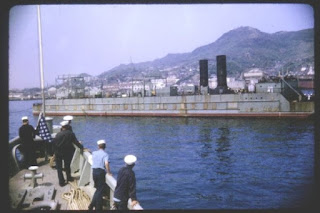
Nagasaki, Japan power barge
Off to Okinawa
Typical fleet radio-shack
Morse-Code key-stations
Service Timeline:
Location Date(s) Activity
U.S. Navy Pier 6/10 -7/15/62. Enlistment; physical; oath
Seattle, WA
US NTC SDIEGO 7/16/1962 Boot-Camp NTC SDIEGO
US NTC SDIEGO 10/1/1962 Graduate basic training
US NTC SDIEGO 11/16/1962 Commence Radio “A” School
US NTC SDIEGO 05/03/1963 Graduate Radio “A” - Promoted to RMSA (E2),
Transferred to Subic Bay, P.I. Transient Center
Subic Bay, P.I. 06/18/1963 Boarded USS Ashtabula, Yokosuka, Japan
Long Beach, CA 11/16/1963 Depart Ashtabula, personal leave, transfer to Abnaki
Pearl Harbor, HI 12/24/1963 BoardedUSS Abnaki, Pearl Harbor Hawaii
Pearl Harbor, HI 7/1964 Promoted to RM3 (E4)
Subic Bay, P.I. 7/17/1966. In-transit to Treasure Island, CA for discharge
T.I., CA 8/8/1966 Medical/dental/disease observation; outprocessing
for discharge from Active to Inactive Reserves.
Ft. Lewis, WA 9/66-12/68 Civilian crypto/comm spec. Dept of the Army at Ft.
Lewis Logistics Center.
Pre-Military.
I graduated from Tucson High School on June 2, 1962, 3rd from the bottom of my class of nearly 600, by GPA. I crossed the same stage and shook the same hands as did the Honor Society graduates with 4.0 GPA’s. The morning of June 3rd, my parents and I left Tucson driving two vehicles, a 1953 Plymouth and a 1948 GMC pickup, destined for Lois and Leroy’s University Place, WA home. Upon arrival my parents stayed briefly at the Seeleys, then left on the latest mission from God after selling one of their vehicles. I don’t recall my parents’ destination. I recall going with them to some church near Bremerton to talk to someone, but it didn’t work out. The Lord works in mysterious ways, or what I refer to as ‘randomness.’
University Place, my Sister and Brother-in-Law’s home was a good base for a teen-ager intent on looking for work on a merchant ship in nearby Port of Tacoma. The personal environment was accepting and non-judgmental. I’m sure Lois looked on at what I pretended was a valid job search and wondered why I couldn’t get out of bed and get gone before Noon. If so, she didn’t express those thoughts, or make me feel that I was doing anything less than my best.
At the time, automation of merchant ships was reducing the sizes of ship’s crews. Even seamen with seniority were being let go, according to some who I talked to. I wasn’t choosy about a possible ship. For instance, one day I boarded a Turkish ‘nightmare’ ship which, though understaffed, wouldn’t hire me…the Captain yelling, wagging his finger in my face, ‘You Americans complain all the time, and cause problems! No place for you on my ship…no place for you!’ So the small amount of money I had saved in the event I went to college was dwindling, and would soon run out altogether. Lois and Leroy didn't need a freeloader, though they never mentioned my dilemma. I decided to enlist in the Navy; enlistment being my Plan B for going to sea in Asia.
I enlisted in Tacoma, but the activity was soon shifted to Seattle’s Navy Pier where I was poked, prodded, weighed, measured, sampled, questioned, interviewed with particular interest as to whether I might be a communist, socialist, criminal, or homosexual. I was none of the above. However, my medical exam at the Navy pier in Seattle discovered that I weighed more than my 5 ft 9 in height would allow by Naval fitness regs. I was given a month to lose the weight. If I could not do that I would be deemed physically unfit to serve in the Navy, which meant that a less choosy U.S. Army would pick me up in some future selective-service draft. I lost the weight, and then some, and on July 15, 1962, after sleeping at the YMCA in downtown Seattle, flew out of Boeing Field on a charter, and arrived at the Naval Training Center ‘boot camp’ in San Diego late in the day. I would sleep in a barracks for the first time ever later that night.
Boot-Camp.
The first full day of boot camp was perceptually the longest day of my life. Awakened at 5 a.m., by some psychopath beating on the bunk bed with a night-stick, I was disoriented, confused, unprepared for everything that happened during the remainder of that day. I had talked with no one about their own boot-camp experiences before deciding to join the Navy, so my expectations were probably along the lines that it would be similar to summer Bible camp. It wasn't. We marched in our civilian clothes, arrived too early everywhere, stood in endless lines to be fed, receive shots, answer questions. We were re-poked and re-prodded, measured for work and dress uniforms, which we would pay for by way of regular deductions over the next year. Our heads were shaved, we were marched to barracks and chow halls, and required to choose enlisted "leaders" from a group of 80 men, none of whom had met each other before now. (This experience was where I began to form the theory that anyone who desires leadership is likely unfit to lead).
We met our Company Commander, a slightly built Petty Officer First-Class Gunner's Mate, Mr. Mathern, who referred to us collectively as 'maggots' and appeared to hate us, collectively and individually. He had one volume — LOUD! He had one tone - OUTRAGED! He apparently didn’t sleep, having the habit of appearing at all hours of the evening and early morning, armed with his flash-light, to inspect our clothing lockers for items which were buttoned wrong, folded wrong, or not buttoned at all. When he found a discrepancy he went on a tantrum, screaming, grabbing clothes out of lockers, and throwing them out the double-doors onto the blacktop pavement in the darkness at the entrance of the barracks. One individual’s fuck up, caused pain and chaos for the other 79 men….but, Individuals seldom made the same error twice, after enduring group justice and punishment…and, so we slowly improved…and, when we did Mathern’s attention would move on to a different trivial infraction, such as body-oil on the collar of your jumper at personnel inspection which occurred outside every morning before chow.
By Navy standards, I was considered a ‘fat boy’ due to my body weight being near the maximum limit for my height at enlistment. Upon arrival at Nimitz Island, after our Company was formed, I was designated as a ‘chow runner.’ The fattest boy in the company was always a chow runner. The Chow Runner left the barracks, or wherever the company happened to be at meal-time, and ran to the chow-hall’s formation grinder where the companies of men would soon arrive, standing in formation, awaiting their turn to eat. The faster the chow runner arrived at check-in, the sooner his Company was able to eat after they had arrived, marching in formation. The sooner the company ate, the more relaxation and smoking time was available before the next scheduled training event. If the chow runner was later, the company ate later, and perhaps the time available to eat, smoke, and relax was foreshortened. Late arrival did not endear the chow-runner with Mr. Mathern or the other 79 men.
Once the company was in the #1 position by the doors of the chow hall, the formation broke up and the individual men rushed into single lines to grab cups, steel trays, and flatware, and were to be served in a cafeteria style line, find open seating, eat, and re-form into a company outside…all in less than 1/2 hour. Causing your Company to eat later, or worse yet, have the meal time shortened, was not a plus for the fat-boy chow runner. As for being late to training after a meal? In no Universe was that going to happen, so if the company got a late start, it meant the meal would be shorter. Being late to form up, or being late to the next training activity was not an option. As a result the smart chow-runner tried harder, ran faster, cut corners, lost more weight and developed a thick skin regarding verbal insults about his personal body weight, speed, and the like. ‘Run fat boy, run!’ was a commonly heard mantra, yelled by strangers along the route to the chow hall. The other call-out from perfect strangers to the marching basic training companies was, ‘You’ll be soooorrrrryyyyy!’ And, we were, until we began to catch on, and gain confidence in the group and in Mr. Mathern. One day it clicked for me! Mathern was not simply an asshole, military misfit who couldn’t survive anywhere else. He was trying to train us to adapt and survive in extreme, out of control situations, by relying on each other and taking care of each other. Things got easier after that epiphany. We began to think like Mathern, and as we did, he backed off and loosened up. Somewhere around two weeks before graduation, he began to behave almost like we were his peers…his shipmates.
As a result of being a ‘chow runner’ and the other usual marching in formation at boot-camp I developed a so-called ‘marching break’ in a small bone of my right foot. Fortunately, this break was discovered after I had already completed the swimming and abandon ship water training and testing, so I was able to stay with my original company wearing a so-called walking cast, but I was relieved of chow-running duties. I graduated boot-camp with my original company on October 1, 1962, knowing that when I returned to San Diego after being home on leave, I would begin attending Radio ‘A’ school, and would presumably graduate as a Radio Seaman Apprentice on May 3rd 1963. Usually, at least back then, once boot-camp was completed and one received one’s initial training orders, the next 6 months or more was pretty much a known, because you had received your orders for your next assignment sometime during the final two weeks of your current assignment.
All went as planned at Radio School, and, as an added bonus, I graduated 3rd in my Radio ‘A’ class of 80, 79 of us USN guys and one Coastie, qualifying me to (more or less) choose my next duty. I just wanted to be on a ship in Asia…I was likely imagining myself as some sort of modern day character out of a Josef Conrad novel…a young man going to sea and traveling the world in search of adventure, and in the process, finding the self that was meant to be. I know, I know…very romantic and mystic, but in my defense I was 18 years old, had never gone to a movie or had a TV in my home, so all I had for entertainment was to read. Josef Conrad, John Steinbeck, Henry Miller, Kurt Vonnegut, Jr, Ernest Hemingway and more, whose characters were all my friends, and my models of what men were, and what men did.
After graduating from Radio ‘A’ school I returned to University Place on Leave to visit with Lois and Leroy and family at their house on Olympic Blvd, after which, my orders took me to the Treasure Island Naval Base near San Francisco, for transfer by chartered flight from Travis AFB East of Oakland, to Subic Bay in the Philippines and, planned embarkment on my first ship, U.S.S. Ashtabula (AO-51) an ‘oiler’ so-called, because she carried, and distributed oil for fuel in the propulsion boilers on other ships, as well as jet fuel and AV gas, a high-octane fuel for prop-planes, and some helicopters assigned to aircraft carriers.
We sailors and Marines who were transiting to South East Asia from Treasure Island were bused to Travis Air Force Base to catch various chartered flights West. Just before my flight left near midnight I called Lois. I needed to hear a familiar, friendly, reassuring voice. I had never felt as unprepared to grow up as I felt that night. I had run out of male bravado. Lois was the familiar comfort I needed before boarding the plane which would take me to the life I said I wanted, aboard my first ship in the Far East. Sometime in the near future I would board the USS Ashtabula in Subic Bay. Except: the ship never came to the Philippines. Instead, after waiting in the transient barracks for her arrival at Subic Bay for nearly 5 weeks, I finally got orders to join the Ashtabula elsewhere. Elsewhere being Yokosuka Japan on June 17, 1963 after a very hairy charter flight during a tropical storm, landing precariously in a cross-wind at an AFB near Tokyo.
After arriving at the pier in a gray school bus, and being signed into the crew by the Officer of the Day, I took an open rack in the Operations berthing compartment, in the same 3-rack stack as an Electronics Technician named Willy from Yakima, Washington. We were amiable and considerate berthmates, but failed to gel as friends who would ever share a common interest. I made no lasting friendships on the Ashtabula. To this day, I have had no additional contact with anyone from those months aboard the Ashtabula, though I met some ‘characters’ very worth knowing. I think the reason is that I was aboard less than 6-months, and I left so suddenly, that only my work-circle knew I was going.
Life on a US Naval vessel is ruled by routines. These routines are signaled by the bells, and announcements over the 1MC (internal/external speaker system), and sometimes by the Bosun’s pipe…a tin-whistle which in skilled hands can signal dozens of distinct calls to action, or information. From reveille, to lights out, the bells, calls, and pipes signal the routines. Quarters (the morning meeting where departments assemble to hear the plan for the day), meals, sweepers, guests, dignitaries, “brass” coming aboard, launching small boats, the Captain’s comings and goings, getting underway, tying up, supply work-parties, movie call, and even when and where you can smoke a cigarette…’the smoking-lamp is lit on the fantail…’, and more. Routines. Every hour and 1/2 hour between reveille and lights out was signaled audibly by the bells and pipes. Unexpected events are also signaled by the bells, the pipe, and the 1MC…fires, spills, collisions, unidentified aircraft or vessels, and attacks can all be signaled by the call to General Quarters. During GQ every crew member and officer has a place to be, an objective to meet, and duties to perform, until the condition has changed, and the signal is passed to ‘stand down from General Quarters.’ My GQ spot was on the bridge with the tactical radio handset and earphones, two feet from the Captain’s left-shoulder…but, only after carrying and dropping off two 40lb CO2 fire extinguishers at the bottom of the ladder (stairs) to the bridge, so they would be available at midship. Routine. Under any operational set of conditions, every crew member had a place to be, equipment to bring, and activities to perform, and, he knew what these expectations were, had been trained to do them, and understood that there could be no acceptable excuse for failing to perform them. These activities were drilled, practiced, by unpredictable calls to action…at any time of day, sometimes (though rarely) during meals or sleeping hours. Practice, practice, practice. Sometimes we didn’t know if a drill was real or practice until it was over.
Meanwhile back aboard the Ashtabula, we traversed the South China Sea from North to South and from just off shore of Vietnam to the Philippines multiple times, unrepping other ships. Unrep is an operational abbreviation for ‘underway replenishment’ where in the oiler refuels other ships while both are underway at perhaps 10 knots, and often in rough weather. The ‘messenger lines’ are shot across the void. The messenger lines then are used to pull the distance lines across the chasm from the Oiler to its customer, followed by large, thick black hoses, which carry AV-gas, jet-fuel, and thick bunker-oil heated to a fluid viscosity so it can be pumped. Think of an ‘oiler’ as a mobile fuel-station for other ships, including aircraft carriers, their defenders, and auxiliary ships such as, ammo and supplies. We would refuel an entire battle group, often starting well before dawn and pumping steadily until after 2200 (10pm) that night…eating on station, drinking on station, leaving only long enough to poop or pee, then back at it. While passing oil and fuel to the other ship, we might be receiving food, supplies, mail, or movies for our ship’s use. Then when finally empty of fuel, we would haul for Subic Bay, or some other fuel-depot, to top off, and less than 24 hours later we would be running back for the Tonkin Gulf to do it all again…and again…and again…for an endless line of aircraft carriers, destroyers, frigates, and supply ships.
The high point of my 5 month aboard the Ashtabula time was our R&R liberty in Hong Kong. We anchored in the hazardous cargo area near Stone Cutter Island. The boat ride to the city was 45 minutes or so, and, of course that meant a 45 minute ride back, when the boat was packed with aggressive drunks who were either about to puke, had already puked, or were puking at the time…often puking into the wind caused by the boats forward motion. It was a long 45-minute return, and not for the feint of heart or queasy of stomach.
My first R&R in Hong Kong was unlike anything I had ever experienced. Even Mexico City where I had been several times as a younger kid, seemed tame and pristine by comparison. Hong Kong was serving the carnal needs and wants of several of the world’s largest navies, including: Great Britain, the U.S., Canada, Australia, South Korea, and New Zealand…drugs, sex, and rock and roll were available at all hours of the day, right out in the open. Some of the activity was obscene beyond being erotic. For instance, I didn’t understand then, and I don’t understand now why anyone would want to watch a girl have sex with a pony, but if you were someone with that desire, you could pay to see it in the Wanchai District of Hong Kong, or at least the street hawker said you could…I am not nor have I ever been a fan of intraspecies sex.
I had never been anywhere as openly ‘capitalistic’ as Hong Kong, Kowloon, and the surrounding neighborhoods…literally, anything and everything was for sale. It was rumored that in the Colony of Macau about an hour’s ferry ride away, you could buy another human. I had never been anywhere where poverty was more palpable…one afternoon while evading the Shore Patrol I had the experience of crossing several roof-tops on Wanchai slum apartment blocks. Every square foot of the roof tops was occupied by families living in make-shift structures fashioned from cardboard, or pallets…cooking on charcoal fires, pirating water and electricity from the apartments on the five or six floors below. Up there, they were entirely exposed to nature, including the tropical storms and typhoons which frequent this part of China.
When we left the ship for liberty, we were encouraged to grab and swallow a handful of penicillin capsules out of the large brown glass jar on the Quarter Deck to help combat any “bugs” we might encounter in the city. The ‘Clap’ was abundant and about the friendliest STD likely to be encountered by a drunk and horny sailor…some microbes, even then, were reputed to be antibiotic resistant, including the dreaded ‘chancroids.’ Thankfully, I never contacted any of the gifts which keep on giving, in Asia or elsewhere.
In late October 1963 the Ashtabula was ordered to return to home port in Long Beach, CA. We departed Asia along the Great Polar route. The trip was as cold and wet as I’ve ever been. Salt spray froze on the forward superstructure and the catwalk between the forward and aft superstructures where I often stumbled along in the dark, carrying a cup or two of coffee from the mess decks aft to the Radio Shack forward. Soon after we arrived in Long Beach we were informed that our ship had been selected for the highly prized participation in the annual Coral Sea Celebration which would take us to Thailand, Singapore, and Australia. Soon after that, I received orders transferring me off the Coral Sea destined Ashtabula to my next ship, which was not going to the Coral Sea Celebration…some unknown faithful ‘lifer’ would instead be rewarded with my billet on the Ashtabula. Singapore, Sydney, and Melbourne would have to wait for a future cruise. As it occurred, that cruise would be aboard the Holland-America Amsterdam in the Fall of 2012, in the company of my traveling and life companion, Jennifer.
I left the Ashtabulafor the last time, later in the afternoon of the same day that the Long Beach police department brought me back to the ship under arrest. The night before, on Broadway in downtown Long Beach, I had dozed off while leaning against the right-front fender of a parked police cruiser, after being awake and ‘celebrating’ for the better part of 3-days. The fact that I was not drunk was irrelevant to the police. The boys in blue simply cuffed me, transported me, and booked me into their finest overnight accommodation at the Long Beach city jail. When I arrived back at the ship the next morning, it was November 16, 1963, coincidentally my 20th birthday, and historically the week before JFK was killed in Dallas.
By the time Kennedy was shot, I was on leave visiting my high school friend Jim Brogdon in Tucson. He and I stood and watched the story unfold on the black and white television in the lobby of the Student Union at the University of Arizona where I met him after his final class that fateful day for the U.S. Though I was not, and am not, a Kennedy fan I can recall being disoriented by the event…in what world could the rich, famous, and powerful be so vulnerable that a traitorous nut-case could reach him with impunity? If a Kennedy was vulnerable, how could anyone else possibly be safe?
Within days of the assassination, Jim drove me to the local air force base to get a cash pay advance for travel. I showed them my orders, transferring me to the USS Abnaki, and received the maximum pay allowable under the circumstances. I said goodbye to my church and high school friends in Tucson, as I started making my way to the Northwest to see family, and eventually West to Pearl Harbor Hawaii to catch my next ship. It would take the better part of a month of hitchhiking, stand-by flights, sleeping in air terminals, and layovers to get to the USS Abnaki on Christmas Eve morning 1963.
When I arrived at the ship, which was berthed at the Pearl Harbor Submarine Base, perhaps 25% of the crew was aboard. Most everyone else was home for Christmas, and would remain home and out of sight until after January 1st. The Officer of the Day and a dungaree clad Bos’un’s Mate greeted me on the Quarter Deck, checked my orders, signed me into the ship’s manifest. The enlisted Messenger of the Watch took me down to the Operations berth to find me an empty rack. I lucked out and got a deck-level rack, claimed it, and soon conked out for a long sleep, waking up in time for Christmas breakfast, which was, a ‘cook your own,’ open grill, with steak and eggs and hash browns. The cook had thoughtfully labeled different sections of the the flattop grill to identitfy what goody should cook there, and, he had put out all the fixings. Turns out he did that every Sunday morning when the ship was destined to stay in port. Merry Christmas to me, 1963.
Though I was a Radioman Seaman (E-3) the ship needed me to function as a Petty Officer (E-4) in order to supervise a Radio watch with at least one subordinate, so I was recommended for the competitive Navy-wide examinations for for Radioman Petty Officer 3rd Class, which would be held on 12/30/1963. I had less than a week to prepare for the exams. I passed the exam, and was awarded a stripe, and thereafter was deemed ‘qualified’ to do the job I had been doing since December 1963. My elevation, however, was brief. On July 20 1964 I was busted to RMSN (suspended for 6 months) fined, and confined to quarters for intoxication, during which alleged intoxicated time I referred to four of Honolulu’s finest plainclothes detectives as ‘dumb fuckin’ Kanakis’ a term which they, and the Navy, deemed to be racially offensive. As it occurred, the term ‘Kanaki’ was acceptable to use only if you were one…I, not being of mixed Polynesian origin, was, not welcome to use the term, therefore was presumed ‘racist.’ Of course I knew that. My intent had been to openly disrespect all four of them in front of each other. My racial disdain was very purposeful, not a position I am now proud to have taken, but again my only defense is that I was under construction as a human…a 20 year old white male with a bad attitude, an abundance of ignorance which often overrode my best instincts, and more than my share of unexplainable rage. I was, quite often, simply mean and angry without specific reason or obvious cause.
I was let off pretty easy, busted, fined, reduced in pay — but, all suspended for 6-months. Unfortunately for me, I again offended within the 6 month suspension, and was actually busted to RMSN, reduced in pay, fined, and awarded 14-days extra duties, in addition to standing my normal watches. This time, the extra duties got my attention…2 weeks X 4 hours a day chipping, sanding, and preserving in the shaft alley bilges (see the picture above) while standing waist deep in water with grease, oil, semen, urine, rat cadavers, and god know’s what else floating in it while the ship was underway, rolling back and forth…resulting in my puking into the same water I was standing in, until I could puke no more. OK…so long story short, Captain James Williams got my attention, and I finished out my final months of Active Duty pretty much squared away…not exactly the perfect sailor, but close enough to perfect to not attract the attention of serious critics and others who could affect the quality of my day-to-day life, or alter my Honorable Discharge in the future.
I was on the Abnaki for a total of 29-months. That time deserves some expanded information. Some of the events I describe below have been augmented in my memory by recently reading the archived “Deck Logs” on file and on-line at the National Archives. Deck Logs are handwritten accounts of the operational events during each 4-hour segment of the calendar day, starting at 0001 local-time 7-days a week. Others, such as most of the Vietnam operations were Classified, so the Deck Logs during ‘Special Operations’ are not descriptive, each 4-hour segment simply labeled as ‘Special Operations.’
The ship was a fleet seagoing tug, commissioned in 1943. It was designed to do long haul towing and assist in salvage operations, and we did some of that. But, it was the ‘one-off’ projects which were the most interesting to me, for example: anchoring a target raft in the nuclear testing area of the South Pacific so the B-52’s could test a new bomb sighting system from an altitude of 50K feet.
In brief, the project involved anchoring a target raft in the Pacific Nuclear Bombing range, at a water-depth exceeding two miles, then waiting for the B-52’s to drop their test ‘bomb’ from an altitude of 50,000 feet. This was not an actual nuclear device, but in all aspects was a simulacrum of such a device. The weapons officer on the B-52 calculated in a 1 degree error so the ‘bomb’ would not actually hit the raft, destroying it. We, almost 10-miles below, would stand-off a measured 3-miles from the raft, and mark the distance from the raft where the ‘hit’ splashed, thereby triangulating the ‘real’ difference between the 1 degree purposeful error and the splash-site. This was an incredibly complex project, starting with the deep-water anchorage, then once anchored, maintaining the raft which had several ‘systems’ operating aboard, including: Radar emitter, an electric motor, fluorescent light, a signal-generator, an infrared generator, and more…the B-52 ‘sight’ could target any of the sources of energy.
The raft, of course, kept breaking down in the unfriendly environment, resulting in spare parts needing to be sea-dropped by aircraft for us to retrieve, and, there were multiple rubber-raft visits daily to fuel and otherwise repair or maintain the target. The project lasted the better part of a month, before we retrieved two+ miles of nylon rope and the metal anchors from the depths, and departed for Johnston Island Atoll to offload the used gear, then haul home to Pearl Harbor.
Another assignment involved intercepting sampans off Vung Tau on the Mekong Delta of Vietnam near Dixie Station. We carried a Vietnamese Naval Officer aboard who gave us ‘legal’ authority to identity, stop, question or board and search civilian sampans. The boarding crew included: a Junior officer, a motorman, at least one gunner, a Bosun’s Mate, a Radioman, and a medical Corpsman. The sampans were identified and marked by Radar as they gathered around a cargo ship in International Waters, each one assigned a ‘name’ for tracking and communication purposes, then, the decision was made which one(s) to stop when they headed for shore. There were dozens of sampans around each Russian, Chinese, Polish,
or North Korean vessel…remember, this was well before the days when satellites provided any useful imagery. All the sampans headed for shore virtually simultaneously…dozens and dozens headed for the Mekong Delta all at once, and all at approximately the same speed, spreading out so that each was miles apart from any other by the time we could reach them…we had to choose. The Vietnamese officer would decide who to stop, who to question, or who to board. We, the boarding party, stood by our rubber raft or motorized ‘whale boat’ and waited for the word to go. All six of us were armed with a weapon which fit our role. The party was usually nervous while waiting…people would ask me if I’d checked the radio equipment, or, if the batteries were ‘fresh.’ The reason was that if the ship lost contact with the boarders for more than 5-minutes, it had a ‘standing order’ to open fire on the sampan. The presumption being that the boarding party had been overpowered, i.e., killed or captured. So, the boarders were ‘nervous’ as we smoked our final cigarettes before the ride over the 1000 or so yards of water.
Among the few small boats we actually boarded and searched, there was never an incident and we never found any contraband. More often we signal the sampan to come alongside. The Vietnamese Officer would question them from his perch on the bridge-wing, then send them on their way. Perhaps only 1 out of 10 of the dozens and dozens of sampans carried contraband…it was just a ‘crap shoot.’ ‘They’ (VC) knew we couldn’t be everywhere at once, and, we could check only a few small boats before the rest disappeared into the 1000’s of mangrove lined channels of the Mekong Delta. The odds were excellent that much of their contraband would make it up the river, and into the ‘right’ hands. Later in the war, the SWIFT boats were organized for search and seizure. At 60 mph they could stop many more boats. With their size, they would risk only 5 or 6-guys while tied up to the sampan, instead of having to raft over from a larger ship, and at some point, the U.S. gained the authority to legally search South Vietnamese citizens and their homes. And with their armament, the SWIFT boat could devastate a target in a matter of seconds.
However, the most time consuming of the Special Operations, one such assignment lasting 64-days without a break, was running interference and jamming the Russian Trawler (Skunk Delta) on ‘Yankee Station’ off North Vietnam, wherein, the Russians would try to interrupt CVA’s during flight operations launching sorties over Hanoi and Haiphong. Three aircraft carriers operated simultaneously on Yankee Station. At any given time, two carriers were launching or retrieving aircraft, while the 3rd CVA was off-line doing maintenance, replenishing armaments, repairing planes, resting its crew and pilots, in preparation for its next two-days on line.
The Russian ‘trawler’ was in fact an electronics surveillance platform, a ‘spy ship’, chocked full of tracking and communications equipment. It surveilled sorties, and ‘listened’ to pilots talking to each other on the way to the targets, or on the way back. Intelligence…some of it immediately useful to the awaiting SAM and AA crews, and other intelligence which could be useful when combined with other info, sometime in the future. They, the Russians, relayed info to the surface-to-air missile sites and antiaircraft crews of North Vietnam, and, they made attempts to physically cross the bows of the CVA’s and interfere with flight-operations while they were retrieving and launching aircraft. It was our job to assure, by any means available, that they were unsuccessful. Running interference on the trawler was a 24/7 operation, involving our staying within 500 yards of the trawler, and maintaining the international rules of ‘right of way.’ When a sortie launched, we would try to place ourselves between the sortie and the trawler and electronically ‘jam’ the airwaves back against the trawler, and away from the sortie. I have no idea how successful we were.
On one occasion, months after I had transferred off, the Abnaki actually purposely collided with the trawler to block it from crossing the bow of the USS Ranger which passed 500 yards ahead of the trawler at 25 knots. The trawler sustained sufficient damage that it had to be relieved of duty, and another trawler assigned, providing the carriers with almost two weeks of harassment-free operations. The Abnaki sustained only another minor scuff to its exterior paint, and added yet another small dent which would soon just blend in with the others accumulated since its commissioning in 1943.
One afternoon during the Spring of 1966, after leaving Danang harbor headed for Yankee Station and coincidentally, my final month of Vietnam duty, we went North as we should, but then turned toward the beach around midnight. We did so in order to insert a sniper into the beach near the DMZ between South and North. He paddled away in the darkness, on his small black rubber boat. The sniper had transferred aboard during a supply visit from a barge in Danang harbor early that same day. In short, the small supply barge with 6 guys aboard came out with supplies, and after the supplies were loaded, only 5 guys went back to shore in Danang. Hopefully, any ‘watching eyes’ from shore would not notice this discrepancy. That night, as I went out on the fantail for a cigarette just before starting my mid watch, I encountered the guy. There were only 3 ‘passengers’ aboard: the sniper, and two guys who were the operators of the jamming shack on our fan tail…this guy was clearly our sniper ‘passenger’ and was having his last cigarette before he would raft to shore and disappear into the cover of night. He told me he had a photo of a Vietnamese guy (his target) a sandbag, a target rifle, some rounds, some jerky, water, antibiotics, and a spotting scope. If all worked out, he would put a single round through the forehead or torso of his target after identifying him from the grainy black and white picture, then head South for the ‘friendlies.’ If he couldn’t take a good shot, or couldn’t be certain of the identity of his target, he’d pass up the shot and head South for the ‘friendlies.’ I never heard how it ended, of course. One of the issues with SEA is you hardly ever heard the rest of the story.
Searching for, and never finding, downed fliers…searching for the blinking light on an orange inflatable vest in the vast darkness of the Tonkin Gulf. This happened multiple times while shadowing the trawler on Yankee Station, that a flier would be unable to make it back to within visual contact with his CVA. If they splashed out of sight the odds of finding them were greatly reduced. Jets sank fast once they splashed, so if there was a survivor, it presented as a tiny speck in a sea of blue reflections, or as a blinking yellowish-whitish bulb. If the flier had not ejected by the time it splashed, odds were he didn’t survive…but, we looked…and looked, until the next call or another task forced us to move on.
On March 6, 1965 we arrived in Danang harbor from Subic Bay, P.I. It was common knowledge that our Old Man and some officers had been meeting with some Mine Squadron guys in Subic. And, it was common knowledge that when we left Subic, we had a passenger aboard, a Mine Squadron Officer. All this info is confirmed by the Deck Logs before March 6, 1965, at which time we were classified as a ‘Special Operation.’ We met up with a Mine Squadron and came under the operational command and control of the senior officer of that Squadron. We were there, among other reasons, to map the bottom approaches to Red Beach 1 with a portable SONAR transponder. The Mine Squadron was there to check for previously placed enemy (or French) mines, remove them if any were found, and, to plant our own defensive mines in preparation for the Marine landing the morning of March 8, 1965…the one and only amphibious landing of the entire war, where not even one Marine lost his life. By the time they (3,500 Marines, APC’s, artillery pieces, and more) trudged up the beach from the surfline, we were standing off 5 miles in case there was salvage work to be done or an LST that required towing after grounding on the beach. Instead of gunfire, the landing party was met by local dignitaries, reporters, and young women offering flowers. We hung around a few more days before departing Danang for Subic Bay again.
On both ships I served on, while in the Vietnam bays, tributaries, and coastal waters, we evaporated sea water for drinking, bathing, cooking, laundry, and the like. On both ships, we swam in the Tonkin Gulf near shore as a recreational treat for the crew…a cool down. We were all exposed to Agent Orange. I don’t claim to know what is true and actual. I have no certain knowledge that my heart conditions are related to my Navy service in Vietnam. The VA believes they were. They believe this with enough certainty that in May 2021 I was awarded a life-long, 100 percent service-connected disability for Ischemic heart disease, presumed to have been caused by exposure the toxins of Agent Orange, as a direct connection to my service. I have mixed feelings about the entire matter, and I know now that I always will. And, in some sense this development keeps the Vietnam ‘question’ alive in my mind, when I felt I was about to close out the question. When I volunteered for shipboard duty in Asia there were a few thousand American ‘uniforms’ in Vietnam. By the time I left in the Summer of 1966 there were maybe 65,000 uniforms in-country and along the coast. The war the American public thinks it remembers, mostly between 1968 and 1973, is not my war, though ‘my’ war developed into the mess wherein hundreds of thousands of American troops were present at any given time. My Vietnam war was an ‘advisors’ action involving fewer than 65,000 uniforms on any given day…many of those uniforms at sea on carriers, defensive vessels, cargo ships and other auxiliary vessels like mine, all of us exposed to the toxins of Agent Orange. It is impossible to know to a certainty that my Ischemic Heart Disease, or, his urinary cancer was caused by Agent Orange. Another open question.
Cities.
While on both ships, I visited Yokosuka and Sasebo, Japan several times each. Both are large naval cities. Kagoshima, Japan, its island volcano glowing in the bay, once. Nagasaki, Japan once…from where we towed a power barge owned by the Army which had been on loan to the city during its reconstruction after the nuclear attack; we towed the power barge Impedance, complete with its crew of 23, to Okinawa, though originally we had set out for Yokosuka I was in Kaohsiung, Taiwan twice, once of the Ashtabula and once on the Abnaki. Hong Kong three times. Subic Bay, Philippines many times. Naha, Guam two or three times. Johnston Island Atoll in the South Pacific at least three times. Oakland, CA Naval Supply Center to pick up a tow, a harbor tug, which we towed back to Pearl Harbor for re-outfitting and local duty. Each city and port had its unique characteristics, but my least favorite destination was Guam. ‘Guam’ was never welcoming or happy to see us, and even the staff of the on-base businesses made sure we felt it. ‘Welcome to Guam. Come again when you can leave sooner.’
In the smaller Japanese towns, such as Kagoshima, the young local men in bars would act as our hosts…we were not allowed to pay for our own beer, nor were we allowed to reciprocate and buy them one. The irony of toasting with the locals…raising my Sapporo or Kieran high…under the large wall-murals of Japanese Zeros diving on and attacking American Naval ships, was not lost on me. ‘Loser buys the drinks!’ Though in a rare show of good judgement, I never uttered those words aloud!
At least half of my sea days, and 25 percent of my shore-days, were spent on duty in a windowless radio-shack. (Above somewhere is a picture of a typical fleet radio shack). The radio shack was designed like a vault…one metal door in, same door out, with a 40-lb fire extinguisher hanging on the metal bulkhead by the hatch with a four-digit combination lock and handle outside to allow access in the rare event that it happened to be unoccupied. Or, one could be let in by the occupant once identity was confirmed via the peep-hole. Inside the radio-shack, there was another smaller separate vault-room which contained all the crypto information, locked in individual combination wall safes, as well as, the manually operated crypto machine which converted plain language to 5-character encrypted clusters, or conversely 5-character clusters to plain language. My Navy clearance classification was Secret-Crypto Access. When I went to work after discharge for the U.S. Army as a civilian at Ft. Lewis Logistics Center, my clearance was elevated to Top Secret - Crypto Access. On board the Navy ships, the Operations Officer performed the manual Top Secret-Crypto Access activities.
The radio shack’s bulkheads were entirely covered by electronic equipment…6-foot tall transmitters, receivers of all sizes, signal-generators, electronic crypto machines (KW’s), patch-panels which enabled us to move teletype machines from receiver to receiver (frequency to frequency) in order to maintain a continuous flow of teletype traffic on the two common networks. If you were quick enough, you could patch a teletype into a new receiver without causing even one garbled character…if you were unfortunate the delay could not only cause garbled data, but cause you to lose synchronization between the electronic crypto equipment (KW35) and the receiver, which resulted in a minimum of 5-minutes of lost data which had to be reconstructed.
The combined electronic and electrical equipment put off a terrific amount of heat…some just radiating, others with active exhaust fans pushing warm air out while humming low. The two teletypes on two separate ‘common-networks’ ran 24/7, the busier one dumping out over 20,000 messages a day while in South East Asia, each requiring the Radio Operators to pick out his ship’s name or ‘call sign’ from the flow of continuous, attached messages…missing a message would be the end of a radio career, resulting in completing one’s enlistment as a ‘deck-ape’ chipping paint on some other ship. The space was not airconditioned although it did have good outside air exchange, thereby replacing the electronically heated air with atmospherically heated outside air. The decking inside the shack was wall-to-wall rubber tread to reduce the chance of electrical grounding and shock. The teletype signal current itself, coming off the end of the patch-cord, was 60 milliamps, enough to stop a heart.
The radio-shack always shared a space physically near the Captain’s cabin. Many/most of the messages were for the Captain, and required him to initial in receipt at all hours of the day, and perhaps even write out and sign a response to be radioed out, and, he might further distribute the incoming message by scribbling one or more of his Officer’s names on the page for the Radioman to further distribute the message. When the copy had been fully initialed it was filed in the radio-shack or returned to the Captain for personal filing. When the ship was underway, it was rare that a fleet Captain would sleep through a night with no knock at the door of his cabin, where a Messenger would be standing holding at least one message on a clipboard, the content obscured by an appropriate classification cover-page.
Some of the Radiomen, me included, had so-called tactical radio ability. Tactical radio might involve using a ‘telephone’ handset on the bridge under the direct verbal guidance of the Captain or the Officer of the Deck. Or it might involve using a portable radio (a back pack), as a crew member of a small boat performing some off ship duty, for example, boarding a sampan or streaming back in a rubber raft to board a vessel under tow, or taking a sick crewman to a shore clinic or a waiting sea-plane. The portable ‘tactical’ radio was a battery operated, heavy backpack, prone to failure, which quickly sapped its single-use batteries…on air chatter was discouraged, and brief when required at all. The tactical radioman was quite simply the voice of the senior Officer present…a conduit. Depending on the watch rotation, I might be the tactical radioman on the bridge when we were entering or leaving port. If I was on the bridge, I would be trailing the Captain or the Officer of the Deck around, two-feet from his left shoulder, relaying his comments to the Harbor Master or another ship involved in the tactics. It was similar to being a ventriloquist’s dummy, only one was in motion instead of sitting on his knee.
By the final time I went to Vietnam in 1966, the Navy was experiencing shortages of skilled Operations ‘A’ school graduates (Radar, Radio, Electronic Technicians, SONAR operators, etc.) on board the smaller ships, including ours. At the same time there were shortages of Operations specific skills, the overall sizes of the ship’s crews were getting larger to accommodate the potential for casualties, and the numbers of generally needed seamen, gunners, and engineering crew. Our ship was designed for about 75-crew members, but we were carrying almost 95 by the Summer of 1966. This is more crew than there were beds; it meant too that frozen and refrigerated foods were consumed more quickly, resulting in powdered, canned, dehydrated foods being used sooner, and sooner…eating powdered, dehydrated, canned foods longer and longer…using more, making more, fresh water for drinking, cooking, laundry…resources, in total, were being strained by too many people.
At the same time we had only one Signalman aboard…but, he had to sleep and eat, and poop and shower, and have breaks from duties…no one can work 24/7 very long. Solution? If we got a flashing-light signal while he was off duty, presumably sleeping, one of the available Radiomen ran to the bridge and took the signal in his stead. Morse-code is morse-code whether its an audible radio signal or flashing light. The next step was to give my bed in the berthing compartment away, and instead provide me a folding army cot on the flying bridge where I could be easily awakened to take a flashing light signal at any hour. The benefit was that I got to sleep out in the open air under a tent like tarp covering. The liability was that there was no such things as having predictable ‘time off.’
When I stood my watch in Vietnam in 1966, my Messenger was an ET1, an Electronics Petty Officer First Class (E6) which meant he was two ranks above me. He could manage his department’s repair and maintenance team and function as my messenger also, because he too had a SECRET Crypto security clearance. Fortunately we were friends, and the difference in rank never became an issue. He would carry the message board, but he could also set up receivers and transmitters as well as resynching the KW35 encryption device when it dropped the network connection. It could be resynched only on the 5’s using the signal from the British Radio Observatory in Greenwich England (Greenwich Mean Time) as the world-wide standard for time.
The South China Sea was infested with electronic ‘spooks’ and anomalies, which defeated RADAR, LORAN, and Radio signals of all kinds, including creating “bogies” which appeared on RADAR to be attacking, but which turned out to not actually be there…some of these events were so ‘real’ that the Captain was convinced to go to ‘General Quarters’ a battle-ready, shipwide condition, only to stand down when an attack or other incident did not come. On one low visibility night, our Captain actually ordered the large carbon arc spotlight to be activated in order to see what our Radar was telling us was just yards away from our position. There was nothing there in the spot light, though the radar was clearly reflecting a large, solid object in the exact spot we had lighted up. On occasion, sitting just North of the Equator in the South China Sea, radio contact was easier to establish a link with Keflavik, Iceland (or WASHDC, or SFRAN) than it was with the communication station less than 600 miles away in Subic Bay, P.I.
So, in mid-July 1966, my drinking-buddy and electronics technician colleague Robert-not-Bob Knapp and I left the ship in a chartered car with a hired local driver, carrying orders to be discharged at Treasure Island, California. The driver was to drive us to Clark AFB, a leisurely half-day’s drive away. On the way to Clark AFB we stopped at a local roadside cafe/bar, and ate tasty local food washed down with many bottles of San Miguel beer…the driver joined right in with our festivities. Knapp and I had orders for transportation from Clark to a domestic base, but had no orders for on-base meals or billeting of any kind if we got hung up at Clark or in between. The plan was, transportation would be immediate, and complete, requiring no onbase meals or overnight stays, and as they say, ‘Bob’s your Uncle!’ except the US Airforce had made other plans.
In fact, as it turned out, we were flying home at exactly the week that the military family Boy Scouts and their uniformed parents and Scoutmasters were flying home to the U.S. out of Clark AFB for the Scouting Jamboree in Indiana. Jamboree attendees had a higher flight priority than we who were returning home from Active duty in South East Asia. We were continuously ‘bumped’ off flights for the next 3-days. We ate on our own dime in the canteen. We slept in the theater and in the waiting room of the air terminal. Three-plus days later we finally got on stand-by flights, and said good-by as Knapp’s flight took him to his destination, and later, my flight left for the hop across to Hawaii and then Treasure Island. I think Knapp’s destination was the Great Lakes Naval Center near Chicago. I never saw him or heard from him again, though I’ve heard from others that he is OK.
At Treasure Island, the Navy took a week to do the administrative and medical tasks which could have been done in a day. In their defense, they did also do some minor dental work, and they observed me for the manifestation of various tropical diseases, including: leprosy, plague, malaria, and yellow fever. I got paid the money owed me, and including the money I came with, I spent like a ‘drunken sailor’ while visiting the various dens of inequity offered by the San Francisco Bay Area. The money I spent there in a week would be equivalent to more than $2,000 now. I drank top shelf Bourban, paid covers, including paying the cover for at least one stranger to a Count Basie show in North Beach. I tipped large, ate well, rode cabs, and did my best to spend it all. In spite of myself, I managed to head home to University Place with money left over…after stopping over in Dayton, Washington to visit Goldie and Papa at their church, and shutting down several bars in Walla Walla before bussing to Seattle and Tacoma, I still had money. In truth, I was helped along in saving money a bit by the Blue Laws of Washington State, because I was riding a bus from Dayton to Tacoma, on Sunday, and so could buy no ‘hair of the dog’ alcohol in any city on my route to UP, arriving with the remnants of a dreadfully painful hangover. Lois, as usual, voiced no judgement, though I felt she was secretly pleased by my lack of foresight and planning.
So that’s my military story which comes to mind at this point. I’m sure there are events, people, places that I’ll think of later which deserved mention or expansion. Chronological history is not my strong suit…I tend toward thinking of history as a patchwork of stories, stitched together by time and place. In some sense, its all happening simultaneously at the moment you’re remembering it…one story reminds you of another. One lesson learned points you to another related event. In the end, everything which has gone before exists all at once…or so it seems.
Post Scripts.
During my later life I have attempted to understand ‘my war’ better by reading about it through the writing of others. I have steered clear of autobiographies, because I don’t trust the ‘actors’ to know or understand their own parts…I think we humans are notoriously bad about seeing ourselves, our intentions, our motives, and their consequences clearly. I have never read an autobiography. On the other hand there are a scant handful of books or papers about Vietnam which might be worthwhile. These are, in my opinion:
- The so-called ‘Pentagon Papers’ which was an actual classified white-paper chartered by President Lyndon Johnson, and made famous by Daniel Ellsworth who ‘leaked’ it for serial publication in a newspaper.
- VIETNAM: An Epic Tragedy (1945 - 1975), by Max Hastings…in my opinion the most objective and worthwhile of the various articles and books.
- A Bright and Shining Lie, by Neil Sheehan…a painstakingly researched book focused entirely on American involvement and the cross-purposes of the political, military, and intelligence communities.
- The Road Not Taken, by Max Boot.
If you could read only one book, I would recommend it be the Max Hastings tome, because he more clearly places ‘Vietnam’ in the flow and context of history, avoiding the myopic bias of American authors and politicians, who tend to view Vietnam as ‘America’s war.’ Hastings knows and opines that we joined Vietnam ‘in progress.’ We did not start it, and we did not lose it…we were merely the latest Western presence to make it worse, on its way to its inevitable reunification of North and South under its hybrid form of Communism. By 1984 the harsh communism of the North became more locally adaptable, and rational…I think Uncle Ho would approve.